


CSRD trial report: the safe route to mandatory reporting in 2028


The EU Sustainability Omnibus I package changed the timeline for many companies. Businesses with more than 1,000 employees and more than EUR 450 million in revenue will now fall under the Corporate Sustainability Reporting Directive (CSRD) starting with fiscal year 2027.
At first glance, that looks like considerably more time to prepare. But anyone who counts backwards from the first reporting deadline sees quickly that the buffer is smaller than it seems. Many companies had already started preparing and then paused when the obligation was postponed. Now the task is to pick up processes that were already underway, in some cases with a different team than before.
The core work has not changed. Materiality assessment, data collection, internal alignment, and audit preparation all take time and have to be sequenced properly. That makes it all the more important to review where you stand now and to make existing gaps visible. A trial report gives you a concrete basis for doing exactly that, and shows where action is still needed.
Key takeaways at a glance
- Reporting obligation: For companies with more than 1,000 employees and revenue exceeding €450 million, the CSRD applies to fiscal years starting from 2027. The first report must therefore be submitted in 2028. This regulation was finalized with the EU Omnibus . The national transposition of these requirements into German law, particularly the HGB, is still pending.
- Using 2026 as a test year: A trial report for the 2026 fiscal year makes it possible to test the future reporting process early, to purposefully develop processes, data foundations, and responsibilities, and to engage with the auditor in a timely manner.
- Identifying risks early: The trial report makes data gaps, unclear responsibilities, and potential auditor questions visible. This leaves sufficient time to address identified weaknesses before the first mandatory, auditable report.
Why a trial report is worth it
A trial report highlights where industrial companies still have gaps in their processes and structures in practice. This includes, for example, missing Scope 3 data from suppliers, unclear responsibilities for individual ESRS topics, or approval processes based on the four-eyes principle that have not yet been established. This is particularly challenging for companies with multiple locations and subsidiaries: key performance indicators are often collected, defined, or documented differently and must be standardized, harmonized, and consolidated across all units for CSRD reporting.
The identified weaknesses can be addressed in a targeted manner: processes can be optimized, responsibilities clarified, data gaps closed, and uniform collection and consolidation processes established. This leaves sufficient time to implement necessary adjustments before the requirements of the mandatory report have to be met under time pressure.
Furthermore, a trial report helps to realistically estimate the actual effort involved. It shows which resources, data, and processes are required for the subsequent mandatory report and which areas of action are particularly urgent.
9-step timeline: from trial report to mandatory reporting
A step-by-step overview for industrial companies on creating a trial report to ensure they can submit an audit-proof CSRD report by 2028.
1. Define reporting goal
Recommended timeframe: September 2026
Before starting reporting , it is necessary to clarify what goal the report should fulfill. Three questions help with this:
- Which ESG data and reporting formats are already being requested (e.g., sustainability report, ISO 14001, EcoVadis, CDP)?
- What additional ESG data should be collected or published (e.g., carbon footprint, training hours per employee, anti-corruption measures)?
- Which category of the final EU omnibus decision does the company fall into, and when does the reporting obligation begin?
ESRS or VS(ME) as a basis
Regardless of the final output format, it is recommended to start with an ESRS or VS(ME) report as a central foundation. All relevant ESG data is consolidated in one place, allowing data points to be selected, excluded, or individually supplemented as needed, keeping the focus on the essential content. In a central tool like Tanso, data providers work within a clearly defined process that evolves from year to year.
The following overview shows which companies will actually be subject to reporting requirements following the final omnibus agreement:
2. Conduct a double materiality assessment (DMA)
Recommended timeframe: September - October 2026
The double materiality assessment (DMA) determines which ESRS data points are relevant and forms the first substantive step of any CSRD reporting.
It is advisable to engage in an early dialogue with your auditor during the DMA phase. The level of ambition can vary between auditors and will continue to evolve over the first few reporting years. Involving your auditor at this stage and clarifying their requirements early on helps avoid the need for retroactive adjustments later in the reporting process.
If a DMA has not yet been conducted, there are generally three approaches:
- External DMA, adopt results only: If an externally conducted DMA already exists and is not to be modified further, it is sufficient to store the result (the material sub-topics) including documentation in the reporting tool.
- External DMA, adopt results and content: The (interim) results, including IRO definitions and assessments, are transferred in a structured manner so that the DMA can also be used and further developed as a basis in subsequent years.
- Create new DMA: The IROs are developed from scratch. This can be done manually or with the support of an AI-powered, industry-specific IRO generator that suggests typical impacts, risks, and opportunities, thereby reducing the effort required for interpretation, especially during the first pass. The Tanso software offers this feature directly integrated.

3. Create and prepare report
Recommended timeframe: October 2026
Whenever possible, an existing report from the previous year should be used as a starting point: report structure, internal instructions, justifications for included and excluded data points, data requests, and responsibilities can be automatically carried over in many tools. Ideally, the raw data collected itself should not be carried over to avoid errors caused by outdated values, but it should remain viewable. If this is the first report, the ESRS or VS(ME) report is created from scratch. Subsequently, the following applies to both cases:
- Review DMA results: Non-material data points should be excluded, and newly material ones should be added. If a previously excluded but now material data point is included, or conversely, a previously material data point is excluded, the respective justification should be documented in a traceable manner.
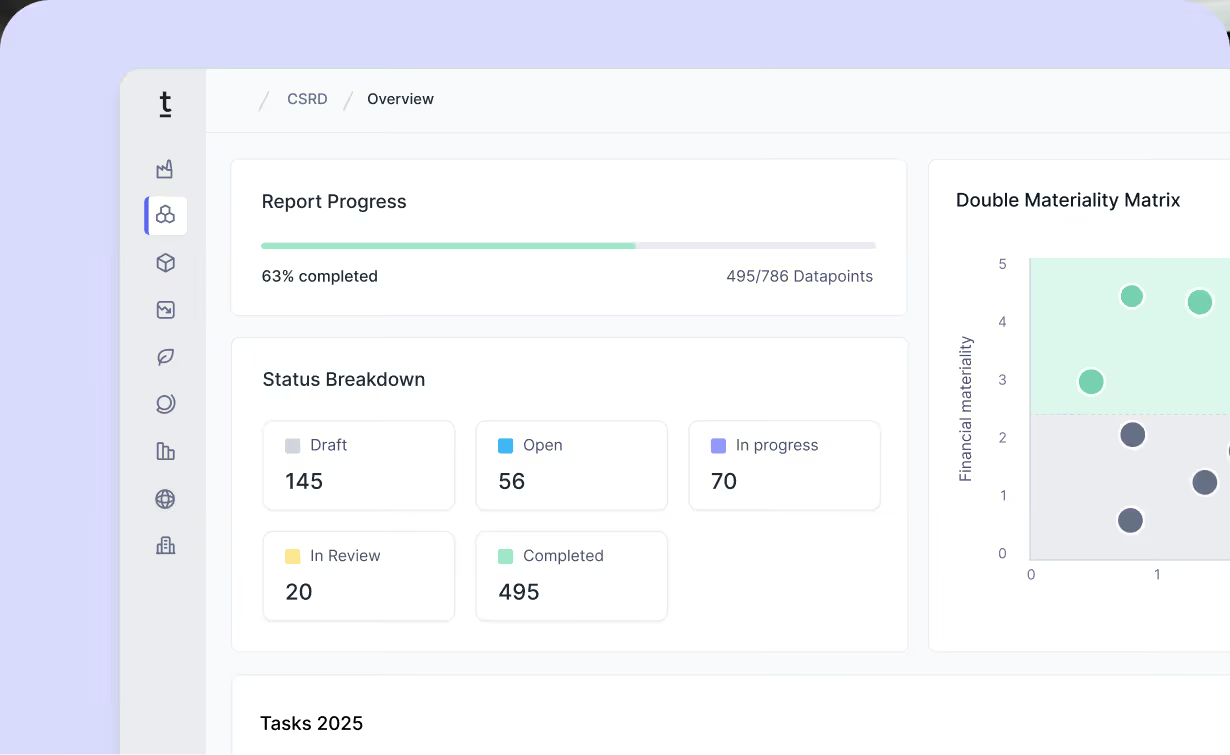
- Get an initial overview: An initial overview clarifies: How many data points need to be collected per standard? Which are quantitative, which are qualitative? Where are responsibilities still missing? How did the data collection process go in the previous year (centralized vs. decentralized)?
- Review or start gap assessment: A gap assessment shows which data is already available and where gaps exist. For an initial trial report, this step is particularly valuable because it highlights exactly which processes still need to be established by 2027.
- Optionally exclude voluntary and phase-in data points: For a trial report, the scope of the report can be specifically focused on data points that are either already available today or are strategically particularly relevant. This degree of freedom is significantly greater in a voluntary report than under mandatory reporting.
Important: As soon as there is an actual CSRD reporting obligation, material data points may only be excluded within the framework of the official phase-in regulations (Appendix C ESRS 1) or excluded as voluntary/non-material data points, no longer based solely on a focus decision. - Add custom data points: Additional relevant KPIs can be added, such as EcoVadis data points, Product Carbon Footprints (PCFs) or more detailed water and waste data.
4. Prepare data collection
Recommended timeframe: November 2026
The structure is in place; now a clear collection process is needed for the entire 2026 fiscal year:
- Prioritize quantitative data points: Existing data from ERP, HR, or energy management systems should be utilized first and checked for completeness. At the same time, it is advisable to establish a standardized, company-wide data collection process for any remaining periods. This creates a consistent data foundation and bridges the gap between retroactive data entry and ongoing data collection.
- Approach qualitative data points strategically: These can be added more flexibly, even with the note that information is not yet fully available. AI-powered tools can assist with drafting, but the internal coordination effort should not be underestimated.
- Consider ESG analytics: It is worth considering now which analyses will be needed later (time comparisons such as year-over-year gender pay gap, location comparisons such as workplace accidents per site) so that data requests can be set up with the appropriate level of granularity.
- Appoint a core team: A person responsible for data points should be designated for specific areas, for example, the Head of HR for S1 data or the Head of Finance for monetary KPIs.
- Hold a kick-off meeting: Clarify as a team: What is the report and why is it being created? Who is responsible for what? By when must which data be available? How will questions be resolved?
- Provide centralized support: For every data point, define exactly what is needed and establish how the team will resolve questions, for example through internal instructions directly at the data point, comment functions, or by comparing with previous year's figures.
5. Collect data
Recommended timeframe: From December 2026
If data is available centrally, it is entered directly into the reporting tool. For decentralized collection, a data request is created for each location or department:
- Designate a responsible person for each location or department and ensure they have the appropriate system access.
- Create the appropriate data requests and notify the responsible person as soon as a data point is ready for processing.
- The responsible person fills in the data, optionally attaches a supporting document or explanation, and submits the data point.
- The person responsible for the data point reviews the submitted responses and consolidates them.
We recommend starting with quantitative data, as this requires the longest lead time. It is important that all data providers work according to the same, clearly communicated process. This significantly reduces questions during the subsequent audit process.
Consistent documentation is crucial for the subsequent audit by the auditor. Every data point should be supported by traceable evidence, such as invoices, certificates, calculation formulas, analyzed raw data, or a documented derivation. Qualitative information also requires a reliable source; where values are estimated, the estimation methodology should be documented transparently. A trial report shows where evidence is not yet systematically filed and where the filing structure needs to be adjusted before the mandatory report.

6. Consolidate data
Recommended timeframe: From February 2027
For the mandatory four-eyes principle, every data point requires an approver. This role is usually assumed by the project lead. Each data point should be checked for accuracy and traceability before final approval. Automatic reminders before the due date also help to keep track of progress.
7. Write & finalize report
Recommended timeframe: March/April 2027
Once all data points are finalized, the content of the ESRS or VS(ME) report is complete. For larger companies, formal approval by the management, board of directors, or supervisory board is also required. Approval processes and meeting schedules can take several weeks and should therefore be planned well in advance. It is advisable to coordinate decision-relevant key figures and core statements with the management team in interim reports to avoid later adjustments.
8. Document learnings & use data for further reporting
Recommended timeframe: April - July 2027
The trial report for the 2026 fiscal year is now complete. The data collected and the tested process can now be leveraged for further use:
- Sustainability report: In collaboration with your marketing team or an agency, you can publish a dedicated report that also serves as documentation for customer inquiries.
- EcoVadis: The report can be used as an attachment, with references to the relevant pages.
- CDP, SAQ 5.0, and other formats: The data already collected can be reused instead of having to be gathered again.
- Visualizations: Results can be communicated clearly, for example, the year-over-year gender pay gap.
Start the 9th cycle for the 2027 mandatory report
Recommended timeframe: July 2027 – April 2028
The reporting cycle for the first mandatory CSRD report (due April 2028) begins in mid-2027. Since the process, data point structure, and responsibilities are already established from the trial report, the focus shifts to refinement, double materiality assessment (DMA) updates, and early engagement with the auditor:
- Update the DMA: Before preparing the mandatory report, the DMA should be reviewed and adjusted based on the existing structure. Changes in the business model, new regulatory requirements, or insights gained from the trial report can be incorporated.
- Engage the auditor early: The auditor should support the process from the beginning, ideally with an initial alignment based on the trial report to clarify audit priorities and methodological expectations.
- Adopt optimized processes: Adjusted data collection, approval, and consolidation processes from the trial report are transferred directly into the mandatory cycle.
Conclusion: Prepare well for the CSRD with a trial report
A trial report offers the opportunity to test the reporting process early on and close existing gaps in a targeted manner, without the time pressure of a statutory reporting obligation. To achieve this, fundamental decisions regarding data collection and reporting must be made now. This is the only way to ensure there is enough time to familiarize employees with the new processes and requirements and to test the workflows before the first mandatory report.














































































.avif)





.avif)
.jpg)


