


CSRD & decarbonization: How the Tanso Reduction Module supports manufacturers


On 24 February 2026, the final Omnibus Directive (Directive (EU) 2026/470) was published in the Official Journal of the EU, narrowing the scope to companies with more than 1,000 employees and net revenue exceeding €450 million. The preceding "Stop-the-Clock" Directive (EU) 2025/794 had already postponed the initial reporting obligation for second-wave companies (originally fiscal year 2025, report 2026) by two years to fiscal year 2027 (report 2028). For companies that remain subject to reporting obligations, this creates an opportunity to capture relevant business data in a targeted way, process it efficiently, and use it as the basis for strategically planning and implementing sustainability measures.
A reduction module enables the structured planning and implementation of decarbonisation measures. Learn more about the benefits of such a module and how the Tanso Reduction Module supports companies in capturing measures precisely, steering them effectively, and communicating them transparently.
Why companies need an emissions reduction module for CSRD reporting
Originally, companies were required under the CSRD to develop a Climate Transition Plan (CTP) in order to decarbonise their business activities. The final Omnibus Directive removes this obligation: companies subject to reporting only need to disclose a climate transition plan going forward if one already exists. From a strategic steering perspective, however, a CTP remains valuable. It means setting targets aligned with the Paris Agreement, planning sustainability measures, and continuously and transparently tracking progress. This is a complex task that requires precise data management.
Linhardt: 45% Scope 3 reduction potential with the Tanso reduction module
Packaging manufacturer Linhardt used the Tanso Reduction Module to evaluate its Scope 1, 2, and 3 measures holistically for the first time. The hotspot analysis revealed that aluminium accounted for around 58% of Linhardt's Corporate Carbon Footprint. Building on this, Linhardt modelled four prioritised reduction measures that can lower Scope 3 emissions by up to 45% by 2030 – equivalent to up to 52,000 tCO₂e, while simultaneously reducing costs in both materials and CO₂ pricing.
"With Tanso, we were able to quantify for the first time which measures deliver which CO₂ lever, what they cost, and what the ROI will look like." says August Wanninger, Vice President Sustainability & Innovation at Linhardt
Managing decarbonization with Tanso
The Tanso Reduction Module enables companies to forecast and analyze future emissions based on implemented reduction measures, compare different scenarios, and set specific emission targets to achieve their sustainability goals.
Step 1: Select a base year
The base year establishes a reference period with available data, serving as a benchmark for future comparisons.
Step 2: Define a scenario with a growth model
The growth model sets up the standard scenario and calculates emission growth projections based on the company’s growth rate. Either a constant growth rate can be applied across all years or an individual rate can be defined for each year.
Step 3: Manage scenarios
A scenario enables the analysis of different emission projections under varying conditions, such as adjustments to growth rates, planned emission reduction measures, or investment constraints. By utilizing scenarios, companies can assess which actions are needed to achieve emission targets under different circumstances.
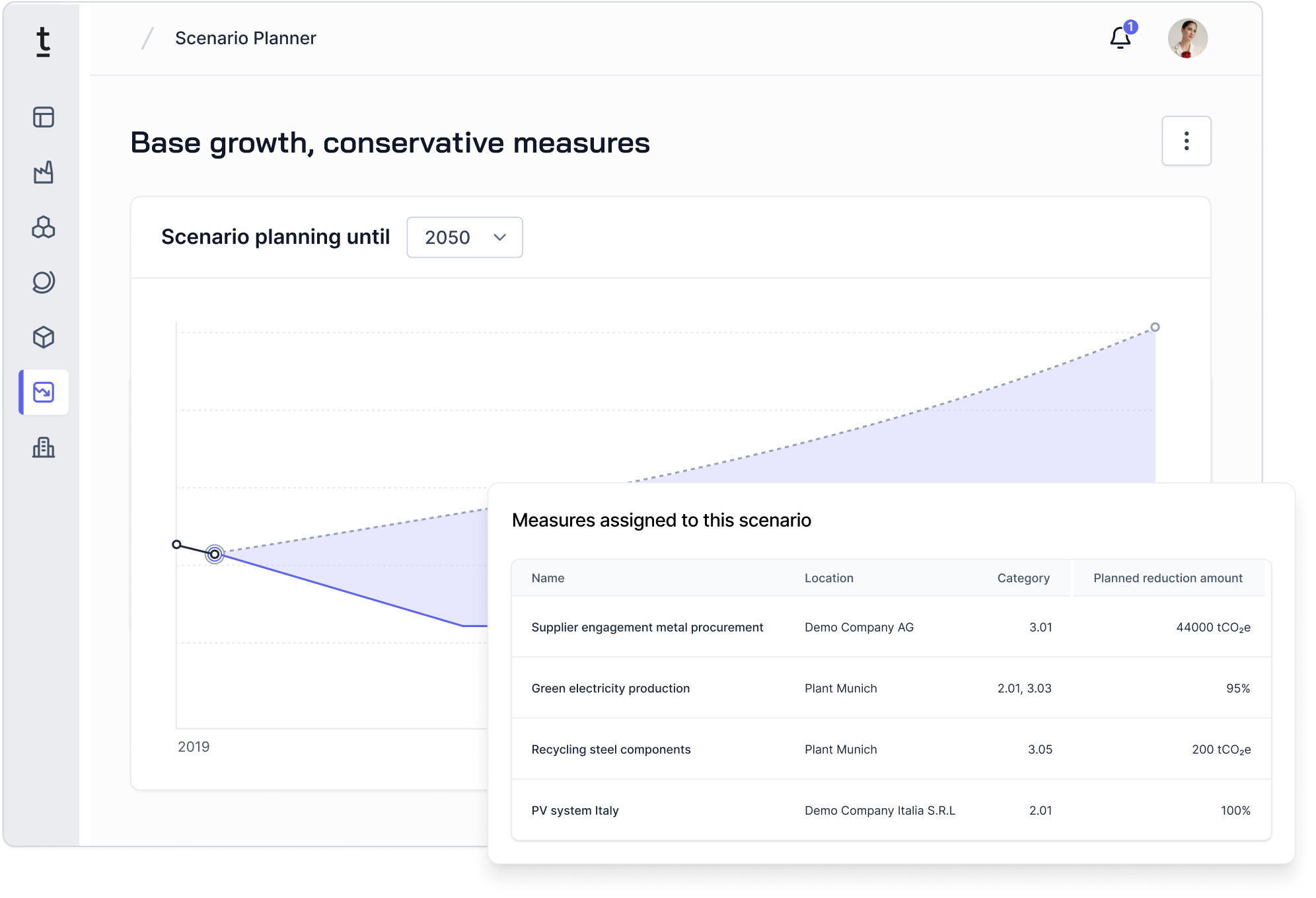
Step 4: Set targets
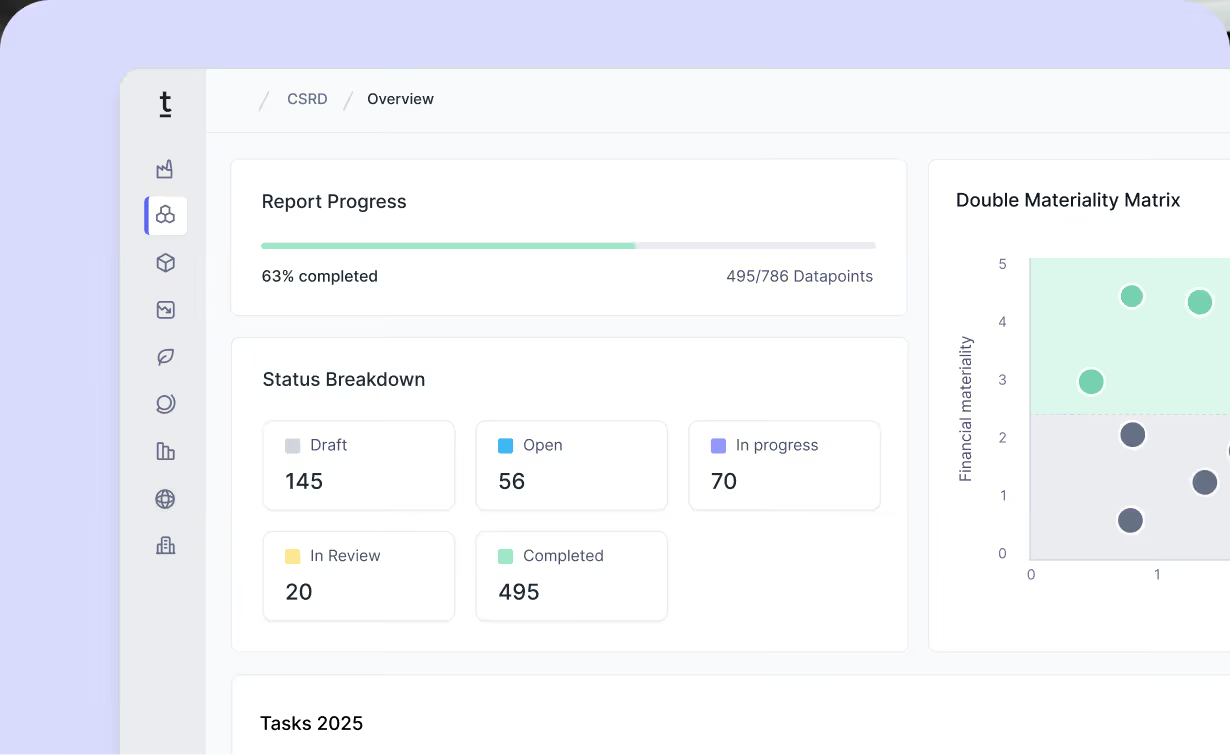
It offers a structured approach to defining, tracking, and reporting reduction targets, both for CSRD reporting and for continuously monitoring progress on emissions reductions. By documenting emission reduction targets across different scopes (Scope 1, 2, and 3) and business units, companies achieve a level of granularity and traceability that goes beyond ESRS-reporting. Science-based targets aligned with the SBTi can also be recorded and documented along the SBTi pathways. Since the data used for target-setting builds on existing CCF data, full transparency and traceability are ensured within the company.
Step 5: Plan and implement reduction measures
The Reduction Module helps maintain an overview of future emissions by displaying projected values for the coming years, evaluating the impact of selected measures, and providing targeted emission reduction recommendations.
By mapping investment costs, responsibilities, and timelines for each reduction measure, effective project management is ensured. Aligning with predefined reduction trends per business unit helps achieve climate targets and strategically manage emissions.
Key benefits of the Tanso Reduction Module at a glance
- Data-Driven Approach: Goals and measures are based on real-time Corporate Carbon Footprint (CCF) data, enabling precise management.
- Set Targets & Track Measures: Create reduction measures, compare scenarios, gain transparency on progress, and receive reduction recommendations.
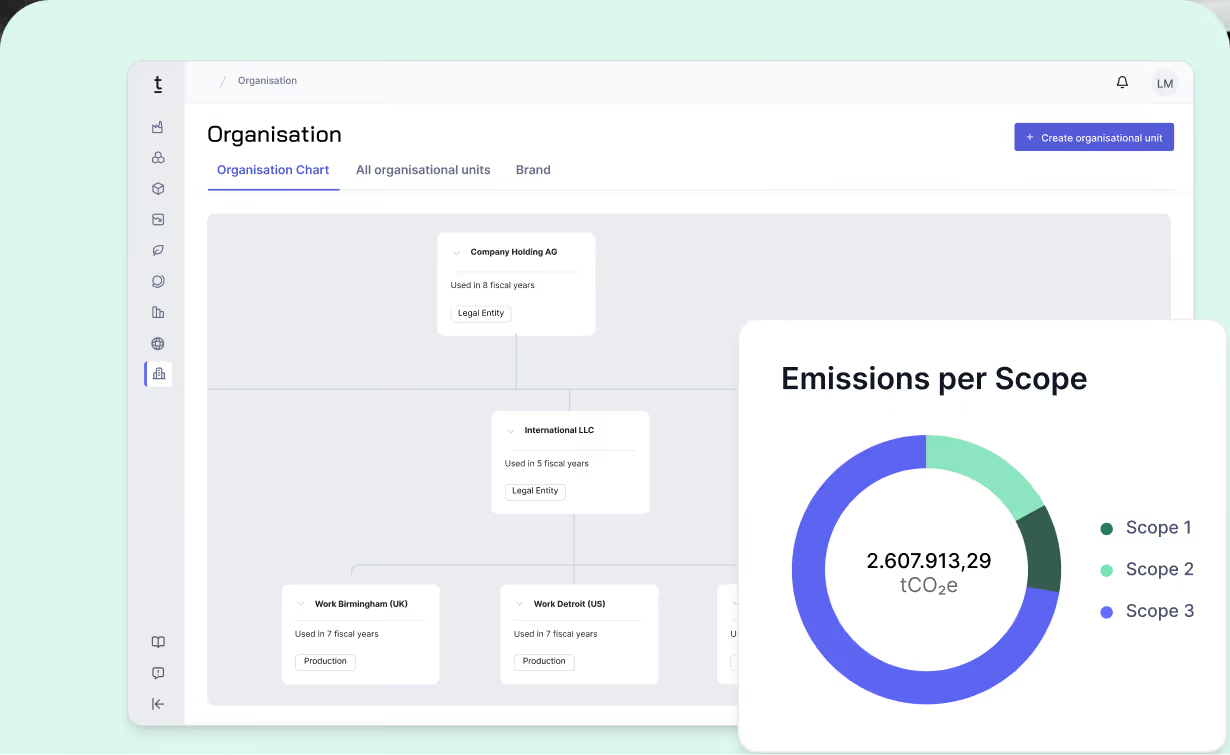
- Clear Responsibility Allocation: Integrate organizational structures, define responsibilities, and efficiently implement reduction measures for transparent goal tracking.
- All-in-One Platform: From CCF data management to hotspot analysis and progress tracking, everything in a single platform.













































































.avif)





.avif)
.jpg)


