


Tanso now supports the TfS standard: PCFs for the chemical industry


In the chemical industry, a large share of emissions arises in the supply chain, in purchased raw materials and intermediates. Anyone who wants to report them reliably needs a product carbon footprint (PCF) calculated according to the rules of the chemical industry. That is exactly what the Tanso PCF module now supports with the Together for Sustainability (TfS) PCF standard. Chemical companies can calculate their PCFs in an industry-compliant way, directly in Tanso.
Why the TfS standard matters now
Many chemical companies still calculate their PCFs using cross-industry standards such as ISO 14067, which do not meet the specific methodological requirements of the chemical industry. The TfS standard is the established, chemistry-specific standard for PCFs and closes exactly this gap. With TfS support in Tanso, companies capture the emissions of their products according to the right rules and generate reports that contain all required information, without manual extra effort. This enables companies to meet customer requirements and make emissions along the supply chain visible.
What the feature delivers
TfS support is fully integrated into the Tanso PCF module, with the extensions the standard requires:
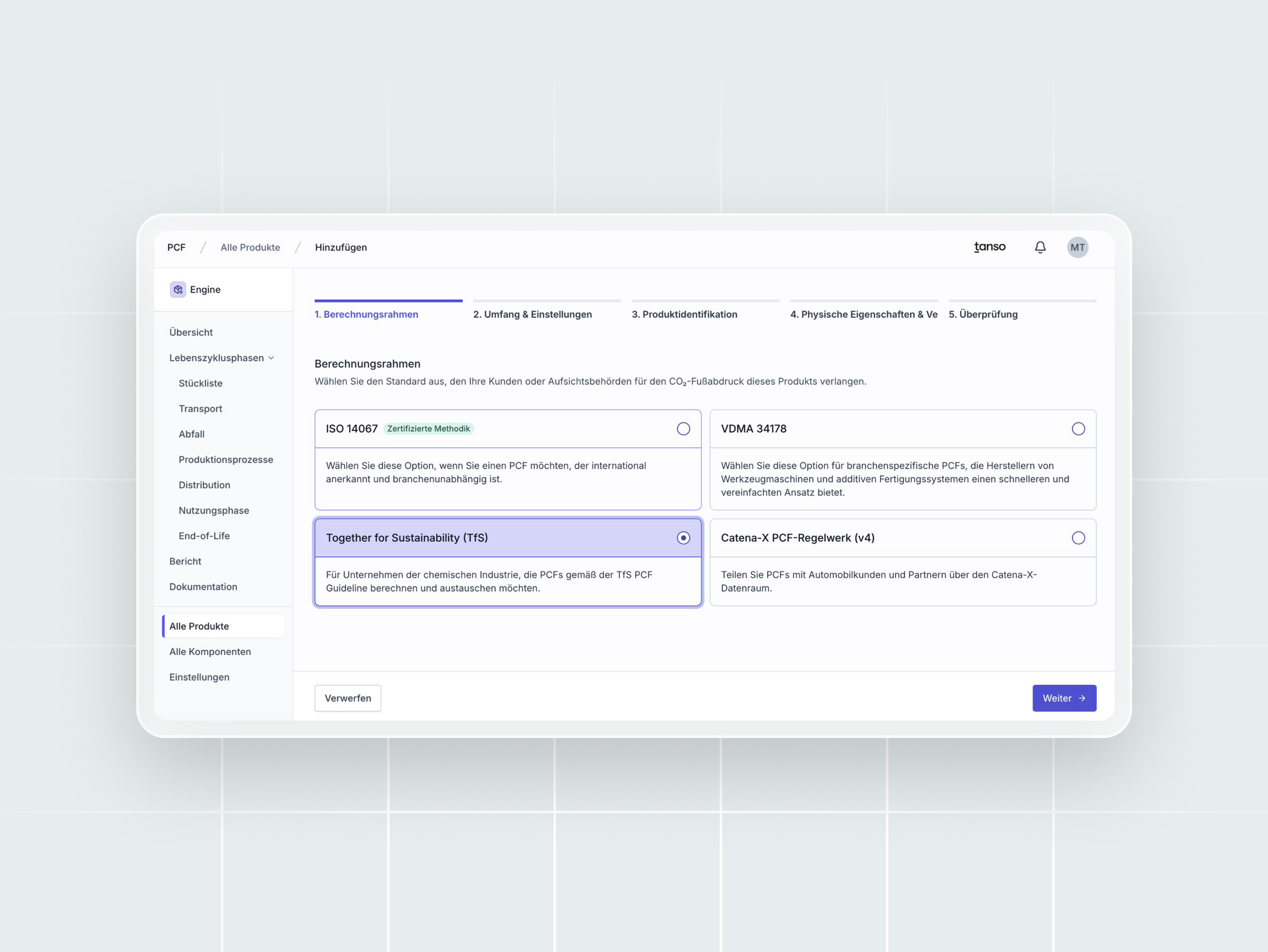
Standard selection in the product workflow
When creating a product, users select the appropriate calculation methodology, TfS or ISO 14067, right at the start. Subsequent inputs adapt automatically, so every product is captured according to the correct standard from the beginning.
Chemistry-specific inputs
For TfS products, additional chemistry-specific information can be captured, such as the CAS registry number and the total, fossil, and biogenic carbon content. Tanso maps the characteristics of chemical products rather than forcing them into an industry-agnostic schema. This reduces adaptation effort and minimizes sources of error.
Built-in quality requirements
The requirements of the TfS standard are built directly into the platform, for example the required completeness of captured masses and emissions, as well as a validity period per PCF including a reminder to review the value regularly. This reduces manual checks and makes results audit-proof from the outset.
TfS-compliant reports
The additional TfS information and emission metrics are automatically included in the PCF report. Companies can share results at the required level of detail and ensure compatibility with other platforms and data ecosystems such as Catena-X, without having to prepare data manually.
The decisive difference
In Tanso, chemical companies calculate in an industry-compliant way according to TfS and keep product and company data on the same platform, together with ISO PCFs, the corporate carbon footprint (CCF), and ESG reporting. This eliminates standalone solutions and duplicate data maintenance.













































































.avif)





.avif)
.jpg)


