


Calculating TfS-compliant PCFs: The transition guide for the chemical industry


You're already calculating Product Carbon Footprints, for example under ISO 14067 or the GHG Protocol, and want to know what implementing the TfS PCF Guideline actually requires in practice? That's what this article covers. If you'd like an overview of the standard first, you'll find one in our introductory article on the TfS standard.
An existing PCF calculation based on ISO 14067 already gets you a long way methodologically. The Together for Sustainability (TfS) PCF Guideline builds on exactly that: it adopts the logic of the standard and closes the gaps that the standard intentionally leaves open. Nevertheless, your usual process cannot be continued one-to-one. Some rules are more strictly defined, and some individual requirements are entirely new.
Below, we show you how to structure the transition from ISO 14067 to TfS PCFs effectively and which methodological aspects matter the most.
Four steps to TfS readiness
Steps 1 and 2: Building the organizational foundation
Define responsibilities and assess the status quo
It starts in-house. What method have PCFs been based on so far? Who is responsible for the calculation, and does this person actually have access to the necessary information from the supply chain?
A TfS-compliant calculation does not end at your own process. It requires reliable data on raw materials, co-products, and, if applicable, recycled or bio-based feedstocks. An organized inventory then answers three questions: Which PCFs already exist, what methodology are they based on, and what evidence is available or still missing?
The inventory can also help identify existing data gaps and create plans to close those gaps and improve data quality. After all, a reliable PCF, whether calculated according to ISO 14067 or TfS, stands or falls with the quality of the data used.
Document the methodology and system boundary in writing
Transparent documentation is already a requirement of ISO 14067. The TfS PCF Guideline goes a step further by making traceability an explicit condition. In concrete terms, this means the cradle-to-gate system boundary should be documented in writing and justified. Cut-off decisions must be substantiated, and excluded items must not account for more than 3% of total PCF emissions combined. Furthermore, any allocation between co-products requires a justification that follows the TfS hierarchy.
In practice, this knowledge is often locked away in the minds of individual employees, scattered across multiple files, or buried in a spreadsheet, but rarely part of a process that can be tracked and adapted. Establishing a clean documentation structure is therefore the foundation for everything else, building trust and transparency when responding to customer inquiries.
Steps 3 and 4: Content and technical review
Aligning existing calculations with TfS requirements
The fastest way to make progress is to start with the PCFs you already have. They immediately reveal which system boundary was chosen, the cut-off decisions behind them, and how co-products have been distributed so far. You don't need to start an ISO-compliant calculation from scratch. It is sufficient to specifically check the areas where the TfS PCF Guideline is more precise than ISO 14067—above all, the cut-off rule of a maximum of 3%, the allocation hierarchy, and additional parameters required for the TfS PCF report, such as information on fossil and biogenic carbon content. The table at the end of this article provides the structure for this.
Building a data strategy for PDS and DQR
From 2027, PCF datasets must meet additional TfS requirements: Primary Data Share (PDS) and Data Quality Rating (DQR) must be reported. The Primary Data Share indicates what portion of the PCF is based on your own primary data. The Data Quality Rating ranks each dataset according to technical, temporal, and geographical representativeness on a scale of 1 to 5. TfS provides specific guidelines for evaluating and calculating these two figures, as well as tips for improving data quality over time, such as identifying low-quality data sources.
In practice, this leads to a few key questions: How high is your primary data share today? Where do your secondary emission factors come from, and what year are they from? And above all: For which processes do you rely on your own measurements, and where do you rely on secondary data?
Based on this, you can start developing your PDS and DQR now so that the structured assessment of your primary data and data quality doesn't come as a surprise in 2027.
How software simplifies the transition
The right software takes the workload off your hands, especially when it comes to reconciling, evaluating, and transferring PCFs to the new standard. Instead of starting from zero, you can quickly adapt existing PCF calculations and make them fit for TfS requirements.
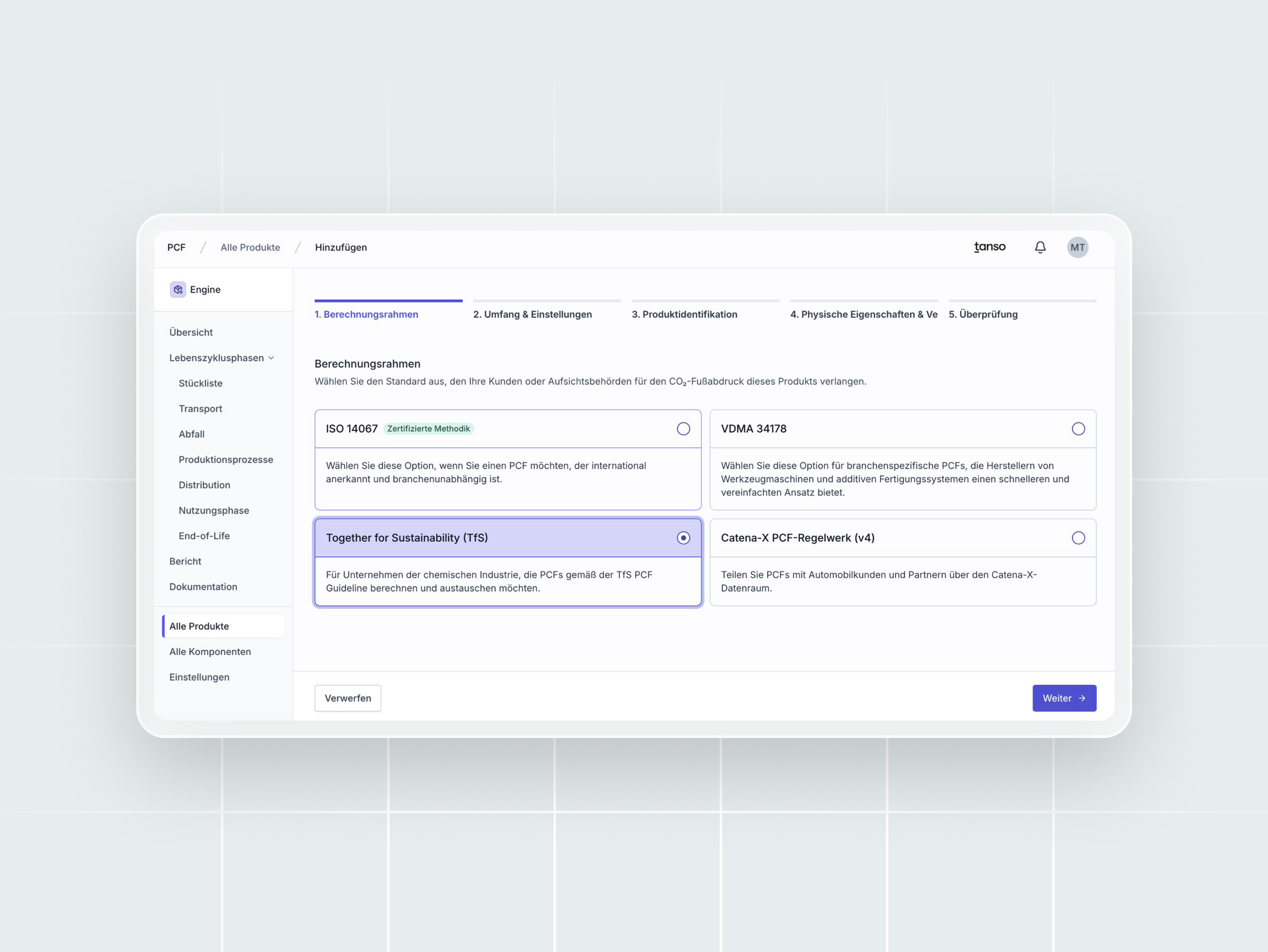
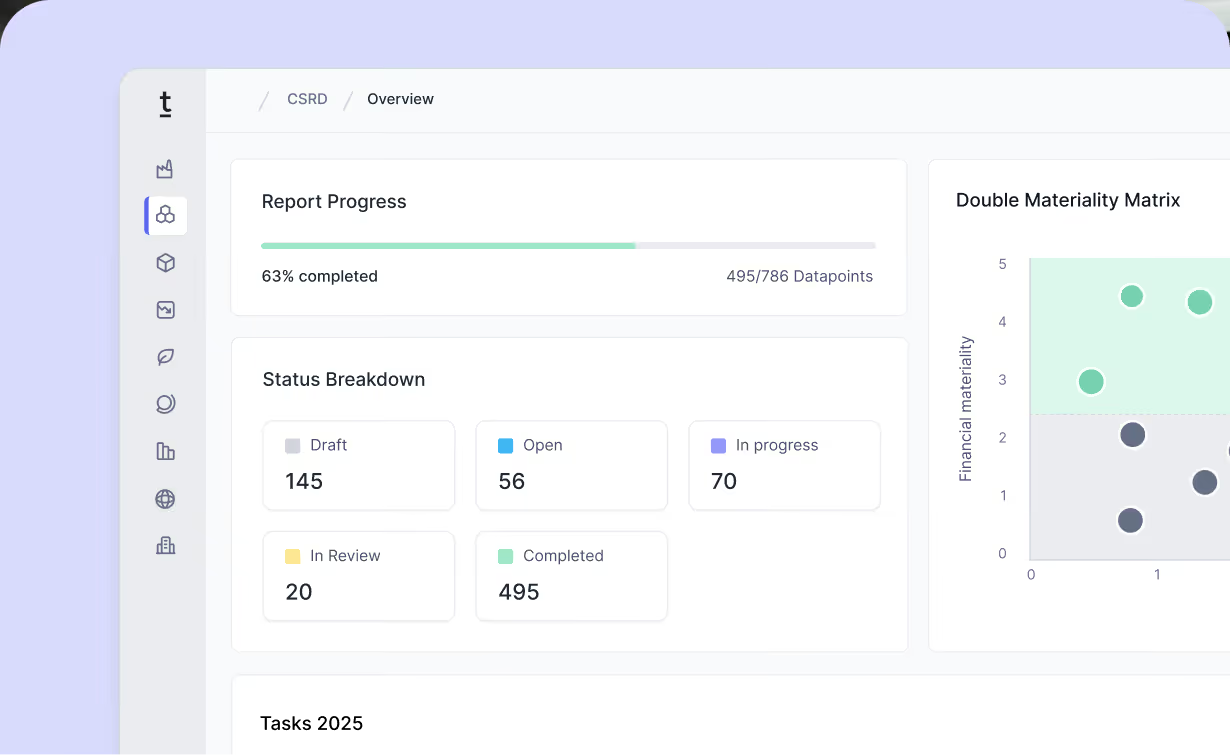
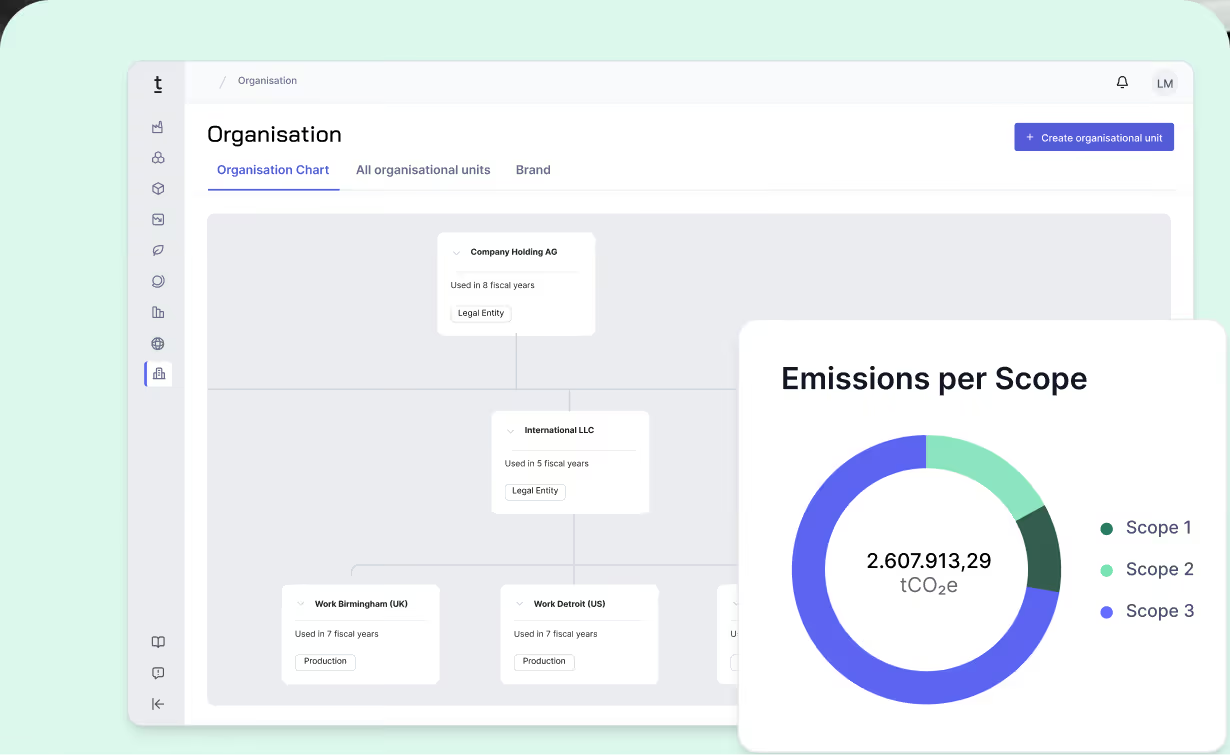
In the Tanso PCF module , TfS support is built right in:
- You select the methodology—TfS or ISO 14067—when creating a product, and the subsequent input fields adjust automatically.
- For TfS products, you enter chemical-specific information such as the CAS registry number as well as the total, fossil, and biogenic carbon content of the product.
- The rules of the standard are integrated, such as the required completeness of recorded masses and emissions, as well as a validity period for each PCF with a reminder for review.
- PCF reports automatically output the parameters required by TfS and keep the results compatible with other data spaces, such as Mattermaps (formerly known as SiGreen).
This allows a large portion of TfS requirements to be mapped directly in the software today, enabling PCFs to be adapted from ISO 14067 to TfS in no time at all. Where gaps or questions remain, our experts are here to help, to identify and close them.
Checklist: The specific differences between ISO 14067 and TfS
The table summarizes the key methodological requirements of the TfS PCF Guideline, categorized by when they become relevant.
Conclusion
Switching to the TfS PCF Guideline does not mean abandoning your previous calculations, but it does require more than just a few minor methodological tweaks. Just as important as the calculation rules are robust documentation, a well-thought-out data structure, and clearly defined internal processes. Those who start their assessment early and establish their data strategy in good time will be able to successfully transition their PCF calculations from ISO 14067 to TfS.











































































.avif)





.avif)
.jpg)


