


EmpCo for B2B: Why "we're B2B" won't protect you


What is the EmpCo Directive?
The EmpCo Directive (Empowering Consumers Directive) is an EU directive against greenwashing. It sets out which environmental claims are still permitted in advertising and which count as misleading. In Germany, it was transposed through an amendment to the Act against Unfair Competition (UWG) and becomes binding on September 27, 2026.
Unlike the much discussed but stalled Green Claims Directive, it has already been transposed into German law, there is no going back on this one. Formally, it targets consumer communication and explicitly excludes sustainability reports. Companies that sell exclusively to other businesses might conclude: this doesn't concern us.
Does the EmpCo Directive apply to B2B companies?
Formally no, practically yes. In the joint webinar hosted by Tanso and SAIM, we highlighted four reasons why B2B companies shouldn't rely on the formal scope:
- B2B2C: Even if a company sells only to business customers, there is often a consumer at the end of the value chain. Claims about product characteristics travel down the supply chain and fall within the EmpCo Directive's scope as a result.
- Spillover effect: Claims originally written for investors, analysts, or the financial market spread to other channels, such as the company website or brochures, and end up in B2C communication unplanned.
- Sustainability reports as a reference source: The sustainability report is a company's most important reference source on sustainability performance. When data and claims from it are reused on other channels, such as campaigns or customer communication, they can fall within the directive's scope.
- The EmpCo gold standard: EmpCo establishes a new quality standard for sustainability communication, away from generic claims and toward specific, evidence-backed environmental claims. B2B communication shouldn't fall behind that standard either.
The five EmpCo Directive rules at a glance
At its core, the directive comes down to four new prohibitions plus one rule on forward-looking claims.
Prohibition 1: Generic environmental claims without evidence
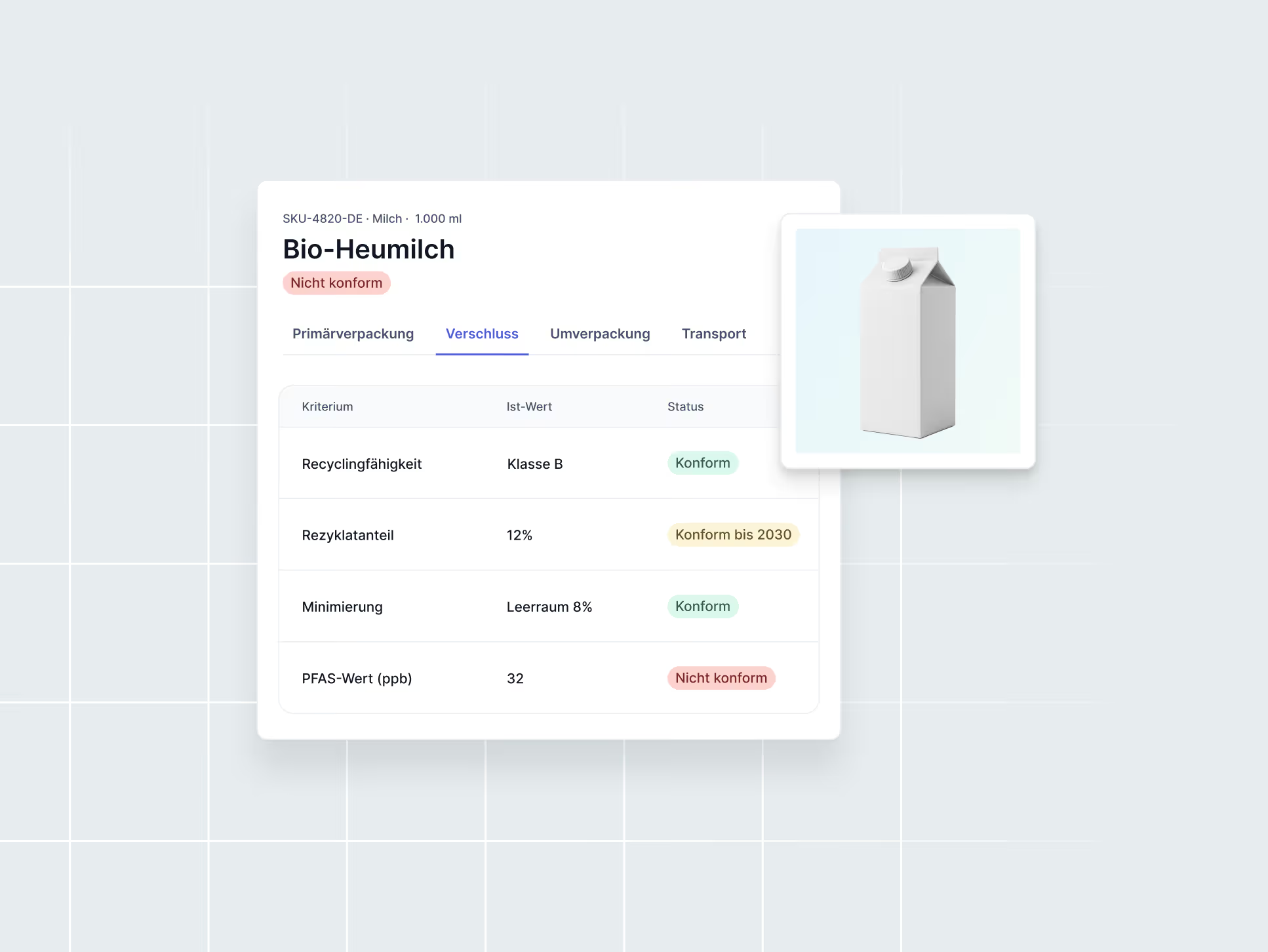
Terms such as "green," "eco-friendly," or "climate-friendly" will only be permissible if they are part of a recognized sustainability label or are specified with equal prominence on the same medium. A comparison to health communication makes it tangible: a food product can no longer be advertised simply as "healthy," it has to get specific, such as "contains vitamin B12."
Prohibition 2: Sustainability labels without an external certification system
In-house signets without external certification imply a verification that never took place. Only labels with independent governance remain permissible: you need a label provider, a label holder, and an independent third party as certifier.
Prohibition 3: Carbon-neutrality advertising based on offsetting
Claims such as climate-neutral, CO₂-neutral, or net zero are no longer allowed at the product level. What remains communicable are concrete product benefits, such as emission-free operation, as well as the climate projects a company genuinely supports.
Prohibition 4: Partial claims presented as whole-product claims
If you've achieved 71% less CO₂ in packaging, you may say so, but not in a way that creates the impression the entire product has improved accordingly.
Rule 5: Targets alone aren't enough, a plan, milestones, and verification are required
Forward-looking claims may only be advertised if backed by a detailed, externally verified implementation plan, such as a decarbonization strategy with concrete measures and third-party verification through an organization like the Science Based Targets initiative.
Four steps to EmpCo-compliant communication
1. Claim inventory
Make every environmental claim visible: on the product and packaging, the website, in campaigns, on social media, and in the sustainability report. Typically the most laborious step, but the most important one.
2. Green claims check
Review every claim for generic environmental terms, self-created labels, carbon-neutrality claims, partial claims, and unverified forward-looking promises.
3. Green claims 2.0
Not every claim has to go. Many can be saved if the specific environmental benefit is named and substantiated. Focus on strategically important claims first.
4. Proofpoint and data management
In the end, the question is whether every remaining claim can be proven if challenged, with data, certificates, and audits from your own supply chain.
For the inventory stage, it's also worth using AI: it can scan documents and website screenshots at speed to surface risky claims and deliver an initial risk assessment, much like AI-assisted report generation. The final judgment should always rest with a human.
Evidence over assertions: Why EmpCo compliance needs data
Green claims can only be reliably substantiated when the underlying data is robust and traceable. Under EmpCo, the burden of proof lies with the company: a company that can't substantiate a claim risks fines of up to 4% of annual revenue and reputational damage. SAIM helps companies systematically identify, assess, and strategically develop their green claims. Tanso provides the underlying data foundation: the platform connects carbon accounting, emissions data, and ESG reporting, making relevant sustainability data centrally available.
Product Carbon Footprint
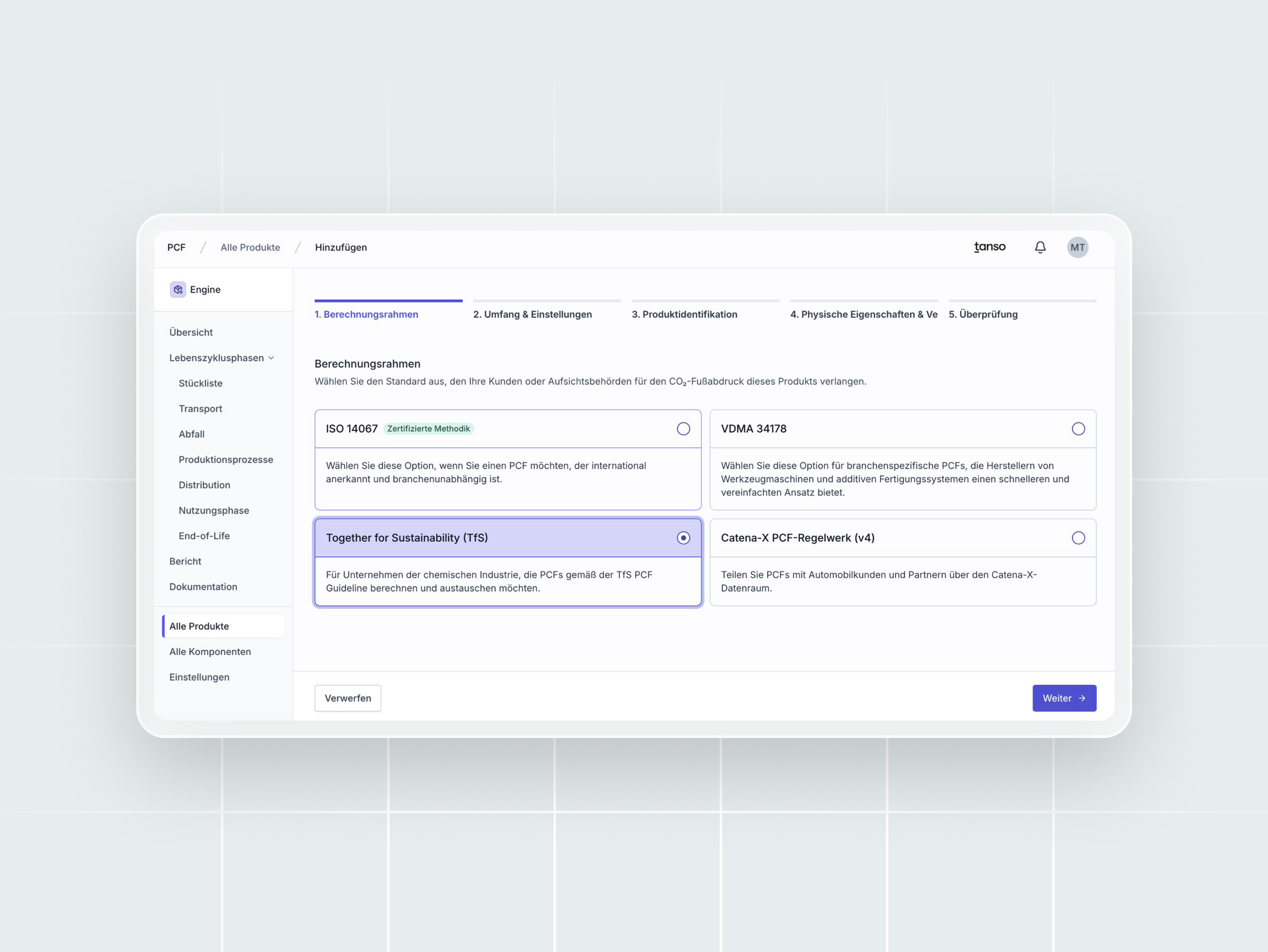
The PCF provides robust evidence at the product level, for a claim such as "carbon footprint reduced by 40% since 2020, calculated in line with ISO 14067" instead of a blanket carbon-neutrality claim.
Corporate Carbon Footprint & reduction module
The CCF and the reduction module turn a mere target announcement into a realistic implementation plan for climate goals.
Emission factor database
Tanso's emission factor database provides the basis for every one of these calculations, with nearly 60,000 curated, reliable, audit-ready, and up-to-date emission factors. And because a large share of emissions sit in Scope 3.1, structured supplier data is needed to substantiate any claim about the supply chain at all.
ESG-Modul
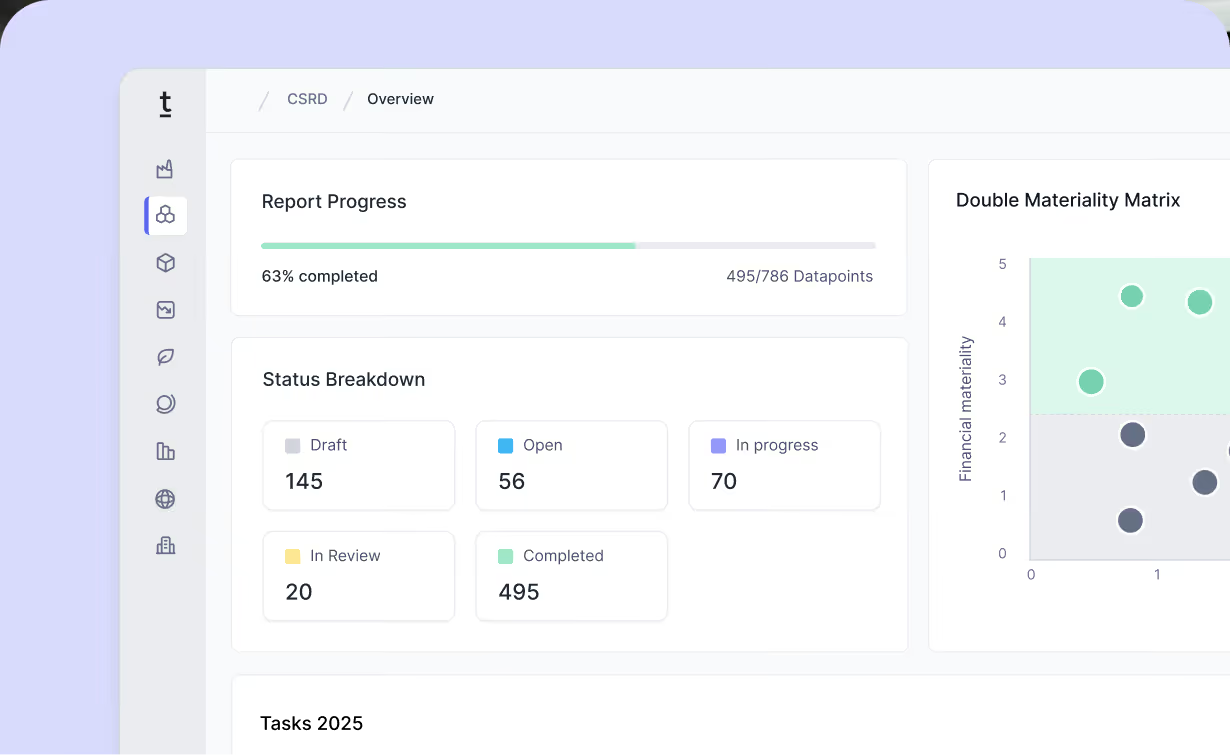
Tanso's ESG module, including year-over-year comparison, ensures that independent, qualified third parties such as auditors can review and verify sustainability performance at any time, complemented by CSRD reporting or, for smaller companies, the VSME report.
Conclusion: EmpCo compliance pays off in B2B too
The EmpCo Directive may formally target consumer communication, but its influence reaches considerably further in practice. For B2B companies, reviewing claims is worth the effort for one reason above all: specific, evidence-backed sustainability communication holds up better over time than generic claims that will soon be off the table anyway.
Frequently asked questions about the EmpCo Directive in B2B
Does the EmpCo Directive apply to B2B companies?
Formally, the directive addresses consumer communication. In practice, B2B companies should still implement it, because claims traveling through B2B2C supply chains, messaging written for investors, and reused report content can all end up reaching the end consumer.
When does the EmpCo Directive take effect?
On September 27, 2026. It was transposed into German law through an amendment to the UWG.
What penalties apply for violating the EmpCo Directive?
In EU-wide coordinated proceedings, fines of up to 4% of annual revenue apply. In practice, the greater risk is cease-and-desist warnings: competitors and consumer protection associations can act against impermissible claims under the UWG.
Does the EmpCo Directive also cover social claims?
Yes. It applies equally to environmental and social characteristics. A claim like "fair trade coffee" without corresponding certification is just as impermissible as a generic environmental claim.
What's the difference between the EmpCo Directive and the Green Claims Directive?
The Green Claims Directive would have required environmental claims to be independently verified, but the European Commission withdrew it in June 2025. EmpCo pursues a similar goal more simply: it prohibits specific types of claims outright and is already binding law.














































































.avif)





.avif)
.jpg)


