


What is Catena-X and why must automotive suppliers act now?


Since April 2025, registration in Catena-X has been an official part of BMW's procurement process. Other major automakers such as Volkswagen, Mercedes-Benz, and Ford are following the same course. Tier-1 and Tier-2 suppliers who are still waiting risk being overtaken by OEM requirements before their own data foundation is in place.
This article explains what Catena-X is, the role Product Carbon Footprints play in it, and what companies should do right now.
What is Catena-X?
Catena-X is an open, decentralized data ecosystem for the automotive industry. Founded by leading OEMs and suppliers such as BMW, Volkswagen, Mercedes-Benz, and Schaeffler, it enables secure, standardized data exchange along the entire supply chain.
The core principle: companies share data without losing control over it - data sovereignty remains with the company itself. Each organization decides for itself who gets access to which data. Data sovereignty is not a compromise but a technically embedded feature.
The network currently addresses a range of use cases: supply chain resilience, quality management, collaborative development, and - increasingly in focus - the exchange of Product Carbon Footprints (PCFs).
Why product carbon footprints are changing now
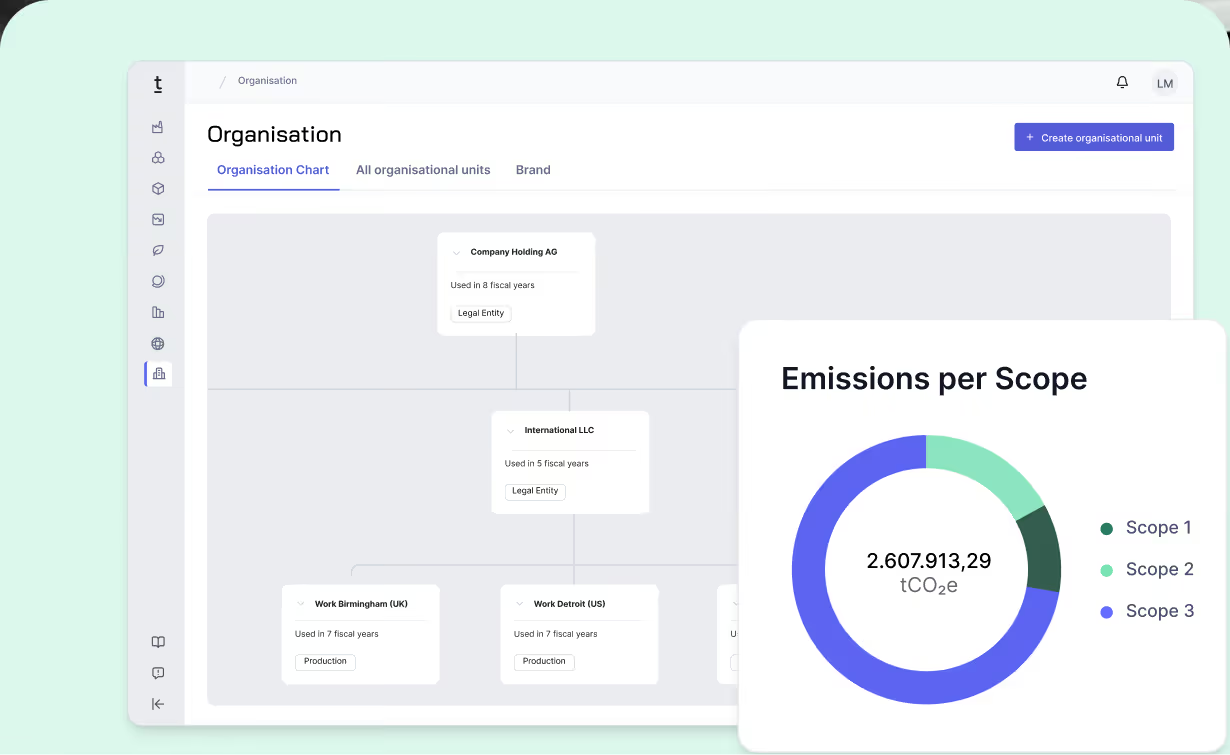
The automotive industry faces a structural challenge: Scope 3 emissions, i.e. emissions along the supply chain, often account for 70 to 90% of total emissions. For electric vehicles, this distribution shifts dramatically - up to 50% of emissions already occur during the production phase. This demands more precise calculations in these categories.
What this means: PCFs are becoming the decisive KPI - no longer just in reporting, but in supplier selection. And here lies the problem: until now, every company has been calculating according to its own methodology. Secondary data, industry averages, different system boundaries - a consistent comparison is virtually impossible.
Catena-X solves exactly this. Instead of isolated calculations and incompatible formats, the network creates a common standard: a unified set of rules for calculation, a standardized format for data exchange, and a verification framework for trust. PCF data can thus be passed along the supply chain, aggregated, and verified without having to start from scratch each time.
The PCF Rulebook v4: The common calculation basis
The Catena-X Product Carbon Footprint Rulebook is the methodological cornerstone for implementation. Version 4 was published in September 2025 and is the currently applicable rulebook.
An important distinction: the Rulebook does not replace the ISO 14067 standard - it builds on it. The ISO standards for life cycle assessment (ISO 14040/44) and for Product Carbon Footprints (ISO 14067) form the foundation. The Catena-X Rulebook then concretizes these standards for the context of the automotive supply chain: where ISO deliberately leaves room for interpretation, the Rulebook makes binding specifications. Beyond that, Catena-X ensures comparability with additional sector-specific standards for steel (worldsteel), aluminum (IAI, European Aluminium), and chemicals (TfS).
The goal: PCFs from different companies should be methodologically comparable and calculated according to the same rules.
ISO 14067 and the Catena-X Rulebook: What's the difference?
Companies already calculating according to ISO 14067 have the methodological foundation in place. Most calculation rules are compatible. However, the Rulebook introduces several important specifications that are relevant for data exchange within the Catena-X ecosystem:
1. System boundary: Cradle-to-gate is mandatory
The Catena-X Rulebook uniformly prescribes a cradle-to-gate system boundary - from raw material extraction to the factory gate. The use phase and end-of-life are explicitly excluded. This clear delineation creates comparability but also sets a clear requirement for your own calculation practice.
2. Primary Data Share (PDS) and Data Quality Rating (DQR): Data transparency becomes measurable
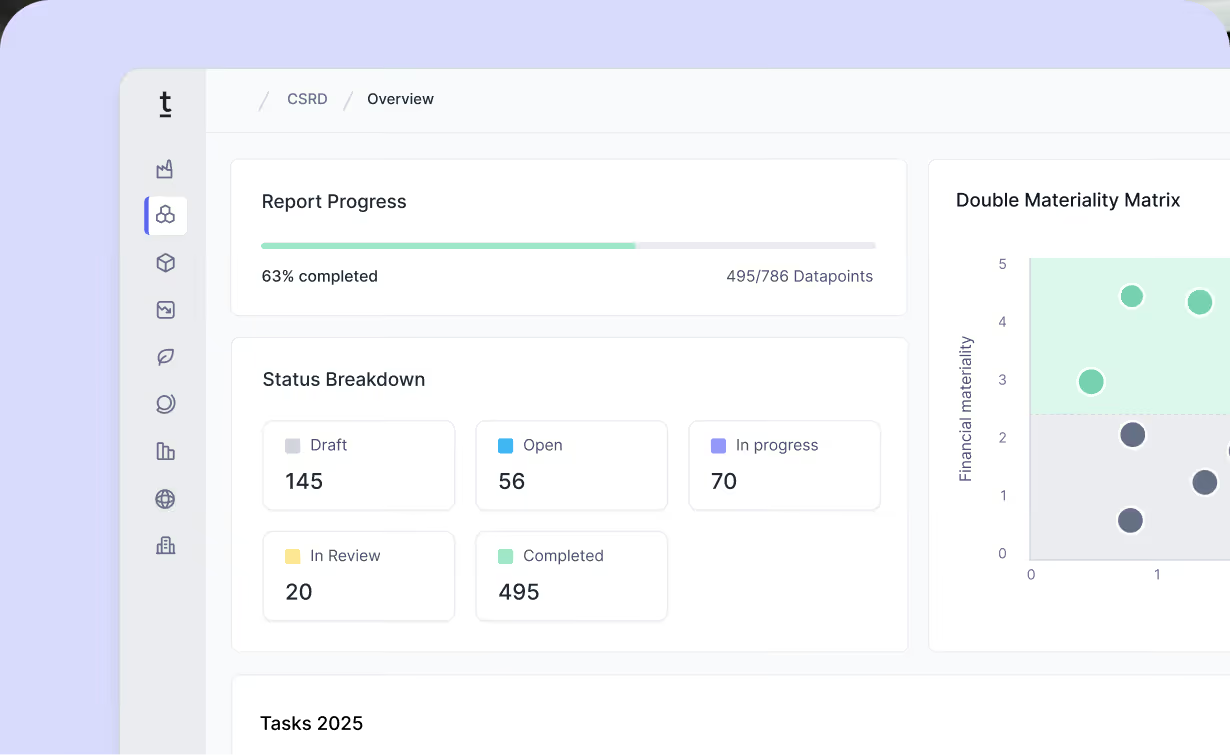
The Rulebook introduces the Primary Data Share as a mandatory metric. It indicates what proportion of the PCF is based on a company's own primary data, measured as a percentage of the absolute PCF. Additionally, a Data Quality Rating (DQR) is reported, evaluating data by technical, temporal, and geographical representativeness. Both metrics will become mandatory for data exchange via Catena-X after the transition phase (ending 2027). ISO includes data quality requirements but does not make them binding as explicit, reported KPIs.
3. Prospective PCFs: New rules for future values
New in Version 4 are clear requirements for prospective PCFs - i.e. PCFs for products that are not yet or not yet fully in series production. ISO 14067 does not specifically address this case. The Catena-X Rulebook distinguishes three scenarios and defines the permissible assumptions for each: new product without a predecessor, further development of an existing product, or an existing product for a future date. This becomes particularly relevant when OEMs request PCFs already during the development phase.
4. Exchange format and data sharing
ISO 14067 is a calculation standard. Catena-X additionally defines how the PCF is exchanged digitally: via a standardized data model (CX-0136) and the Catena-X data space. This is perhaps the most fundamental new building block: not the calculation itself, but the connectivity to the ecosystem.
What does this mean for companies that already calculate in accordance with ISO?
The good news: the methodological foundation is solid. Companies currently calculating PCFs according to ISO 14067 do not need to rebuild their calculation logic from scratch.
What's new: PDS and DQR must be explicitly reported going forward. The system boundary must be consistently documented as cradle-to-gate. The decisive final step: the PCF must be available in a format that can be exchanged within the Catena-X data space.
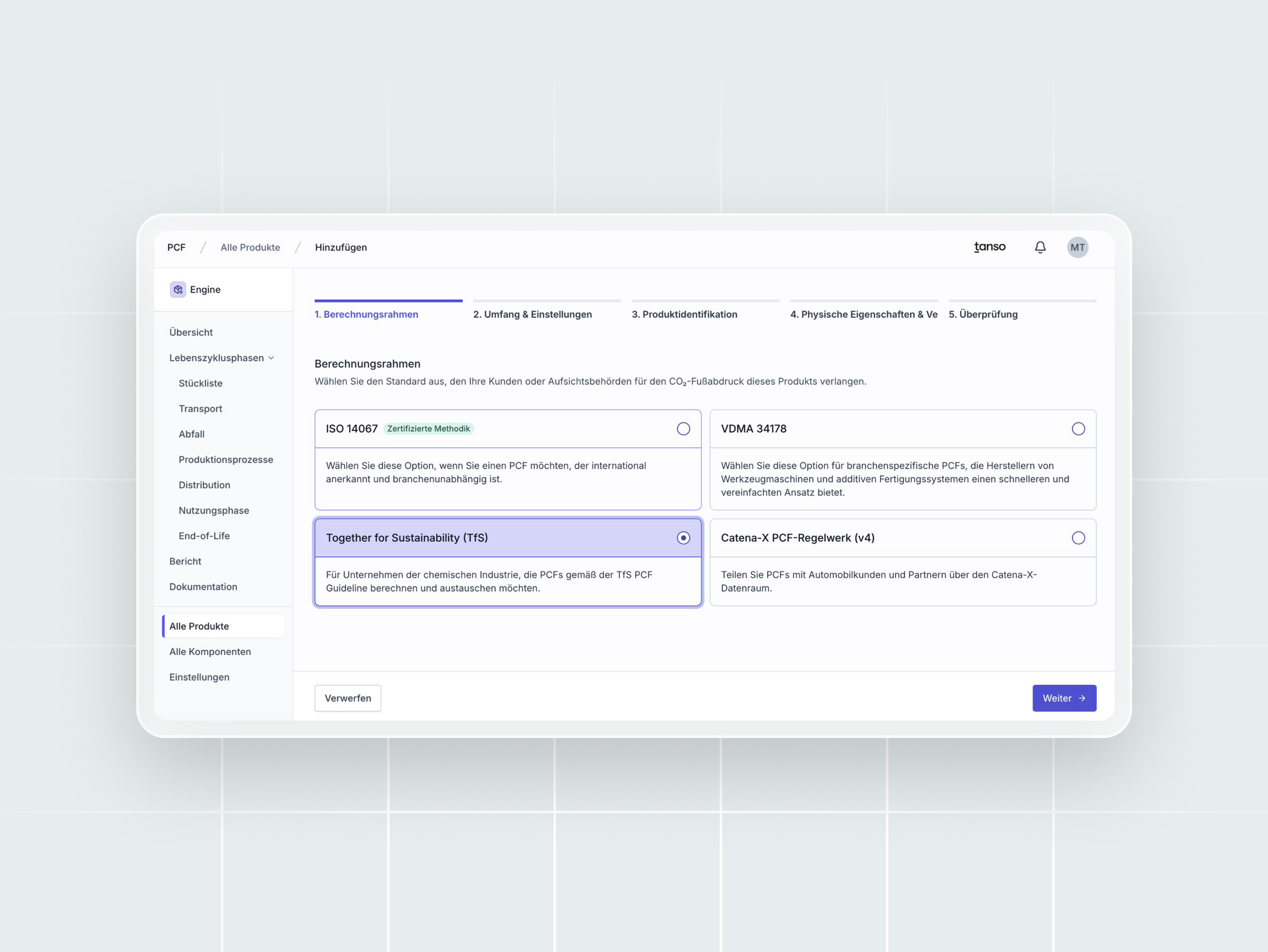
With Tanso, the path from ISO-compliant PCF calculation to Catena-X readiness is not a restart. Our PCF software supports calculation according to Catena-X requirements, including primary data collection along the supply chain, consistent system boundaries, and the foundation for PDS and DQR.
Next steps for suppliers in the automotive industry
The pressure to act is mounting. Those who start now have time to build a robust data foundation. Those who wait risk having to respond to OEM PCF requests reactively and under time pressure.
1. Assess your methodological status quo: Are PCFs already calculated according to ISO 14067? If so, the foundation is already strong. If not, that's the first step.
2. Identify gaps: Which Catena-X Rulebook requirements are not yet met? Is the system boundary cleanly defined as cradle-to-gate? Are primary data being collected systematically? Have exclusion thresholds been respected?
3. Clarify OEM requirements: Which customers are already requesting Catena-X-compliant PCFs - or will do so in the foreseeable future? Since April 2025, this is already a reality at BMW. It pays to clarify requirements proactively rather than waiting for the request.
4. Launch pilots for core products: You don't need to calculate your entire portfolio at once. Instead, start with the products that are most relevant for your key OEM customers and build a robust calculation basis there.
5. Plan your onboarding to the Catena-X data space: The technical connection to the ecosystem (via Cofinity-X as the marketplace operator) requires lead time. Plan early which implementation path is best for your company.
Catena-X is changing the rules of the game for Product Carbon Footprints in the automotive supply chain. The question is not whether but when suppliers will have to participate. Those who act now create competitive advantages. Those who wait will, at best, catch up under pressure.










































































.avif)





.avif)
.jpg)


