


Instant PCFs? Why data quality still matters


The promise of “Instant PCFs”
Many companies are currently under pressure to provide Product Carbon Footprints (PCFs) for customers or tenders. At the same time, collecting data along the value chain is often complex and time-consuming.
Against this backdrop, new software solutions appear particularly attractive as they promise something very compelling: PCFs can be calculated instantly, even when only limited product information is available.
Some of these approaches use artificial intelligence to automatically derive emission values from minimal input data. In some cases, a PCF is generated based on:
- product descriptions
- product categories
- supplier websites
- product URLs
At first glance, this sounds like an ideal solution for companies that need to provide emission values quickly. But this raises a crucial question: Can a credible PCF be calculated without real data?
A PCF starts with understanding the product
A high-quality PCF always begins with one fundamental step: understanding the product across its entire lifecycle.
To create a comparable and methodologically sound PCF, companies first need to determine:
- which materials a product consists of
- which manufacturing processes are involved
- which energy inputs occur
- which transport routes are used
This understanding forms the foundation for any robust PCF calculation. It also means: For an initial PCF calculation, companies typically need time, as they must establish a reliable data foundation and a calculation methodology tailored to the product.
Companies need to identify data sources, define their system boundaries, work with well-founded assumptions (e.g., in cases of data gaps), and select appropriate emission factors. This step is essential to create a methodologically robust foundation and comparability between PCFs.
First data quality - then speed
Building this data foundation is not a disadvantage, it is an investment. Once the structure is properly established, PCFs can be (re)calculated very quickly and at scale.
Modern software platforms can automate this process. When the data foundation is in place, calculating a new PCF often takes less than one minute.
The key point is therefore not speed, but sequence: First establish a robust blueprint for calculation - then scale it automatically. Companies that attempt to skip this initial step risk producing PCFs that may be generated quickly but lack methodological robustness.
A PCF must not only be fast, but also audit-ready
This becomes especially relevant when it comes to certifiability and external verification. PCFs increasingly need to be audit-ready - whether by independent bodies or as part of customer requirements. Without a transparent data foundation, clearly defined system boundaries, and a traceable methodology, such audits are hardly possible.
Or put simply: A PCF that cannot be clearly explained and verified is in practice often worthless.
At the same time, customer expectations are evolving. In industries such as automotive, food, and chemicals, PCFs are increasingly scrutinized - sometimes even “reverse engineered” in a way similar to cost structures. This means: Customers assess whether the reported emissions align with materials used, energy consumption, and production processes. Companies relying on generic or AI-generated estimates risk losing credibility, being unable to answer follow-up questions or, in the worst case, being excluded from supplier evaluations.
In these scenarios, one thing becomes clear: A fast PCF is only an advantage if it is also reliable.
Why comparability matters
In practice, PCFs often serve a very specific purpose: they answer customer requests.
Industrial companies usually do not calculate PCFs out of curiosity. They do so because customers increasingly request them, for example as part of supplier evaluations, tenders and Scope 3 accounting.
For PCFs to be useful in these contexts, they must be comparable and standards-compliant. This means that a PCF calculated by one company must be methodologically comparable with PCFs from other companies in the same industry.
This is where one of the biggest challenges of purely AI-generated estimates emerges. If a PCF is created solely from general product categories or automatically interpreted information, it is often unclear:
- which standard was used
- which system boundaries were applied
- which assumptions were made
- which emission factors were selected
For customers, auditors, or partners in the value chain, such numbers are therefore difficult to interpret.
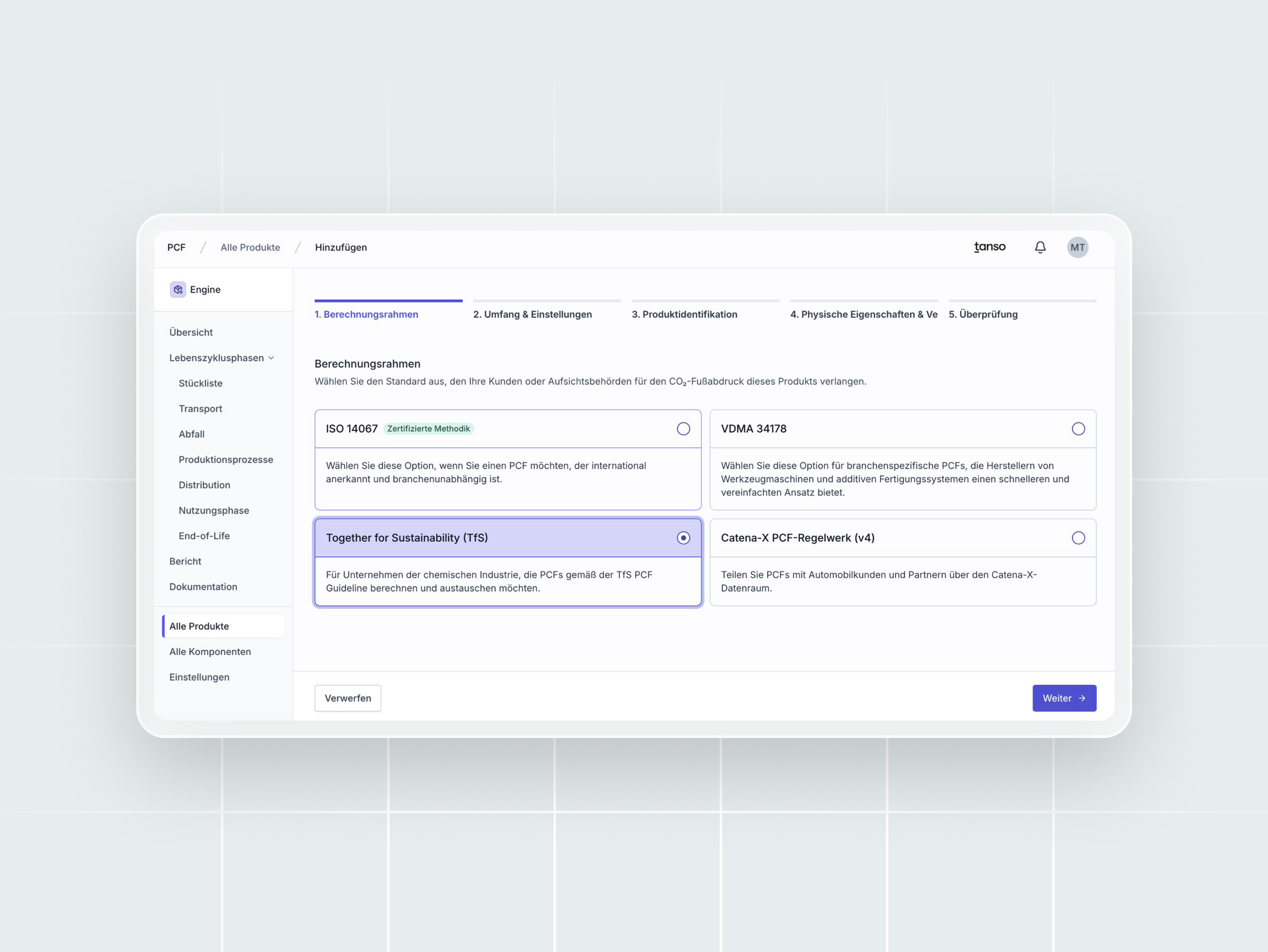
Another important building block for comparable PCFs is the use of Product Category Rules (PCRs). Foundational standards such as ISO 14067, ISO 14040/44, and the GHG Product Standard provide the overall methodological framework. PCRs translate these general standards into specific calculation rules for particular product categories.
Arne Grotenrath, freelance Lead Auditor for Carbon Footprints and Life Cycle Assessments, explains:
“In my view, PCRs are the key to translating the relatively general standards into concrete guidance for companies - and also for software solutions that support PCF calculations.”
Especially for automated calculations, whether performed using software platforms or AI, such clearly defined rules are essential to ensure that results remain comparable and compliant with established standards.
The risk of instant PCFs
AI-based estimates can certainly provide an initial orientation. However, when they are communicated as full PCFs, several risks arise.
Lack of traceability
Without a transparent data basis, it is often impossible to explain how a value was calculated, and results may not be consistently reproducible.
Limited acceptance by customers
Customers who require PCFs for their own Scope 3 accounting or supplier evaluations expect methodologically robust numbers. Otherwise, PCFs may be rejected - or suppliers may even be excluded.
Subsequent corrections
If an automatically generated PCF later needs to be manually reviewed and adjusted, the initial time savings quickly disappear. In the worst case, additional work is created because calculations must be corrected multiple times.
AI-based approaches can certainly add value - however, primarily in contexts where structured processes and reliable data are already in place.
Arne Grotenrath describes this dynamic as follows:
“The use of AI can make good processes better and will make poor processes worse - and thereby widen the gap between companies that are well positioned in terms of data processing and process management and those that still have catching up to do.”
Especially when dealing with large datasets and repetitive processes, AI can indeed create efficiency gains - for example in updating emission factors or calculating large product portfolios.
“I'm currently observing a market shift from calculating individual PCFs to the use of PCF tools that allow companies to calculate the PCF of individual products across an entire product portfolio. This is exactly where I see potential for AI - particularly when handling large datasets and recurring processes,” Grotenrath explains.
However, the key point remains: AI can support existing processes, but it cannot replace a solid methodological foundation.
How Norder Band scales PCF calculation
A practical example of how robust and scalable PCF calculation can work is Norder Band, one of Europe’s leading service centers for stainless steel processing.
The company faced increasing demand from customers for PCFs. At the same time, many relevant data points were initially spread across different systems and needed to be structured and consolidated.
Together with Tanso, Norder Band first built a reliable data foundation and a standards-compliant methodology for PCF calculation. This included understanding relevant material and production data, identifying emission sources, and defining a consistent calculation logic.
Once this foundation was established, the process could be scaled and automated. Today, the company calculates up to 5,000 Product Carbon Footprints per day, quickly and consistently.
This example shows that building a solid data foundation initially requires some time. However, once methodology and data structures are established, PCFs can be calculated within seconds and efficiently applied across large product portfolios.
Conclusion: The fastest PCF is not necessarily the best
The future of PCF calculation will likely combine solid data foundations with AI-supported analysis and automation. However, if product data is entirely replaced by AI assumptions, there is a risk that PCFs become black-box estimates.
Companies that want to communicate emissions credibly and share them with customers therefore need one thing above all: PCFs that are transparent, comparable, and methodologically robust.
The first PCF may take a little longer. What matters is that the foundation is correct. Once that basis is established, PCFs can then be calculated quickly, automatically, and at scale.


































































.avif)





.avif)
.jpg)


