


PPWR explained: EU packaging regulation, timeline, and compliance steps for businesses


Updated on 13 August 2026.
Since 12 August 2026, the new EU Packaging and Packaging Waste Regulation (PPWR) is binding across all Member States. It affects virtually every company that packages, distributes or imports products in the EU and introduces far-reaching changes.
In this article, we explain what's behind the PPWR, what specific requirements companies are facing and what needs to happen now.
Key takeaways
- The Packaging and Packaging Waste Regulation (PPWR, EU 2025/40) applies since August 12, 2026 across all EU Member States, directly and without transposition into national law.
- Virtually every company manufacturing, importing, or distributing packaging in the EU is affected. There is no general exemption for small and medium-sized enterprises.
- Core obligations since August 2026: packaging minimization, recyclability, EU declaration of conformity (DoC), EPR registration, and a maximum 40% empty space ratio for e-commerce packaging.
- Non-compliance can result in fines of up to EUR 200,000 and sales bans.
What is the PPWR?
The PPWR (Packaging and Packaging Waste Regulation, EU 2025/40) is the EU's new packaging regulation. It entered into force on 11 February 2025 and replaces the former Packaging and Packaging Waste Directive from 1994.
The crucial difference from the old directive: the PPWR is an EU regulation, meaning it applies directly in all Member States without the need for transposition into national law. This means uniform rules for all companies operating in the EU market, with only very limited, clearly defined scope for national derogations.
The regulation aims to significantly reduce packaging waste, strengthen the circular economy and accelerate the transition to more sustainable packaging solutions.
Implementation in Germany: Responsibilities and market surveillance
Although the PPWR applies directly as an EU regulation, a national framework is still needed for responsibilities, enforcement and penalties. In Germany, the existing Packaging Act (Verpackungsgesetz, VerpackG) is being replaced by the new Packaging Law Implementation Act (Verpackungsrecht-Durchführungsgesetz, VerpackDG). The federal cabinet approved the draft law on 11 February, 2026. The Bundestag and Bundesrat passed the VerpackDG in June and July 2026; it has been in force since 12 August, 2026. The PPWR itself, as an EU regulation, applies directly regardless of the national legislative process.
The VerpackDG regulates what the PPWR deliberately leaves to the Member States: who enforces, who sanctions and how Germany's established structures are carried forward. In practice, this means companies will be operating under a parallel framework of directly applicable PPWR provisions and national implementing legislation.
Key actors
The Central Agency Packaging Register (Zentrale Stelle Verpackungsregister, ZSVR) remains the central authority responsible for monitoring compliance with packaging law obligations in Germany. It operates the public register LUCID, in which every company placing packaging on the German market must be registered. The ZSVR is already aligning its organisation with the PPWR and expanded its executive board on 1 April 2026 to reflect the growing interconnection between national and European law.
The Federal Environment Agency (Umweltbundesamt, UBA) exercises legal and technical supervision over the ZSVR and serves as the appeals authority. It is not the operational point of contact for companies, but sets the technical framework for the circular economy in Germany.
Market surveillance, i.e. verifying whether packaging on the market actually meets PPWR requirements, falls under the competent authorities of the federal states (Länder). The ZSVR actively refers suspected cases of non-compliance to these state-level authorities.
What this means for companies
Since August 2026, companies in Germany need to work within two parallel regulatory frameworks: the substantive requirements of the PPWR (substance restrictions, recyclability, declaration of conformity, etc.) and the enforcement rules of the VerpackDG (registration, system participation, penalties). Registration in the LUCID register remains mandatory, the dual systems will continue and violations of registration or reporting obligations can result in fines of up to €200,000 as well as sales bans.
For companies that also place packaging on the market in other EU Member States, there is an additional layer: the PPWR requires registration with the respective national registers of each target market. Companies operating across multiple EU countries will need to structure their compliance processes accordingly.
Who is affected by the PPWR?
In short: almost everyone. The PPWR applies to manufacturers, importers, distributors, online marketplaces and fulfilment service providers, regardless of company size or sector. There is no general exemption for small or medium-sized enterprises.
Particularly in scope are:
- Manufacturers and importers placing packaging on the EU market
- Online retailers and marketplaces handling packaging logistics for third-party sellers
- Companies in the food sector using single-use packaging
Key requirements at a glance
Packaging minimisation
Unnecessary packaging must be removed from the market. Weight, volume and empty space must be reduced to the functional minimum. For e-commerce packaging, the empty space ratio must not exceed 40% from August 2026.
Recyclability
From 2030, all packaging placed on the EU market must be recyclable. The PPWR introduces a classification system from Grade A to E — only packaging rated Grade C or above will be permitted.
Recycled content
Plastic packaging must contain a minimum share of recycled material from post-consumer waste. The targets increase progressively through 2030 and 2040.
Reuse
Since August 2026, reuse systems must be in place for certain packaging formats. From 2030, binding reuse targets apply to transport, sales and e-commerce packaging.
Extended Producer Responsibility (EPR)
The PPWR obliges companies to take responsibility for the entire lifecycle of their packaging, from design through to end-of-life. Manufacturers bear the costs of collection, recovery and recycling.
EU Declaration of Conformity (DoC)
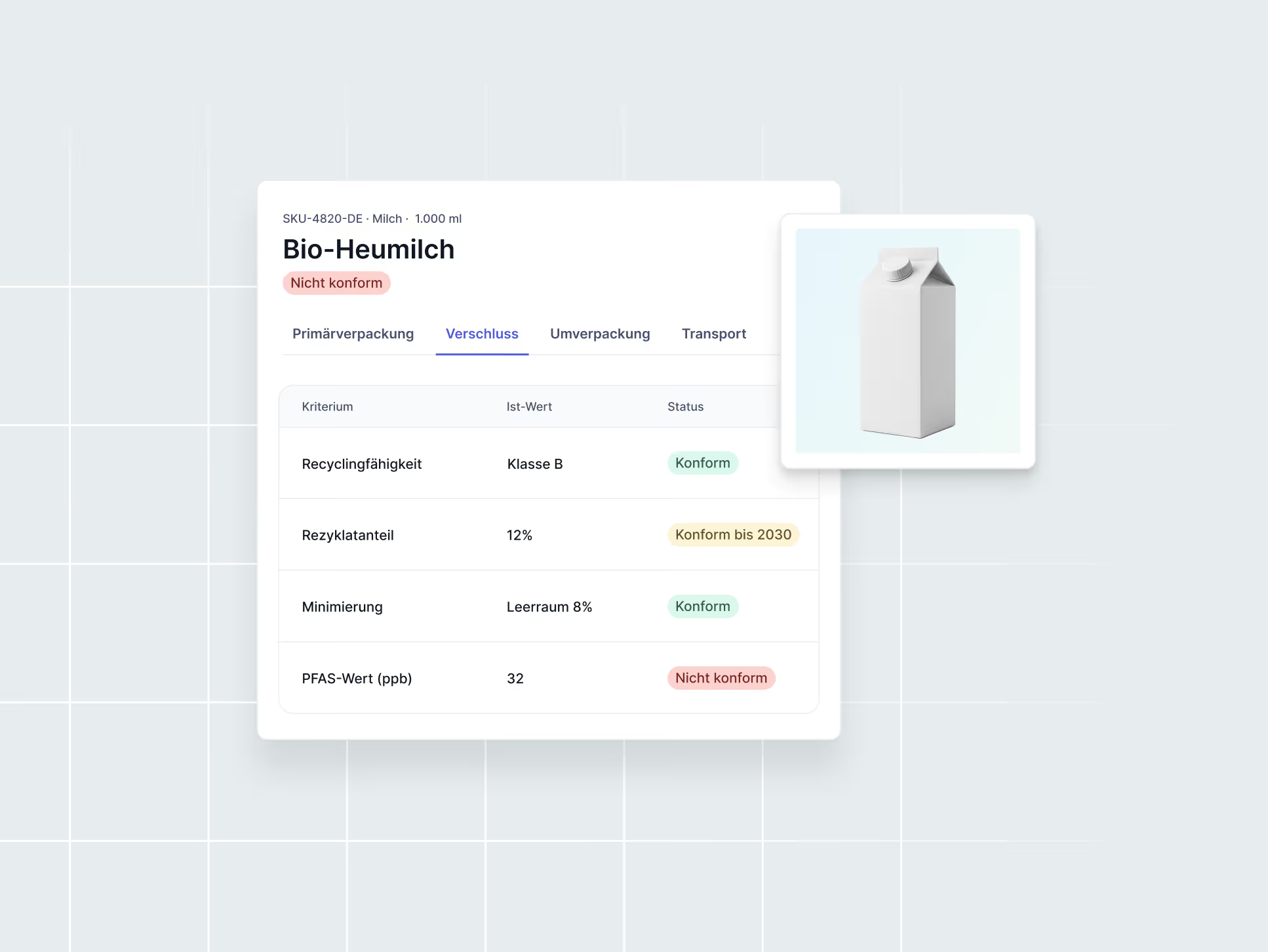
Manufacturers must draw up an EU declaration of conformity (DoC) for each packaging type, confirming that their packaging meets the requirements of the PPWR. The accompanying technical documentation must be retained for five years (ten years for reusable packaging). Importers must ensure that a conformity assessment is in place before placing packaging on the EU market. The DoC is thus a central compliance document - and a frequently underestimated driver of effort.
Digital labelling
From 2027, packaging must carry digital data carriers (e.g. QR codes) linking to structured environmental information on material composition, recyclability and reuse options.
Prohibited formats
From 2030, certain single-use packaging formats are banned, including single-portion packaging for condiments, coffee creamers and sugar in the HORECA sector, as well as unnecessary grouped packaging.
What should companies do now?
The PPWR has been in force since August 2026, and the next deadlines through 2030 are approaching faster than they seem. We recommend taking the following steps:
- Inventory assessment: Which packaging is currently in use - and does it meet the new design requirements?
- Supplier documentation: Recycled content must be verifiable. Start collecting documentation now.
- Clarify EPR obligations: In which EU markets are you active? What registration requirements apply there?
- Prepare declarations of conformity (DoC): A DoC must be in place for each packaging type - ideally obtained and documented in coordination with suppliers well in advance.
- Prepare IT and data processes: Digital labelling and reporting obligations require structured packaging data.
- Review reuse systems: Do you use transport or sales packaging in B2B operations? If so, reuse requirements are relevant now.














































































.avif)





.avif)
.jpg)


