Heller Hintergrund mit grünem, punktförmigem Farbverlauf in der unteren rechten Ecke und subtilem Radialverlauf nach innen
Product Carbon Footprint Software

Audit-ready PCFs for your key accounts, Catena-X and TfS

From bill of materials to PCF report on one data foundation, in line with ISO 14067.
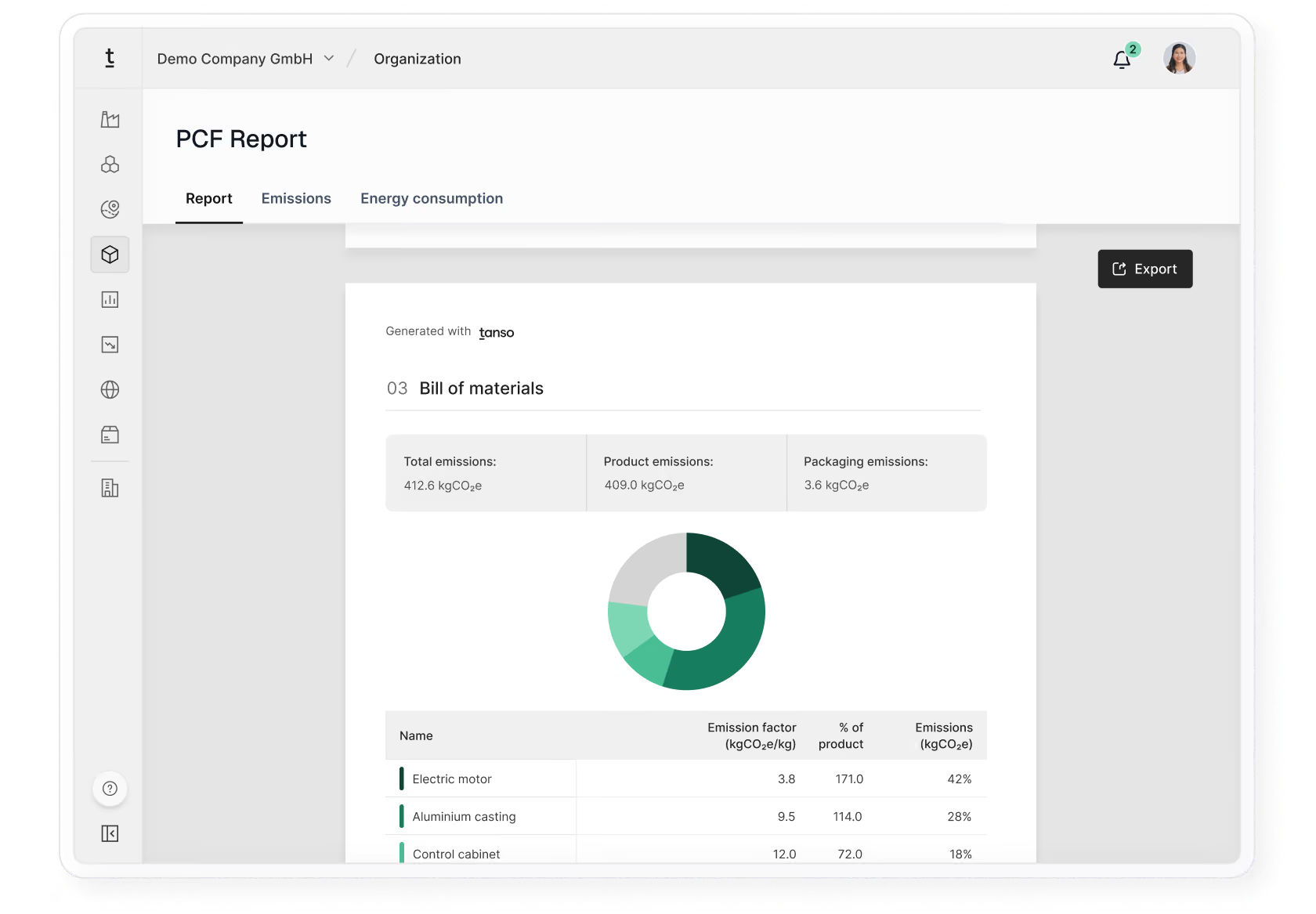
PCF-Bericht der Demo Company GmbH mit Tabs für Bericht, Emissionen und Energieverbrauch. Abschnitt Stückliste zeigt Gesamtemissionen 412,6 kgCO2e, Produktemissionen 409,0 kgCO2e und Verpackungsemissionen 3,6 kgCO2e. Ein Tortendiagramm visualisiert die Emissionsverteilung. Tabelle listet Emissionsfaktoren und Anteil am Produkt für elektrische Bauteile wie Elektromotor mit 42% Emissionen, Aluminiumguss mit 28% und Steuerungsschrank mit 18%. Rechts oben Schaltfläche zum Exportieren, linke Seitenleiste mit verschiedenen Symbolen für Navigation.

What our customers say

ASSMANN
"We first calculated our CCF with Tanso and now our PCF as well. Tanso's holistic approach lets us reuse values we've already determined, which helps us avoid duplicate work and save significant time."
Dr. Julia Koch
Dr. Julia Koch
Sustainability Manager at ASSMANN
iwis
"Tanso is our central solution for carbon accounting and ESG management: a single platform that brings CCF, PCF, and CSRD together seamlessly and creates synergies where duplicate work used to be necessary."
Tatyana Becker
Tatyana Becker
Head of Sustainability Management at iwis
Norder Band AG
"With Tanso, we reduced the effort required for PCF calculations from 1.5 hours to a single click - while simultaneously increasing transparency and data quality."
Thomas Stoelting
Thomas Stoelting
Sales Manager at Norder Band AG
sovity
"For Catena-X data exchange, what matters most is how well the PCF has been prepared in advance. Tanso delivers Catena-X-compliant PCF data that can be calculated efficiently and easily thanks to AI-powered data management. That's exactly the foundation that lets us at sovity calculate and exchange PCF data for our customers across entire value chains."
Sebastian Kleff
Sebastian Kleff
CEO & Co-Founder at sovity
Treibacher
"Today, I can calculate in five minutes how much CO₂ we would save by electrifying a furnace. This level of flexibility would have been impossible in the past."
Sandra Demel-Eckhart
Sustainability Manager at Treibacher

Everything you need for a scalable PCF process

DATA COLLECTION

Collect data efficiently with AI

Automated AI processing of bills of materials and product data sheets
Import from ERP, PLM, and Excel or via API
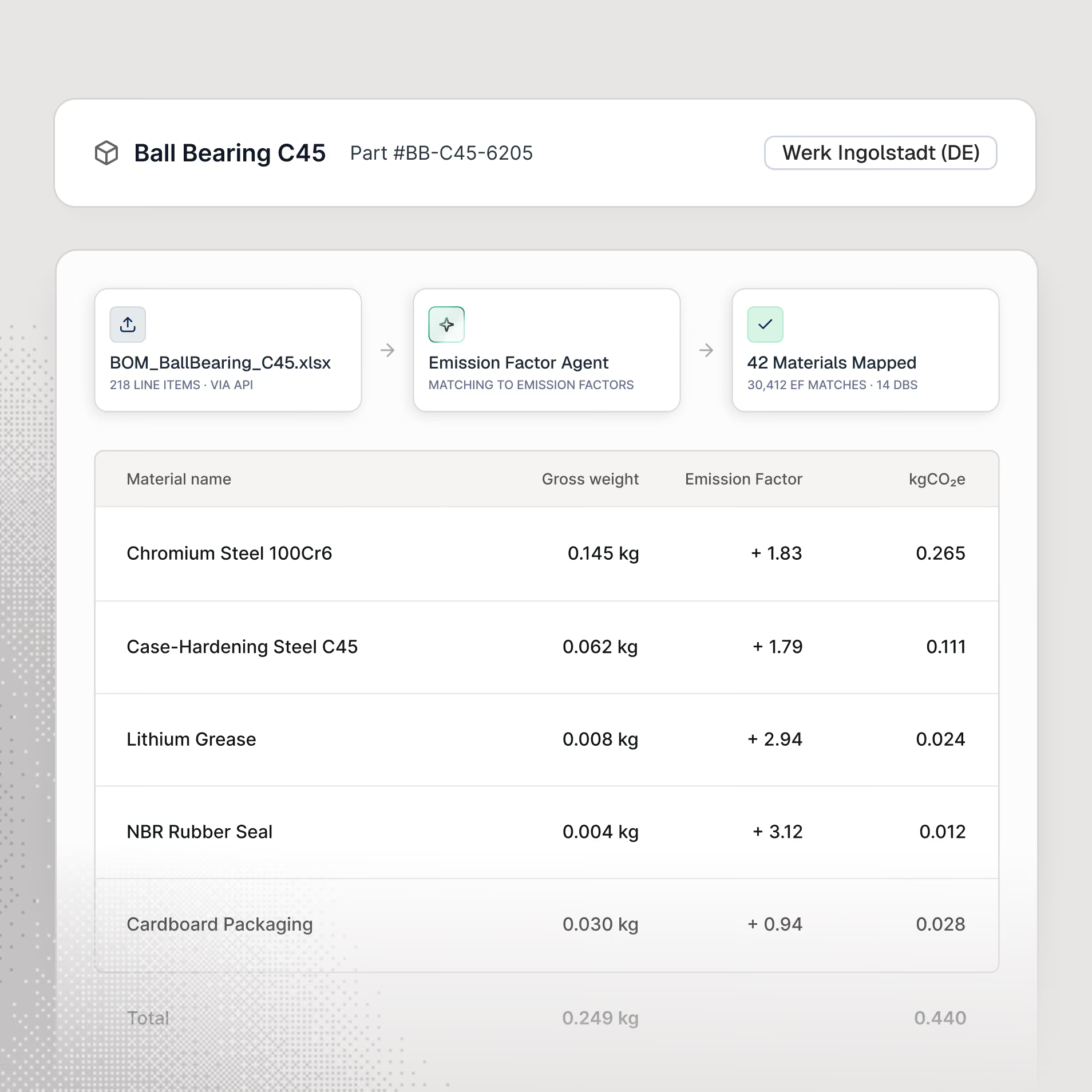
Automated mapping to 30,000+ emission factors from 14 recognized databases
Tabelle zeigt die CO2-Emissionen für Kugellager C45, Werk Ingolstadt. Materialien: Chromstahl 100Cr6 (0,145 kg, Emissionsfaktor 1,83, 0,265 kgCO2e), Einsatzgehärteter Stahl C45 (0,062 kg, Faktor 1,79, 0,111 kgCO2e), Lithiumfett (0,008 kg, Faktor 2,94, 0,024 kgCO2e), NBR Gummidichtung (0,004 kg, Faktor 3,12, 0,012 kgCO2e), Kartonverpackung (0,030 kg, Faktor 0,94, 0,028 kgCO2e). Gesamtgewicht 0,249 kg, Gesamt CO2-Emission 0,440 kgCO2e.
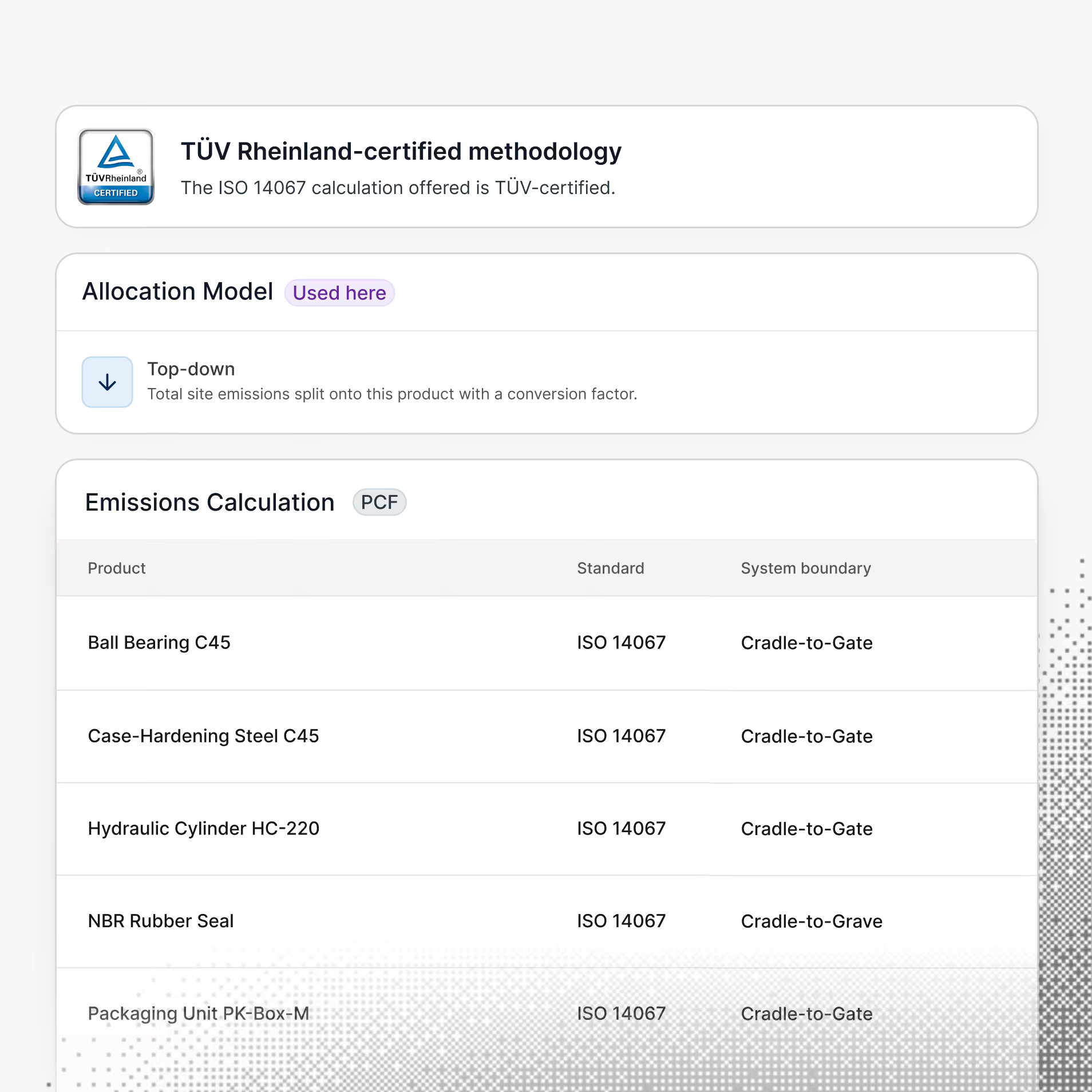
Zertifizierte Methode von TÜV Rheinland für ISO 14067-Berechnung mit einem Top-down-Zuweisungsmodell, das Gesamtemissionen anteilig auf Produkte umlegt. Emissionsberechnungstabelle zeigt Produkte wie Kugellager C45, gehärteten Stahl C45, Hydraulikzylinder HC-220, NBR-Gummidichtung und Verpackungseinheit PK-Box-M, alle nach ISO 14067 mit Systemgrenzen-Auflistung von Cradle-to-Gate oder Cradle-to-Grave.
CALCULATION

Calculate emissions automatically in line with ISO 14067

TÜV Rheinland-certified methodology, consistent across all products
Calculations adapt to your data quality: spend-based, quantity-based, or primary data
Across all life cycle stages: cradle-to-gate and cradle-to-grave
ANALYSIS

Identify optimization potential

Automated breakdown of emission hotspots by product and material
Variant comparison across product configurations to identify reduction levers
Synergies with the CCF calculation for process emissions
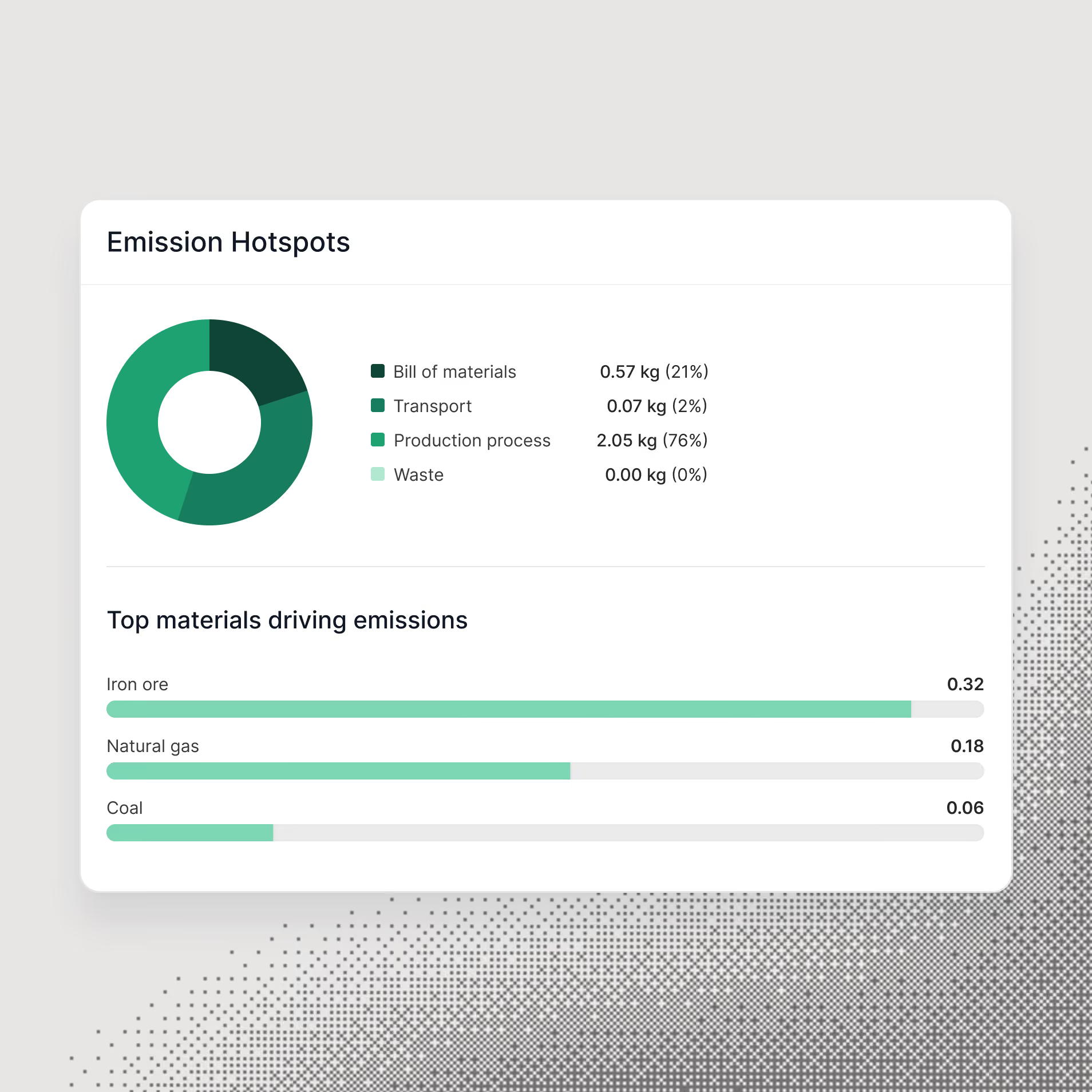
Diagramm zeigt Emissionsschwerpunkte mit einem Ringdiagramm: Materialliste 0,57 kg (21%), Transport 0,07 kg (2%), Produktionsprozess 2,05 kg (76%), Abfall 0,00 kg (0%) und Balkendiagramm der wichtigsten Materialien für Emissionen: Eisenerz 0,32, Erdgas 0,18, Kohle 0,06 Kilogramm.
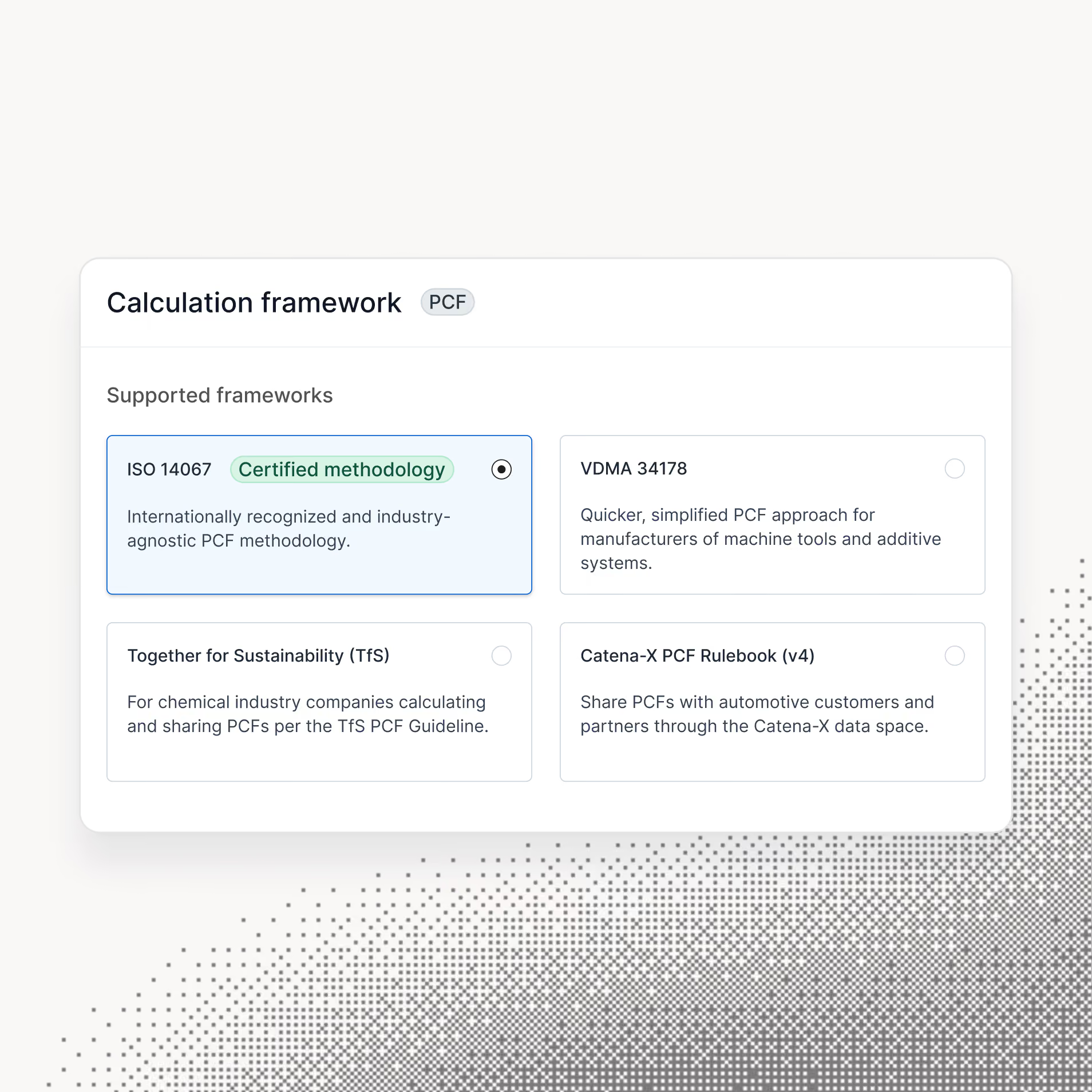
Berechnungsrahmen PCF mit vier unterstützten Frameworks: ISO 14067 zertifizierte Methodik mit international anerkannter und branchenneutraler PCF Methodik, VDMA 34178 für schnellere, vereinfachte PCF-Berechnung für Maschinenbauer und additive Systeme, Together for Sustainability für chemische Industrie zur Berechnung und Teilung von PCFs nach TfS Richtlinie, und Catena-X PCF Rulebook (v4) zum Teilen von PCFs mit Automobilkunden und Partnern über den Catena-X Datenraum.
CUSTOMER REQUIREMENTS

Meet industry-specific requirements efficiently

Standard-compliant exports for Catena-X, TfS, EcoVadis, and custom customer formats
Support for industry-specific frameworks (FLAG for food, VDMA for mechanical engineering, PCR for other industries)
Preparation for the Digital Product Passport (DPP)
COMMUNICATION

Communicate effectively with customers and auditors

Customizable PCF reports at the click of a button
Audit trail and approval workflows for certification-ready results
Direct API transfer to OEM systems via the Catena-X connector
PCF-Bericht der Demo Company für den TorqueGuard TG-14 Aktuatorantrieb mit Bild des Produkts, Ausgabe am 10.09.2026, Berichtszeitraum 2026, Produktionsstätte Berlin, Systemgrenze Cradle-to-Gate.

Three product options, one scalable process

PCF

Pragmatic entry point

TÜV-certified methodology with AI support for varying data quality

Immediate results for customer requests. Ideal for companies that need to respond quickly to their first PCF requests

Core features: automated PCF calculation from bills of materials, AI support for data gaps, standard-compliant customer communication

PCF PRO

Optimization and steering

Understand product emissions and reduce them strategically

For companies with complex products, hierarchical bills of materials, and industry-specific requirements

Core features: hierarchical bills of materials and an extended component library, variant comparisons for reduction planning, industry-specific standards (FLAG, PCR, Catena-X, TfS), preparation for DPP

PCF API

Portfolio scaling

Automated PCF calculation across your entire product portfolio

Add-on for customers who want to scale calculations after a successful initial calculation

Core features: OpenAPI 3.1.0 specification for easy SDK generation, separate sandbox and production environments, direct connection to ERP and data warehouses, secure data transfer (HTTPS, TLS 1.2+, Azure Frankfurt)

Results with Tanso

70%

faster PCF creation

3x

more accurate emission factor mapping

PCF standards for your industry

Automotive

Catena-X

ISO 14067 with specific extensions for automotive data exchange

Standardized communication with OEMs via defined interfaces

API connection for direct data transfer to OEM systems

Partnership with sovity as a certified connector provider

Chemicals

Together for Sustainability
chemicals

TfS PCF Guideline based on ISO 14067 with chemical-specific rules for allocation, by-products, and system boundaries

Chemical-specific allocation rules and system boundaries

Clearly defined, comparable methodology for external audits

Compatibility along the value chain

Mechanical engineering

VDMA
mechanical engineering

VDMA Product Category Rules as an industry-specific methodology for machinery and plant engineering

Selectable for each product in addition to ISO 14067

Choice of methodology between VDMA PCR and ISO 14067 for each product

Consistent audit trail across both methodologies

Your PCF in five steps

01

Import bill of materials

Import from ERP, PLM, or Excel
AI-powered processing of bills of materials and product data sheets, even with deep nesting
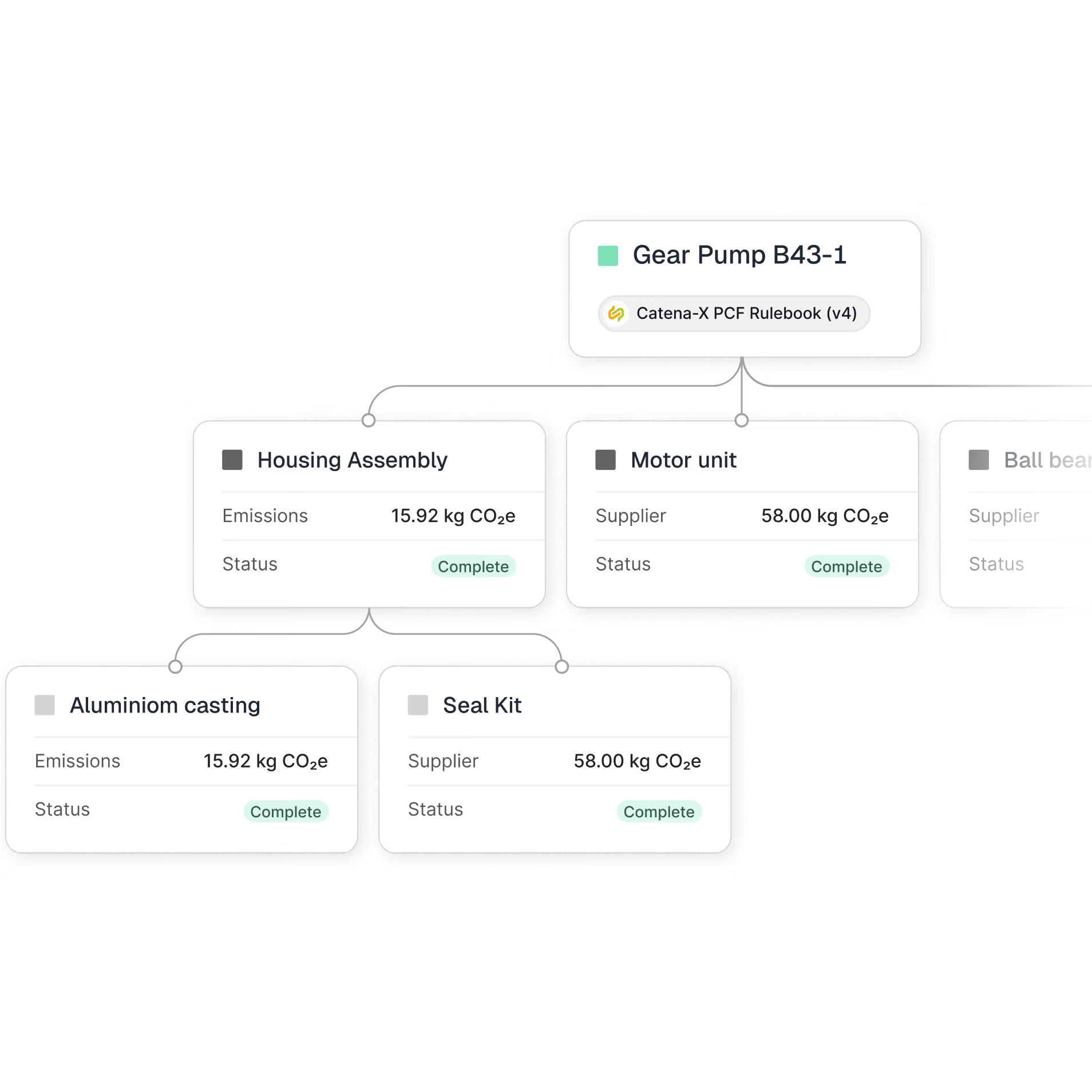
Diagramm der CO2-Emissionen der Zahnräderpumpe B43-1 mit Catena-X PCF Rulebook (v4). Die Housing Assembly zeigt 15,92 kg CO2e Emissionen, Status komplett. Motor unit hat 58,00 kg CO2e Emissionen, Status komplett. Aluminiumguss hat 15,92 kg CO2e, Status komplett. Seal Kit zeigt 58,00 kg CO2e, Status komplett. Ball bearing ist auch dargestellt.
02

Map materials and processes

Automated mapping to 30,000+ emission factors from 14 recognized databases
Manual adjustment and prioritization when needed
Übersicht der Emissionsfaktor-Zuordnung mit über 30.000 kuratierten Faktoren, 14 Datenbanken und mehr als 1.000 entwickelten Faktoren, dargestellt an Produkten Aluminiumgehäuse, CNC-Bearbeitung und Kupferdraht, alle mit dem Status 'Abgeglichen'. Rechts neben der Tabelle sind Logos von Organisationen wie BAFA, ecoinvent, DBEIS, EPA, GLEC und UBA zu sehen. Unten links steht 'Tanso Emission Factor Agent'.
03

Calculate your PCF in line with ISO 14067

TÜV-Rheinland certified methodology across all life cycle stages
Calculations adapt to your data quality: spend-based to get started, quantity-based for higher precision
Grafik zeigt den Produktlebenszyklus des TorqueGuard TG-14, ein mechanisches Bauteil mit Metallzahnrädern. Die CO2-Emissionen sind nach ISO 14067 in Kilogramm angegeben: Rohmaterialien 7,64 kg, Produktion 5,09 kg, Transport 1,91 kg, Ende der Lebensdauer 1,28 kg. Der Lebenszyklus wird von der „Wiege zur Werkstor“-Phase bewertet.
04

Prepare optimization and customer communication

Hotspot identification, reduction measures, and variant comparisons
Reports in customer formats at the click of a button
Diagramm zeigt Ziel zur Reduzierung von Abfall in der Produktion um 45 Prozent mit SBTi-Alignment, Einsparpotenzial von -2.235 Tonnen CO2-Äquivalenten, und prognostizierten Gesamteinsparungen von 30.000 Euro bis 2030 mit Break-even im Jahr 2027.
05

Export and transfer

PCF data export to Catena-X, TfS, EcoVadis, or custom customer formats
Automated transfer to OEM systems via the PCF API
Bericht über den CO2-Fußabdruck 2026 mit Angaben: Berichtszeitraum jährlich, Geschäftsjahr 2026, Gesamtemissionen 412,6 kgCO2e, erstellt von Tobias Lehmann, E-Mail t.lehmann@beispiel.de. Export- und Übertragungsstatus zeigt Synchronisation mit Catena-X.

More PCF resources

Talk to our PCF experts.

During the meeting, we'll show you:
Your specific use cases: first PCF calculation, complex products, or portfolio scaling
A live demo of the platform with examples from your industry
How Tanso fits into your existing IT landscape (SAP, PLM, ERP)
Blaues Quadrat mit weißem ISO-Logo: stilisierte Weltkugel und ISO-Schriftzug oben rechts
ISO/IEC 27001
Runde EU-Flagge mit gelbem Sternenkranz auf blauem Grund
GDPR compliant
Abstraktes, zweifarbiges Icon: oben roter, unten goldgelber horizontaler Halbkreis, klare Kanten, flache Darstellung
Developed & hosted in Germany
Request a consultation
Türkisfarbene, gepunktete Farbschicht verläuft diagonal über dunklen Hintergrund, wirkt wie digitaler Farbschleier

Frequently asked questions

How do I calculate PCFs for products with deeply nested bills of materials?

Tanso PCF Pro supports hierarchical bills of materials and an extended component library. Changes to materials or suppliers propagate automatically through the entire structure, without having to rebuild the dataset.

Does Tanso PCF prepare for the DPP?

Yes. The data captured in Tanso PCF Pro forms the methodological foundation for a later extension to the Digital Product Passport (DPP). As soon as these requirements apply to your product category, your existing PCF dataset can be extended without re-entering data.

Can Tanso calculate PCFs with incomplete data?

Yes. The calculation methodology adapts to the available data quality: you start spend-based with secondary factors and later switch to quantity-based calculations with primary data from the supplier portal, without having to rebuild the system.

Does Tanso support Together for Sustainability (TfS) for the chemical industry?

Yes. The TfS PCF Guideline is based on ISO 14067 with specific extensions for chemical processes. Tanso calculates PCFs using industry-specific parameters for the chemical industry and exports the results in TfS format.

What is the difference between PCF, PCF Pro and PCF API?

PCF is the pragmatic entry point for companies receiving their first PCF requests. PCF Pro addresses complex products with hierarchical bills of materials and industry-specific requirements such as FLAG, PCR or Catena-X. PCF API is the add-on for automated PCF calculation across the entire product portfolio, connected to your ERP or data warehouse. All three versions share the TÜV-certified methodology and ISO 14067 compliance.

How does Tanso fit into our ERP or PLM system?

Tanso PCF and PCF Pro are ERP, PLM and data lake compatible. You get started with structured CSV imports. For scaled use across the entire portfolio, the PCF API is available with an OpenAPI 3.1.0 specification and separate sandbox and production environments.

How do I deliver PCF data for Catena-X requests from my OEM customers?

As PCF software, Tanso is Catena-X compatible. You calculate the PCF according to ISO 14067 in Tanso and export the results in the Catena-X standard format. For direct API transfer to OEM systems such as Mercedes, we work with sovity as a certified connector provider.

weißes Logo mit dem Schriftzug tanso auf schwarzem Hintergrund, abgerundete Kleinbuchstaben, modernes Logo.

Tanso is the ESG and carbon accounting software trusted by industrial companies across the DACH region to stay competitive and compliant.

700+ industrial companies trust Tanso
Stay in the loop

ESG and carbon updates from industrial practice, straight to your inbox.