With increasing transparency requirements from customers and investors, as well as legal requirements such as the Corporate Sustainability Reporting Directive (CSRD) and the EU Taxonomy, carbon accounting is becoming an increasing focus for industrial companies. In the future, CO₂ emissions must be recorded in a transparent, verifiable, and comparable manner - not only at the corporate level (corporate carbon footprint), but increasingly also at the product level (product carbon footprint).
For companies, this means that processes and data must be scalable, digitally networked, and verifiably audit-ready. Choosing the right carbon software thus becomes a strategic lever for decarbonization and regulatory compliance.
Why do companies rely on specialized carbon management software
Industrial companies with complex production and supply chains in particular face the challenge of processing large amounts of data from different sources centrally and in accordance with standards. Specialized carbon management software automates this data collection across locations, production processes, energy sources, and supply chains, enabling complete, audit-ready accounting across all scopes in accordance with recognized standards. Scope 3 emissions in particular - which account for the largest share of the total footprint in many industrial sectors - are difficult to measure reliably or improve efficiently without specialized software.
Challenges of manual data collection
Manual collection of CO₂ data is increasingly inefficient, error-prone, and difficult to scale. Decentralized spreadsheets, a lack of standards, and poor data quality make it difficult to verify balances and increase the effort required for reporting and audits.
Without specialized software, companies quickly reach their limits:
- High time and resource requirement: Manual data collection, preprocessing, and verification tie up enormous internal capacities and prolong reporting cycles.
- Prone to errors: Manual entries and heterogeneous sources often lead to inconsistencies, transmission errors, and unverifiable results.
- Low data quality and lack of transparency: Data is often scattered across departments or systems, resulting in a lack of consistency, traceability, and timeliness.
- Regulatory risks: Without standardized processes, there is an increased risk of not fully complying with reporting requirements or not complying in a legally compliant manner.
- No overview of Scope 3 emissions: Scope 3 can hardly be accurately mapped without automated supply chain data—a key risk for industrial companies.
- Lack of scalability: As companies grow or reporting requirements increase, Excel-based work quickly reaches its limits.
Advantages of carbon management software
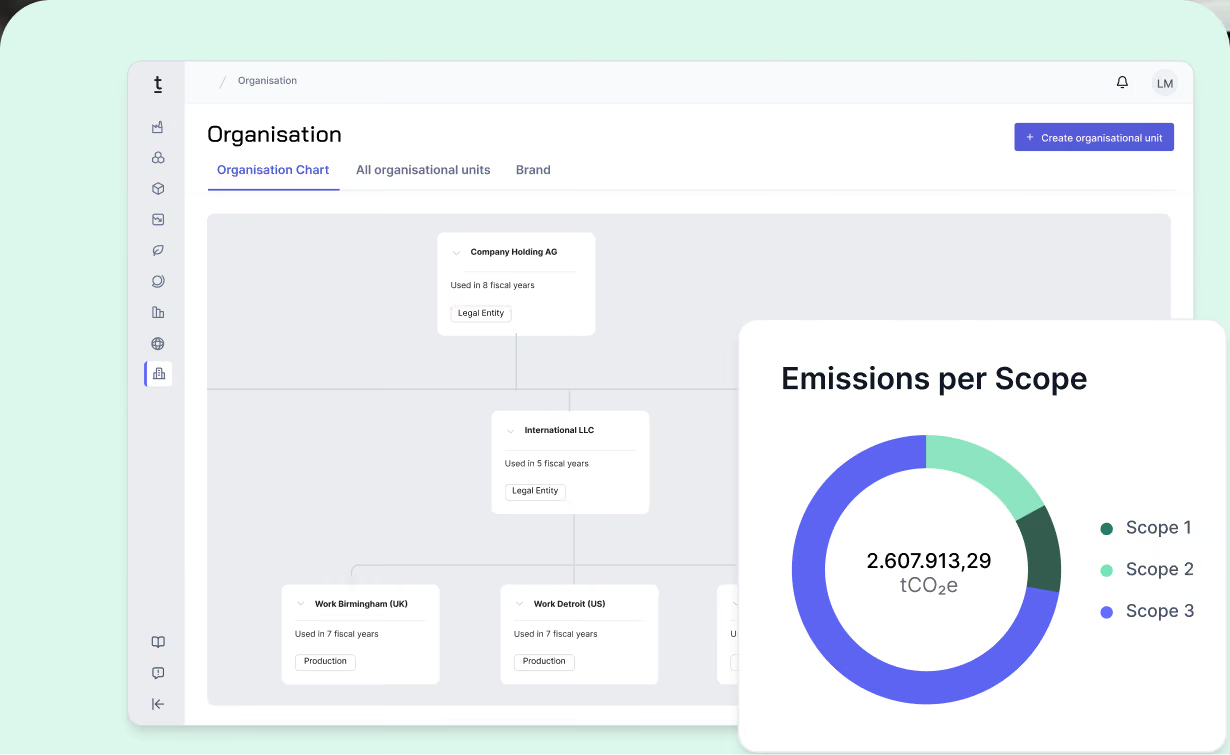
Carbon management software such as Tanso offers companies a centralized, efficient, and standardized solution for systematically recording, analyzing, and transparently reporting their environmental data. This brings both operational and strategic advantages:
- Fast & efficient: Automated data collection and emission factors save up to 80% of reporting time.
- Audit-ready data & standard security: Accounting according to GHG Protocol/ISO – legally compliant and verifiable, including Scope 1-3.
- High data quality & transparency: Uniform database, clear traceability, and fewer errors thanks to automation.
- Regulatory certainty: Reports for authorities, customers, or investors can be generated centrally and in a standardized manner.
- Targeted emission reduction: Hotspot analyses and scenarios help to identify potential savings and implement measures.
- Competitive & cost advantages: Sustainable processes improve credibility and reduce energy and process costs in the long term.
- Scalable & future-proof: Grows with company size and requirements – from CO₂ balance to comprehensive ESG reporting.
Top 5 carbon management software solutions at a glance
Companies are increasingly faced with the task of recording and managing their CO₂ emissions in a structured manner. The following section presents key software providers that offer suitable solutions for this purpose.
1. Tanso
Tanso offers integrated carbon management software that covers all corporate and product carbon footprint and emission reduction requirements in a central environment. The solution combines AI-supported data collection, a reliable emissions methodology, and seamless system integration. With its modular, ISO-certified CCF and PCF modules, it reliably meets all modern climate accounting requirements. In combination with the standard-compliant ESG modules, Tanso meets all requirements for modern sustainability software, including multi-reporting for CSRD, GRI, VSME, EU taxonomy, EcoVadis, CDP, and SAQ 5.
Tanso places particular importance on data quality, automation, and integration depth: Companies can record their CO₂ data consistently, auditable, and across locations along the entire value chain. The platform maps the entire carbon footprint process – from the corporate carbon footprint (Scope 1-3) to detailed product carbon footprints according to ISO standards to scenarios, reduction measures, and continuous monitoring. This creates a central “single source of truth” for all climate-related information and a reliable basis for decarbonization strategies. Tanso's software solution is aimed in particular at medium-sized and larger industrial and manufacturing companies.
Key features:
- CCF and PCF calculation according to ISO standards, TÜV-certified and supplemented by the Greenhouse Gas Protocol for transparent and consistent emissions data
- AI-based data management for automated collection, refinement and analysis of CO₂ emissions data
- Seamless integration into existing IT landscapes, including SAP, Microsoft Dynamics 365 and ProAlpha, among others
- Hotspot analysis and progress tracking, as well as scenario comparisons and reduction recommendations
- Structured approval systems for audit-proof traceability
- Comprehensive analysis options with user-defined dashboards
2. ClimatePartner
ClimatePartner is carbon management software that supports companies in recording, calculating, and reducing their greenhouse gas emissions. The platform offers functions for corporate and product carbon footprints, automated data collection along the value chain, and monitoring of reduction measures. The solution is primarily aimed at medium-sized and larger companies.
Key features:
- Emission factor assignment and data verification
- Uses recognized standards such as the Greenhouse Gas Protocol for CCF and PCF calculations
- Offers emission hotspot analyses, scenario models, and the option to define reduction targets and measures
3. SAP Sustainability Footprint Management
With its sustainability portfolio, in particular SAP Sustainability Footprint Management (SFM) and, in addition, the SAP Sustainability Control Tower, SAP offers an enterprise carbon management solution for creating corporate carbon footprints (CCF) and product carbon footprints (PCF). The platform integrates emissions calculations directly into existing ERP, production, and supply chain processes. SAP primarily targets medium-sized and large companies.
Key features:
- Uses AI for emission factor mapping and data harmonization
- Supports CO₂ accounting in accordance with internationally recognized standards such as the GHG Protocol
- Integrations with SAP S/4HANA, other ERP systems, and external data sources are supported via APIs
- No automated derivation of specific prioritized reduction measures
4. Cozero
Cozero is specialized carbon management software that helps companies track, analyze, and reduce their emissions. The platform offers end-to-end carbon management: automated data collection, creation of corporate and product carbon footprints, reduction pathways, scenarios, and monitoring. The solution is primarily aimed at medium-sized and large companies.
Key features:
- Based on international standards such as the Greenhouse Gas Protocol for CO₂ calculations
- Includes module functions for identifying emission hotspots
- API interface for connecting existing systems and exchanging emission data
- No AI-based data management for automated data collection
5. FRED
FRED is a carbon management software that focuses primarily on calculating the corporate carbon footprint (CCF) and the product carbon footprint (PCF). The platform works with standard-compliant methods and provides relevant emissions data on materials and production processes. FRED is primarily aimed at manufacturing companies.
Key features:
- Uses standard-compliant methods for CCF and PCF based on relevant ISO standards
- Basic functions for tracking CO₂ trends
- Does not use AI-based data management for automated data collection
- Does not have an official API or ERP interface
Measurable decarbonization with the right carbon management software
Reliable carbon management software helps companies record, evaluate, and reduce emissions in a structured manner over the long term. It provides clarity about emission sources, enables consistent calculations according to recognized standards, and simplifies compliance with regulatory requirements. This creates a solid foundation for climate management decisions.
Experience with solutions such as Tanso shows that specialized platforms offer significant advantages for many companies: They take complex supply chains into account, support CCF and PCF calculations according to recognized standards, and offer functions for reduction planning and progress tracking. This not only enables carbon management to be implemented efficiently, but also allows it to be used in a targeted manner to make rational decisions, reduce risks, and strengthen long-term competitiveness.




.avif)