


PPWR deadlines 2026–2040: Complete compliance timeline for companies

Updated on August 13, 2026.
The PPWR is not a one-off deadline, it is a phased implementation plan stretching from August 2026 well into the 2030s. This article maps the key PPWR deadlines in chronological order, explains what specifically applies at each stage and shows which preparations you should be initiating today, even if the actual obligation doesn't kick in for several years.
What applied from 2025?
What applies since February 2025? Since February 11, 2025, the PPWR (EU 2025/40) has been in force as directly applicable EU law across all Member States, starting the clock toward the August 2026 application date.
For a full overview of the regulation itself, see our article PPWR explained: EU packaging regulation, timeline, and compliance steps for businesses.
Phase 1) August 2026: The starting line
What applies since August 12, 2026? Since this date, all packaging placed on the EU market must meet the core PPWR obligations: substance compliance, packaging minimization, declaration of conformity (DoC), and EPR registration. There is no transitional period for new goods.
What applies immediately
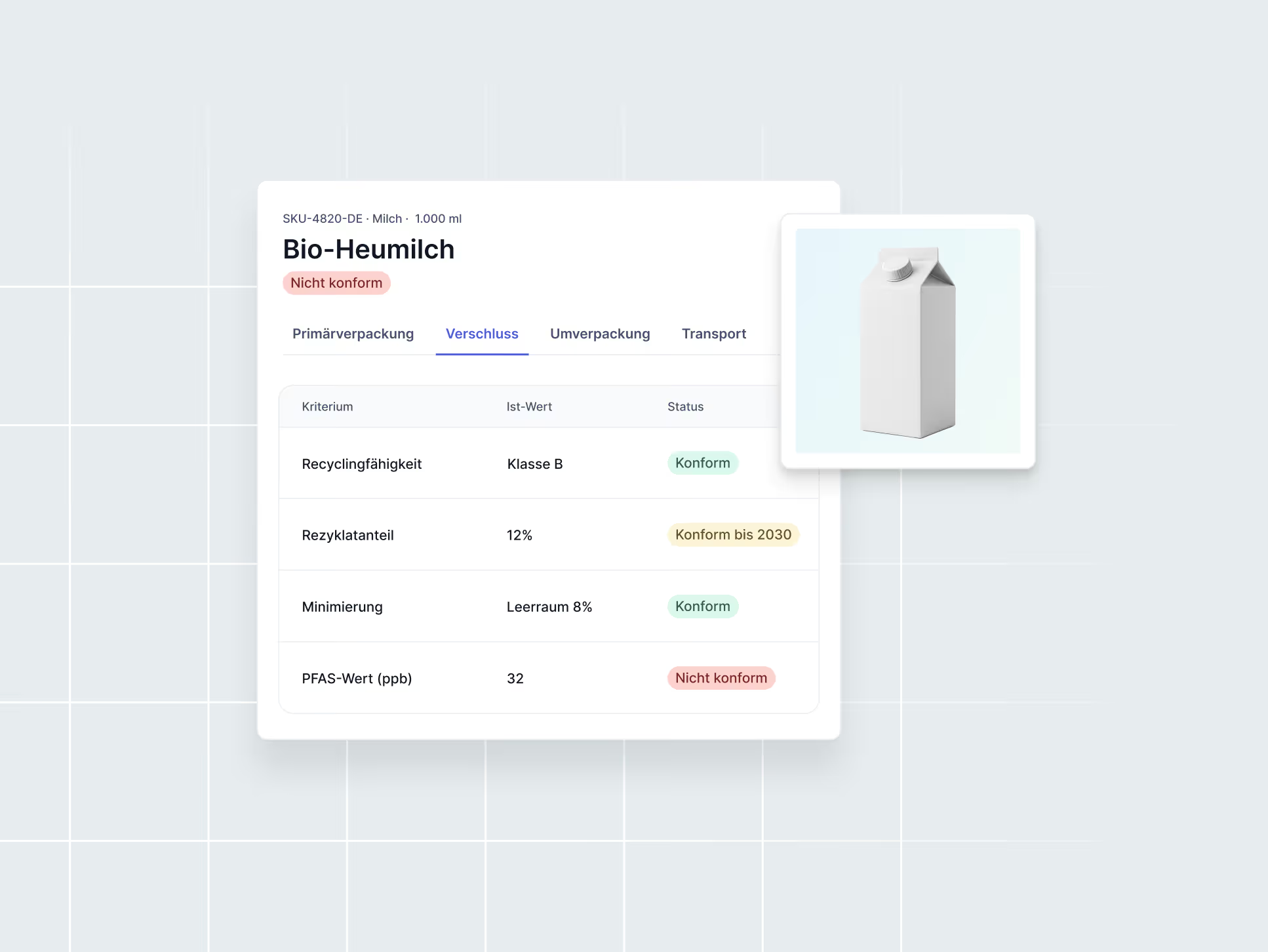
Substances of concern (Article 5): The combined concentration of lead, cadmium, mercury and hexavalent chromium in any packaging must not exceed 100 mg/kg. For food-contact packaging, there is an additional ban on per- and polyfluoroalkyl substances (PFAS). This affects, among other things, grease-resistant coatings on paper cups, pizza boxes and fast-food packaging.
Packaging minimisation (Article 10): Weight and volume must be reduced to the functional minimum. Double walls, false bottoms and superfluous layers must be avoided. For e-commerce packaging, the empty space ratio must not exceed 40% from this date.
Declaration of conformity (DoC): Manufacturers must draw up an EU declaration of conformity in accordance with Annex VIII for each packaging type and maintain the accompanying technical documentation. Importers may only place packaging on the market if such a conformity assessment is in place.
EPR registration: Companies must be registered with the respective national EPR systems in every EU Member State in which they place packaging on the market. In Germany, this means registration in the LUCID register operated by the ZSVR and participation in a dual system, governed by the VerpackDG.
Reuse systems: For reusable packaging already on the market, a functioning reuse system must be in place since August 2026. This primarily affects transport and logistics packaging in B2B operations.
What you should do now
Companies that have not yet started should focus on three priorities:
- Verify substance compliance
- Organise DoC preparation
- Ensure EPR registration across all relevant EU markets
Phase 2) February 2027: HORECA and refill obligations
What applies from February 2027? From February 12, 2027, food service and hospitality (HORECA) establishments must allow customers to bring their own containers for takeaway food and beverages.
The obligation applies to final distributors, i.e. restaurants, cafés, takeaway outlets and hotels offering food and beverages for immediate consumption.
Important: this is a "bring-your-own-container" obligation, the establishment must accept and fill customer-supplied containers. The further obligation to actively offer reusable packaging within a reuse system follows one year later (February 2028).
What you should do now
For HORECA operators and companies supplying this sector: plan processes for handling customer-supplied containers, clarify food hygiene requirements and train staff.
Phase 3) 2028: Design for recycling & labelling
What applies from 2028? From August 12, 2028, harmonized labelling requirements apply EU-wide, and HORECA establishments must actively offer their own reusable packaging within a reuse system.
Design-for-recycling criteria
By 1 January 2028, the European Commission must publish the delegated acts specifying the recyclability criteria and the performance grading system (Grades A to E). These criteria determine whether a packaging format may still be placed on the market from 2030. For companies, this means: once the criteria are published, a de facto two-year countdown begins to assess the entire packaging portfolio and redesign non-compliant formats.
Harmonized labelling
From 12 August 2028, harmonised labelling requirements for packaging apply EU-wide. Packaging must carry standardised material composition information enabling consumers to sort waste correctly. The European Commission is developing uniform pictograms to appear on both packaging and waste receptacles. From this date, Member States may no longer maintain parallel national labelling requirements.
Packaging produced before the deadline benefits from a three-year sell-through period.
HORECA: Reusable packaging offering
From February 2028, HORECA establishments must additionally offer their own reusable packaging within a reuse system for takeaway food and beverages. This means consumers will not only be able to bring their own containers, but also to request reusable ones.
What you should do now
Packaging design cycles typically take 12 to 18 months. Companies that want to be on the market with recyclable packaging by 2030 must begin the transition by 2028 at the latest, ideally earlier. Review your portfolio now for critical formats: composite materials, multi-layer films, packaging with components that are difficult to separate. On labelling: monitor the publication of the EU pictograms and plan print templates and packaging designs so they can incorporate the new labels without triggering a complete redesign.
Phase 4) 2029: Collection systems and digital infrastructure
What applies from 2029? From 2029, single-use plastic bottles and metal cans must achieve a 90% collection rate, digital labelling via QR code becomes mandatory, and the EU-wide packaging register begins replacing national registers such as LUCID.
Deposit and return systems
By 2029, single-use plastic bottles and single-use metal beverage containers (up to 3 litres) must achieve a separate collection rate of 90% through deposit-return or equivalent collection systems. Member States that do not wish to introduce a deposit-return system must submit an application with an alternative implementation plan to the Commission.
EU-wide packaging register
From February 2029, a unified EU packaging register is intended to progressively replace national registers (such as LUCID in Germany). For companies, this means simplification in the medium term, a single platform instead of separate registrations in each Member State. In the short term, however, the migration may involve additional effort.
Digital labelling (QR codes)
Packaging must carry digital data carriers, typically QR codes, linking to structured environmental information: material composition, recyclability, reuse options and sorting instructions. Where the packaged product is already subject to a Digital Product Passport (DPP) under the ESPR, both sets of information should be provided via the same data carrier.
What you should do now
Digital labelling requires a clean product data infrastructure. Verify whether your master data — material composition, weight per component, recyclability grade — is structured in a way that allows machine-readable delivery via QR code. Companies already working on a Digital Product Passport should incorporate PPWR requirements from the outset to avoid building duplicate data architectures.
Phase 5) 2030: The major turning point
What applies from 2030? From January 1, 2030, all packaging on the EU market must be recyclable (at least Grade C), plastic packaging must contain minimum shares of post-consumer recycled content, and certain single-use formats are banned.
Recyclability becomes a market access requirement
From 1 January 2030, all packaging on the EU market must be recyclable and achieve at least Grade C (≥ 70 points). Packaging that falls below this threshold may no longer be placed on the market. From 2038, the threshold tightens further: only packaging rated Grade B or above will be permitted.
Minimum recycled content for plastics
Plastic packaging must contain minimum shares of post-consumer recycled content (PCR). The targets vary by packaging type:
From 2030: Contact-sensitive PET packaging (excluding single-use PET beverage bottles): 30% PCR. Contact-sensitive packaging made from plastics other than PET: 10% PCR. Single-use plastic beverage bottles: 30% PCR (carried over from the Single-Use Plastics Directive). All other plastic packaging: 35% PCR.
From 2040: Targets increase to 50%, 25%, 65% and 65% respectively.
Binding reuse targets
From 2030, binding reuse targets apply to specific packaging formats for the first time. Transport packaging for B2B shipments between different economic operators or Member States: at least 40% reusable within a reuse system (70% by 2040). Transport packaging for intra-Member State B2B shipments within the same economic operator: 100% reusable. Grouped packaging in box format (excluding cardboard): at least 10% reusable (25% by 2040). Alcoholic and non-alcoholic beverages: at least 10% in reusable packaging (40% by 2040).
Stricter packaging minimisation
From 2030, tighter minimisation rules apply. Double walls, false bottoms, superfluous layers and misleadingly oversized packaging are explicitly prohibited. The maximum empty space ratio for transport, grouped and e-commerce packaging drops to 50%.
Bans on certain single-use formats
Certain single-use packaging formats will be removed from the market from 1 January 2030: single-portion packaging for condiments, coffee creamers, sugar and similar items in HORECA. Grouped plastic packaging (e.g. shrink wrap around beverage bottles). Single-use packaging for food and beverages consumed on the premises in HORECA. Single-use packaging for fresh fruit and vegetables below 1.5 kg. Miniature packaging for personal care products in hotels.
What you should do now
2030 sounds far off, but the lead times are real: supplier qualification takes 12 to 18 months, packaging redesigns require design cycles plus testing phases, and long-term PCR supply contracts should be negotiated early. Demand for high-quality recyclate will increase, and supply is already tight.
Specifically: assess your entire packaging portfolio for recyclability, ideally against the expected design-for-recycling criteria. Identify packaging types with composite materials, problematic coatings or components that are difficult to separate. Begin sourcing PCR plastics now and secure supply contracts before the market tightens further.
Phase 6) 2035–2040: Long-term tightening
What applies from 2035 and 2040? From 2035, packaging must demonstrably be recycled in practice; from 2038, Grade C is removed; and by 2040, recycled content targets rise to up to 65% and per capita packaging waste must have fallen by 15% compared to 2018.
Important to note: the PPWR provides for reviews by the European Commission at several points, covering the effectiveness of recycled content targets, reuse objectives and empty space requirements, among others. Many industry experts expect that individual targets and deadlines may still be adjusted in the course of these reviews, depending on how recycling infrastructure, recyclate markets and practical implementation across Member States develop.
2035: Recycling at scale
From 2035, packaging must not only be designed for recyclability, it must actually be collected, sorted and recycled in practice, at sufficient scale and on the basis of existing infrastructure. This shifts the focus from theory to reality: it is no longer sufficient for packaging to be recyclable in principle. It must demonstrably be so.
2038: Grade C removed
Packaging with recyclability performance Grade C (70–79%) may no longer be placed on the market from 2038. Only Grades A and B will be permitted.
2040: Higher recycled content and reuse targets
Minimum PCR shares for plastic packaging rise to up to 65%. Reuse targets for transport packaging increase to 70%, for grouped packaging to 25%, and for beverage packaging to 40%. Per capita packaging waste must have fallen by 15% compared to 2018 levels.




































































.avif)





.avif)
.jpg)


