At Mercedes-Benz, climate neutrality is anchored in the terms of contract. The so-called Ambition Letter is a criterion for new awards: those who do not sign it will not be considered. From 2039 onwards, only production materials that are carbon-neutral across all value chain stages will be allowed to pass through factory gates, with battery cells, steel, and aluminum as the focus components, which account for around 80% of CO₂ emissions (Ambition 2039).
This is not a statement of intent, but a procurement decision. And more and more OEMs are now mandating not only what data they expect, but also the channel through which it must be delivered: via Catena-X, for all new contracts.
For suppliers, this changes the question entirely. It is no longer just about whether a Product Carbon Footprint (PCF) is calculated methodically correctly. It is about whether it arrives in the right format via the right channel so that the customer can integrate it directly into their own reporting.
We have described what Catena-X is and how the PCF Rulebook version 4 differs from ISO 14067 in this article , and the methodological transition in this one. This article picks up from there: with the implementation.
Why OEMs are now requesting PCFs via Catena-X
PCF requests rarely stem from a single obligation. They come from three directions:
Market and customer pressure. Responding to concrete data requirements from major customers, differentiating yourself from competitors, and addressing inquiries proactively rather than reactively.
Regulations and risk management. The Digital Product Passport under the EU ESPR will be introduced in stages starting in 2027. The Scope 3 reporting CSRD and ESRS E1 require data at the product level. With CBAM, the relevance of procurement is becoming increasingly apparent.
Strategy and optimization. Decarbonization through targeted measures at the product level, product development, and product optimization based on CO₂ data.
The path these requirements take through the supply chain is always the same: regulations affect the OEM, the OEM requests PCFs from its suppliers, and these suppliers need primary data for materials like steel or plastic from their own suppliers. Each stage passes on requirements and receives verified emissions data in return.
Ford, Mercedes-Benz, Continental, Bosch, and MAHLE have all published concrete decarbonization targets that rely on data from the supply chain: Ford aims for climate neutrality across its vehicles, operations, and supply chain by 2050; Mercedes-Benz intends to make its entire new vehicle fleet CO₂-neutral across all value chain stages by 2039; Continental is targeting a Scope 1 and 2 intensity of 0.13 t CO₂e per ton of tire production by 2035; Bosch aims to reduce absolute Scope 3 emissions by 30% by 2030; and MAHLE has an SBTi-validated target of a 28% reduction in Scope 3 emissions by 2030. Anyone pursuing such goals needs reliable data from the supply chain, not industry averages.
What OEMs expect from Catena-X PCFs: 5 requirements
OEMs and major customers in the automotive supply chain have five requirements that are now considered standard:
- Primary data instead of average values, especially for materials and energy used
- Calculation based on the standardized Catena-X methodology, currently PCF Rulebook Version 4
- Clear system boundaries (cradle-to-gate) and a defined declared unit
- Seamless documentation and verifiability
- Compatibility with customer reporting via the standardized Catena-X data space
The goal is to ensure comparability between products. This is the only way to derive actionable measures for materials, energy, and the supply chain. The latter point is regularly underestimated in projects: a methodologically sound PCF sent as a PDF email attachment does not meet the requirements.
Successfully implementing Catena-X PCFs
Two hurdles appear in almost every project. Reliable PCFs require primary data, but usually only secondary data or industry averages are available. And without a common standard for calculation and exchange, every customer request triggers a separate, manual process.
These hurdles cannot be overcome all at once. What works is a step-by-step transformation across three maturity levels:
First steps. Select a reference product and collect initial primary data. The goal is to choose the right standard, establish methodology and data transmission, and involve internal stakeholders. The priority is a quick start and a sense of the most important levers, not perfection.
Scaling. Build a modular calculation approach, structure primary data requests, connect to ERP or PLM, and automate initial steps. At this stage, effective reduction measures can be considered for the first time.
Industrializing. Continuous PCF calculation, integrated into the quoting process, with a high degree of automation in calculation and transmission. The analysis of cost drivers and emission reductions becomes part of the product strategy.
What the Catena-X data space connection specifically requires
Catena-X standardizes not just the calculation, but the entire chain: the rulebook for calculation, an open-source data model (currently PCF 9.0.0), the discoverability of product data within the network, granularly controllable access permissions, the exchange process itself, and uniformly defined APIs.
The technical basis for the exchange is the EDC, short for Eclipse Dataspace Components, often simply called a connector. It is responsible for data exchange and authentication between two partners. For the PCF use case, there is a dedicated, publicly accessible standard (CX-0136), which, in addition to the connector, includes digital twins for product identification, among other things.
This leads to a make-or-buy decision. Experience shows that anyone setting up all components themselves and subsequently having the overall solution certified will need several months. Those who use an already certified solution only need to upload PCF data; the time-critical factor then becomes contract negotiation, not the technology.
The process consists of five steps:
- An automotive manufacturer requests the PCF for a component via the Catena-X data space.
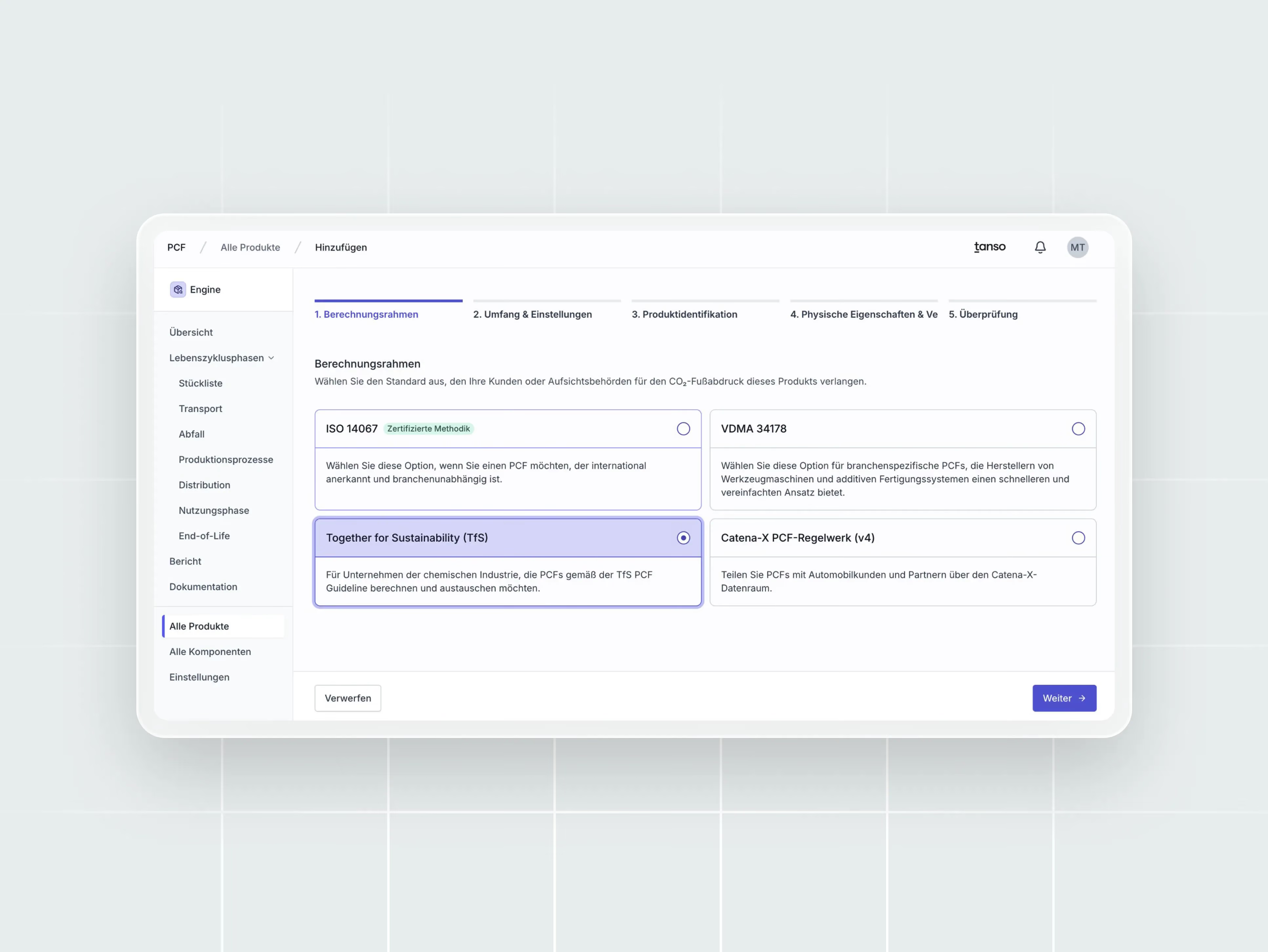
- Calculate the PCF in Tanso according to the Catena-X rulebook.
- Results are shared via the data space connection in sovity.
- Companies retain full control and data sovereignty throughout the process. Exchanges take place exclusively between the respective partners.
- Updates are automatically sent to all connected customers.
A single integration serves all customers who rely on this standard. No switching between portals, no individual data formats. The same data also forms the basis for Scope 3 reporting under the CSRD, the EU Battery Regulation, and CBAM requirements.

Up to €30,000 in funding: the Data Space Accelerator
The Data Space Accelerator program of the International Data Spaces Association (IDSA) is a publicly funded initiative designed to lower the barriers to entry for industrial data spaces such as Catena-X, Chem-X, and Semiconductor-X. The effort involved in productive data exchange is reimbursed in two stages. In both cases, a productive exchange with at least one customer is required.
Basic Path: €15,000 for the exchange of company certificates via Catena-X, such as ISO 9001. The effort required in terms of content is low, but the technical access is the same as what you will need later for PCFs.
Advanced Path: €30,000 for expanding data exchange to include an additional use case, such as the PCF.
Registration, onboarding, productive exchange, and participation in the reimbursement program are the four steps. Places are limited, and the program only runs until the end of the year. It is best to check directly on the program page to see if your company meets the participation requirements.
Checklist: six steps to Catena-X PCF readiness
- Define scope and responsibility: relevant products, internal responsibilities, and applicable PCF standards.
- Create a customer request inventory: collect all PCF, CO₂, and sustainability inquiries from the last twelve months. These requests often reach Sales or Customer Service first, rather than the sustainability department.
- Plan data space integration: plan for Catena-X integration early, as it requires lead time.
- Check for financial support: evaluate the relevance of the Data Space Accelerator funding and apply if applicable.
- Calculate PCFs: create data, perform calculations, and prepare a format compliant with the data space.
- Continuous improvement: expand data quality and the data foundation, and update PCFs regularly.
Why Catena-X is also worthwhile for non-automotive suppliers
Catena-X is live today, but it is not alone. Factory-X for plant and factory equipment manufacturers, Aerospace-X for the aerospace industry, Semiconductor-X for semiconductors, and Chem-X for the chemical industry are all built on the same technological foundation, using open-source standards and data models across all sectors.
For suppliers without a purely automotive business, this is the crucial takeaway: anyone who builds a Catena-X-capable connection today covers a significant portion of what is coming from other industries.