


CSRD reporting and auditing: success factors and tips


The requirements for sustainability reporting present significant challenges for many companies. Under the CSRD (Corporate Sustainability Reporting Directive), significantly more companies originally became subject to reporting obligations, including non-listed companies. However, the EU Omnibus package subsequently narrowed the scope: as things stand, only companies with more than 1,000 employees and over €450 million in net revenue are subject to reporting requirements, while first-time application for the second and third waves was pushed back to fiscal year 2027 (reporting in 2028). The integration of comprehensive sustainability performance KPIs into regular management reports nonetheless continues to add complexity. For the first time, both financial and impact-related materiality aspects are taken into account, enabling a holistic perspective on the interactions between companies, the environment, and society
Steps before the sustainability report audit
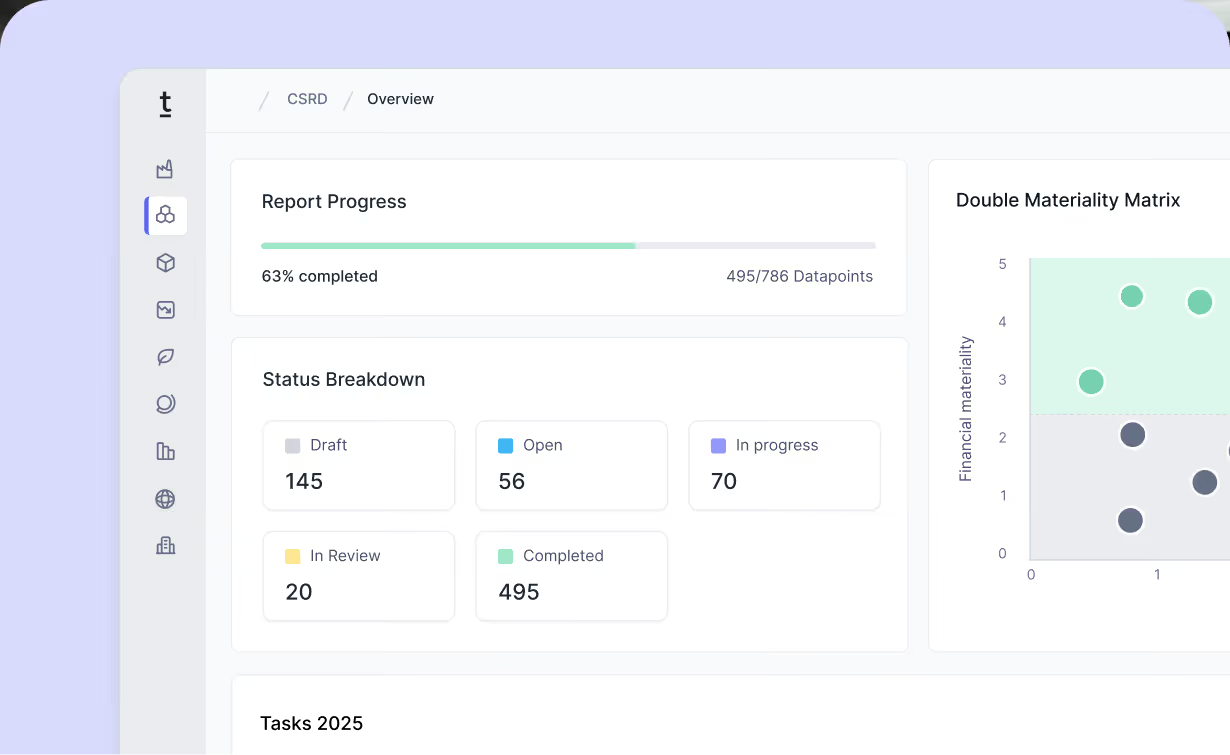
The first step in the CSRD report process is conducting a double materiality assessment (DMA) to identify the key sustainability matters for the company. Based on this, structured processes for data collection should be established to ensure the regular collection, aggregation and evaluation of relevant data while simultaneously ensuring its quality. The next step is to create a report in which the current status, defined targets, measures and progress made are communicated clearly and comprehensibly in a non-financial management report. Finally, an auditor subjects the sustainability report to a comprehensive audit to ensure compliance with legal requirements and the reliability of the reported information.
Changes to reporting structure under the CSRD
Management report before the CSRD
The introduction of the CSRD makes sustainability reporting an integral part of financial reporting and entails a mandatory audit of these reports. Prior to the application of the CSRD, the management report mainly comprised traditional elements such as the analysis of the development and performance of business activities, the expected development, the corporate governance statement and the description of material risks and uncertainties.In addition, a non-financial statement, including the EU taxonomy, could be integrated, although reporting on sustainability issues was previously voluntary.
Management report under the CSRD
With the application of the CSRD, the management report undergoes a comprehensive expansion. In the future, a mandatory sustainability report will form part of the management report. This contains general information as well as information on environmental aspects (E), social issues (S) and governance issues (G), supplemented by the EU Taxonomy. This integration means that sustainability reporting is not only a central component of corporate reporting, but is also subject to a strict audit requirement for the first time. This poses new challenges for companies, but at the same time offers the opportunity to systematically integrate sustainability into their strategic orientation.
Impact of the CSRD on manufacturing companies
The introduction of the CSRD standardizes sustainability reporting and increases the requirements for data quality and reconciliation processes between financial and non-financial information. More extensive disclosure obligations and increased stakeholder expectations require more precise reports. Mandatory auditing increases regulatory requirements and resource requirements. At the same time, sustainability is becoming more integrated into corporate reporting and is therefore becoming a central strategic element.
CSRD assurance levels: limited and reasonable assurance
Sustainability reporting under the CSRD is subject to a multi-stage review process:
Audit with limited assurance
Since 2025/2026, sustainability reporting has been subject to limited assurance. This type of audit ensures that the information provided is plausible and comprehensible, without offering a full confirmation of its accuracy
Planned tightening: Audit with reasonable assurance
The EU Commission was originally required to assess by October 2028 whether a transition to reasonable assurance was feasible, and to issue corresponding assurance standards. This tightening would have matched the level of assurance applied to financial reports and required comprehensive verification of the data. The EU Omnibus package removed this planned obligation: as things currently stand, sustainability reports will remain permanently subject to limited assurance
Who is authorized to audit a sustainability report
Sustainability reports are audited by an auditor, an auditing firm or the auditor of the annual or consolidated financial statements. Independent audit service providers are currently not permitted as they do not meet the national and European quality standards for auditing sustainability reports. In practice, in most cases the auditor of the annual or consolidated financial statements also takes responsibility for the audit of sustainability reporting. This approach guarantees a consistent assessment of financial and non-financial reporting requirements and ensures high-quality and reliable reporting.
4 tips for working with your auditor on CSRD reporting
Effective collaboration with the auditor is crucial for successful implementation of CSRD in the organization. The following success factors play a key role here:
Consistent planning of the CSRD audit process
The structure of a modular CSRD implementation project forms the basis for successful implementation. This involves defining clear objectives and milestones that are tailored to both the needs of the company and the requirements of the auditor. This structured approach ensures transparent planning and efficient implementation of the new reporting requirements.
Early involvement of the auditor
Early appointing and close coordination with the auditor are essential to ensure smooth cooperation. The requirements, the scope of the audit and the required documents should be clearly defined at an early stage of the project in order to avoid delays and ensure efficient implementation.
Clear communication with the auditor
A continuous exchange of information with the auditor about progress, assumptions, challenges and results is crucial for successful collaboration. Creating transparent processes will prevent misunderstandings and ensure efficient communication that supports the audit process.
Comprehensive data management for the audit
The completeness and reliability of all relevant data must be ensured in order to guarantee sound and comprehensible reporting. An integrated data management system that is directly agreed with the auditor facilitates the availability and verification of the required information and contributes to efficient collaboration.
Recommendations for reducing the effort of CSRD reporting
The implementation of CSRD requirements requires a systematic approach that begins with a clearly documented double materiality assessment. Audit-proof data collection processes, transparent reporting and the creation of efficient audit structures are crucial to ensure complete traceability and smooth cooperation with auditors. Considering these processes and requirements at an early stage can significantly reduce the workload and ensure that the processes are both suitable for documentation and auditing. With precise planning and coordinated processes, companies can not only meet the requirements of the CSRD, but also use sustainability reporting as a strategic tool for transparency and long-term value creation.
















































































.avif)





.avif)
.jpg)


