While the CSRD regulation explicitly recommends comprehensive reporting across all Scope 3 categories, it allows certain categories to be excluded from your Corporate Carbon Footprint (CCF) inventory, provided that you provide a valid justification. Typical reasons for excluding certain Scope 3 categories include:
Non-material emissions: Some Scope 3 categories may not be relevant to your organization because you do not have any corresponding activities. For example, Scope 3 Category 14 (Emissions from franchises) does not apply if your company does not operate any franchises.
Data collection challenges: Collecting the data required to calculate emissions in certain Scope 3 categories can prove excessively difficult or time-consuming.
A materiality assessment is a method for determining which Scope 3 categories are material to your organization and which are not. If a category is not material to your organization, you can document the rationale for its exclusion based on the materiality assessment.
Tanso Info
Scope 3 materiality assessment is very different than the double materiality assessment (DMA). In a DMA, you engage with internal and external stakeholders to decide which sustainability topics are material to your CSRD reporting. In a Scope 3 materiality assessment, you engage with internal stakeholders to decide which Scope 3 categories are material to your CCF.
These Scope 3 categories are recommended by Tanso
After analyzing reports from international organizations such as the Carbon Disclosure Project (CDP) and the Science Based Targets Initiative (SBTi), we have compiled a list of Scope 3 categories that we consider material for the manufacturing sector. In addition, Tanso can provide high-quality secondary data to account for emissions in these categories when primary data is unavailable or difficult to collect. These categories are:
Categories
Name
3.1
Purchased goods and services
3.3
Fuel and energy related activities
3.4
Upstream transportation and distribution
3.5
Waste generated during operations
3.6
Business Travel
3.7
Employee commuting
3.9
Downstream transportation and distribution
3.12
End-of-life treatment of sold products
Tanso Info
If you decide to exclude one or more of these recommended categories for CSRD reporting, then you would need to provide a strong justification for excluding them. Once you provide a justification, it will be automatically added to your CSRD report under the E1-6_26 datapoint.
This is not a recommendation of categories to include in your CCF but rather those that don't require a materiality assessment. You must still include other categories if they are material to you.
Which Scope 3 categories require a materiality assessment?
Apart from the above recommended Scope 3 categories, there are 7 additional categories for which you would need to decide whether they are material to you or not. These categories are:
Categories
Name
3.2
Capital goods
3.8
Upstream leased assets
3.10
Processing of sold products
3.11
Use phase of sold products
3.13
Downstream leased assets
3.14
Franchises
3.15
Investments
Decide which Scope 3 category is material for you by following the below mentioned decision trees. The decision trees include questions you should ask yourself and your stakeholders to decide on the materiality of the respective category, and examples on how to phrase your argument when deciding to exclude certain categories.
Assess the materiality of Scope 3.2, 3.14 and 3.15
Assess the materiality of Scope 3.10 and 3.11
Accurately Accounting for Scope 3.8 and 3.13 (GHG Protocol)
If you have full operational or financial control over your upstream and downstream leased assets, you should account for their emissions in your Scope 1 and Scope 2 inventory. This is in line with the GHG Protocol CCF guidelines.
Scope 3 materiality assessment with Tanso
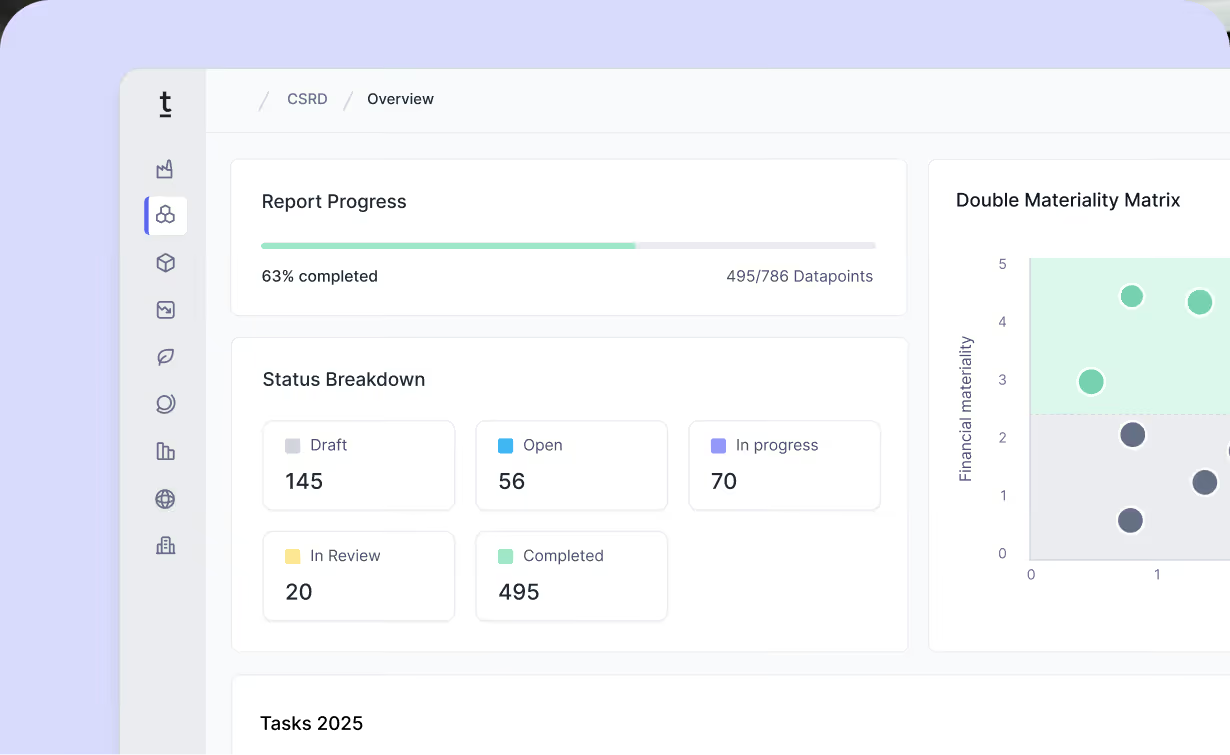
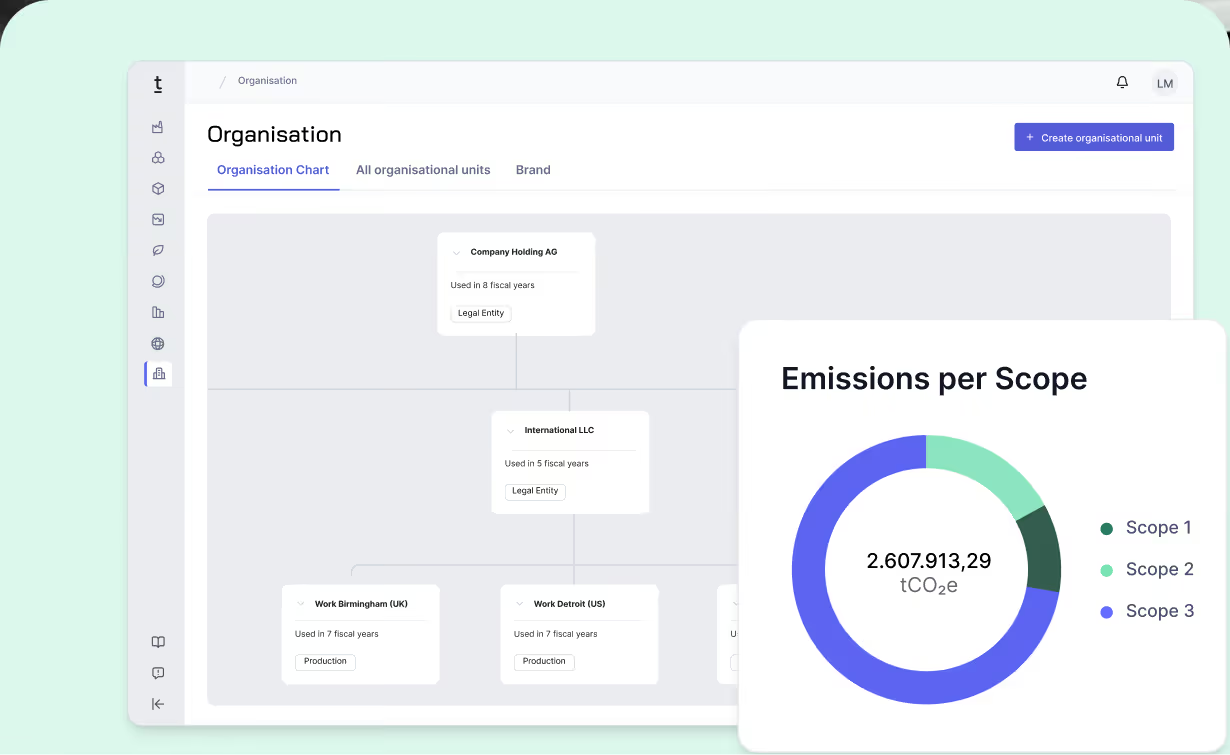
Based on your industry, Tanso suggests the relevant Scope 3 categories, provides high-quality secondary emission factors where primary data is missing, and automatically documents your exclusion justifications in an audit-ready format for your CSRD report, including mapping to data point E1-6_26.



















































































.avif)





.avif)
.jpg)


