


From ISO 14067 to Catena-X PCFs: How to successfully navigate the transition


This article is aimed at companies that already calculate Product Carbon Footprints according to ISO 14067 and want to understand what the step toward Catena-X conformity means in practice. If you are just getting started, we recommend our introductory article on Catena-X first.
Companies already calculating PCFs according to ISO 14067 have the methodological foundation in place. The Catena-X PCF Rulebook builds on ISO and supplements it where ISO leaves room for interpretation. In practice, however, this does not mean that existing processes can simply be carried over unchanged. Some methodological requirements are more specific, others are entirely new, and digital data exchange within the Catena-X ecosystem is a completely new dimension.
This article shows how the transition can be approached in a structured way and what matters methodologically.
The Catena-X Rulebook transition phase: What applies until end of 2027 and why preparation matters now
The Catena-X PCF Rulebook v4 has extended the transition phase for implementation until the end of 2027, specifically to ease the changeover for small and medium-sized enterprises. This means: not all requirements are immediately mandatory. Specifically, this primarily concerns the Primary Data Share (PDS) and the Data Quality Rating (DQR), which only need to be reported in data exchanges after the transition phase. Today, they are still voluntary.
What is already mandatory now: the correct system boundary, cut-off documentation, calculation rules for electricity and recycling, and the basic structure of data exchange.
A common mistake is to postpone the "voluntary" requirements until 2027. However, PDS and DQR require that primary data is collected systematically and data quality is assessed in a structured manner. This is not a one-time effort but a data infrastructure that needs to be built. Companies that only start in 2027 will have virtually no buffer to implement this correctly. On top of that, OEMs like BMW have already integrated Catena-X into their procurement process. Market requirements leave no room for delay.
Four steps to Catena-X readiness
Steps 1 & 2: The organizational foundation
Clarify responsibilities and start the assessment
The first step is internal: How have PCFs been calculated so far? Who is responsible for PCF calculation, and does that person have access to the relevant information along the supply chain?
PCF calculations according to the Catena-X Rulebook require more than your own production data - supplier data, transport data, and energy certificates must flow reliably. At the same time, in many companies, data and responsibilities are distributed across procurement, production, and logistics.
A structured assessment clarifies which PCFs already exist, what methodology they were created with, and which documents are available or missing. This step does not need to be extensive, but it creates the foundation for everything that follows.
Document methodology and system boundary in writing
ISO 14067 also requires transparent documentation, but the Catena-X Rulebook makes traceability an explicit prerequisite for data exchange. This means: the system boundary must be defined and justified in writing. The screening analysis demonstrating that 97% of the PCF is covered must be documented and auditable. Allocation decisions must be justified.
Many companies calculating in compliance with ISO have this documentation implicitly in their heads, spread across documents, or in a spreadsheet - but often not as a traceable, adaptable process. Building a clear documentation structure is the preparatory work for all subsequent steps.
Steps 3 & 4: The methodological-technical review
Compare existing calculations against Rulebook requirements
The most efficient starting point is existing PCFs: they directly show what system boundary was defined, what cut-off decisions were made, and which emission factors the calculation is based on. Companies already calculating in line with ISO do not need to start from scratch - they can specifically review only the areas where the Catena-X Rulebook is more specific than ISO 14067. The table at the end of this article provides the structure for this.
Develop a data strategy for PDS and DQR
This step prepares for the requirements after 2027. The Primary Data Share indicates what proportion of the PCF is based on a company's own primary data. The value is calculated weighted by the absolute contribution of each data point to the PCF. The Data Quality Rating evaluates datasets by technical, temporal, and geographical representativeness on a scale of 1 to 5.
In practical terms, this means you need to analyze: How large is your share of primary data already? Where do secondary emission factors come from? How old are they? Are they country-specific or global averages? And most importantly: for which processes do you have your own measured data, and where do you rely on secondary data?
How software supports the transition
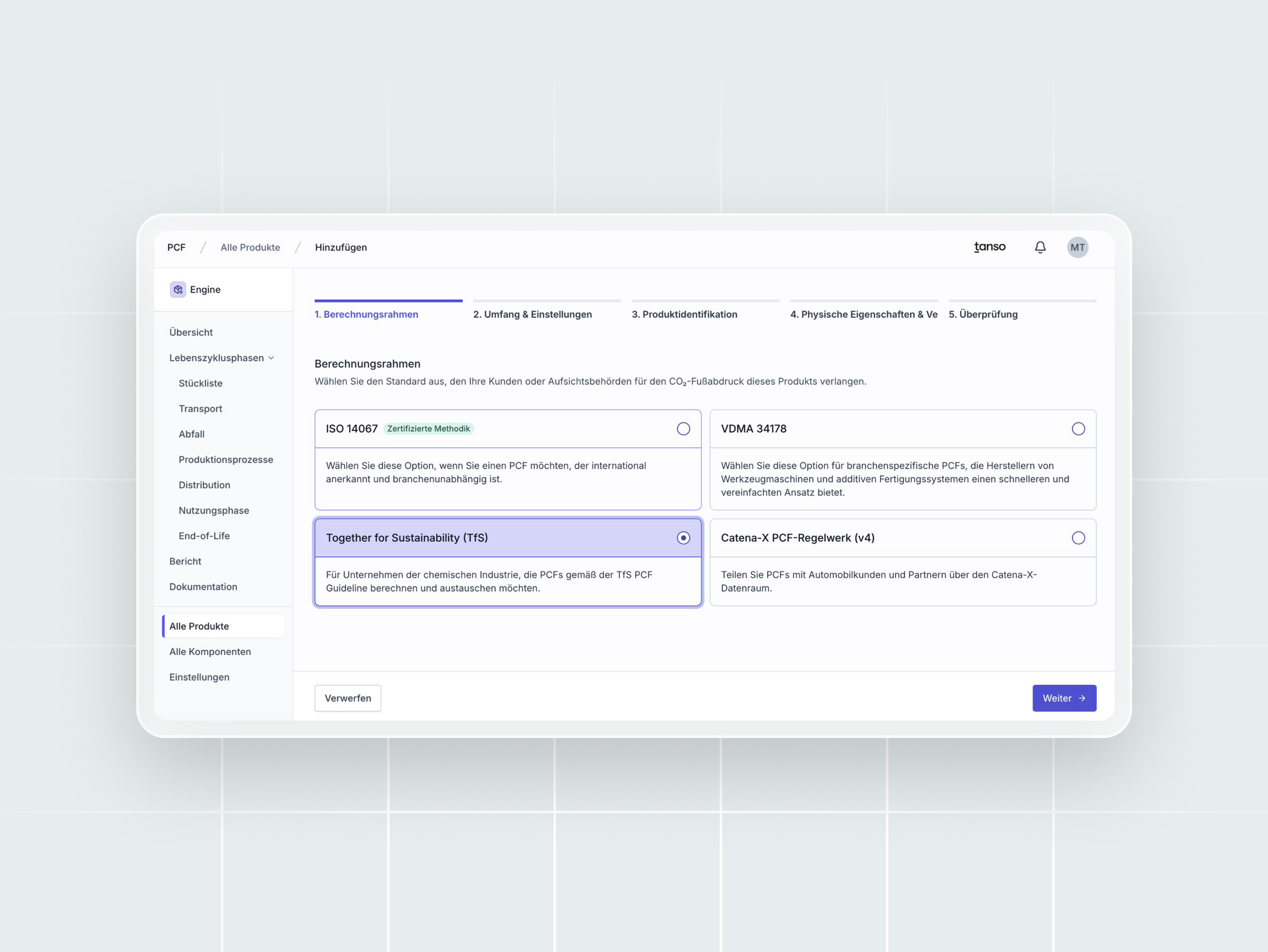
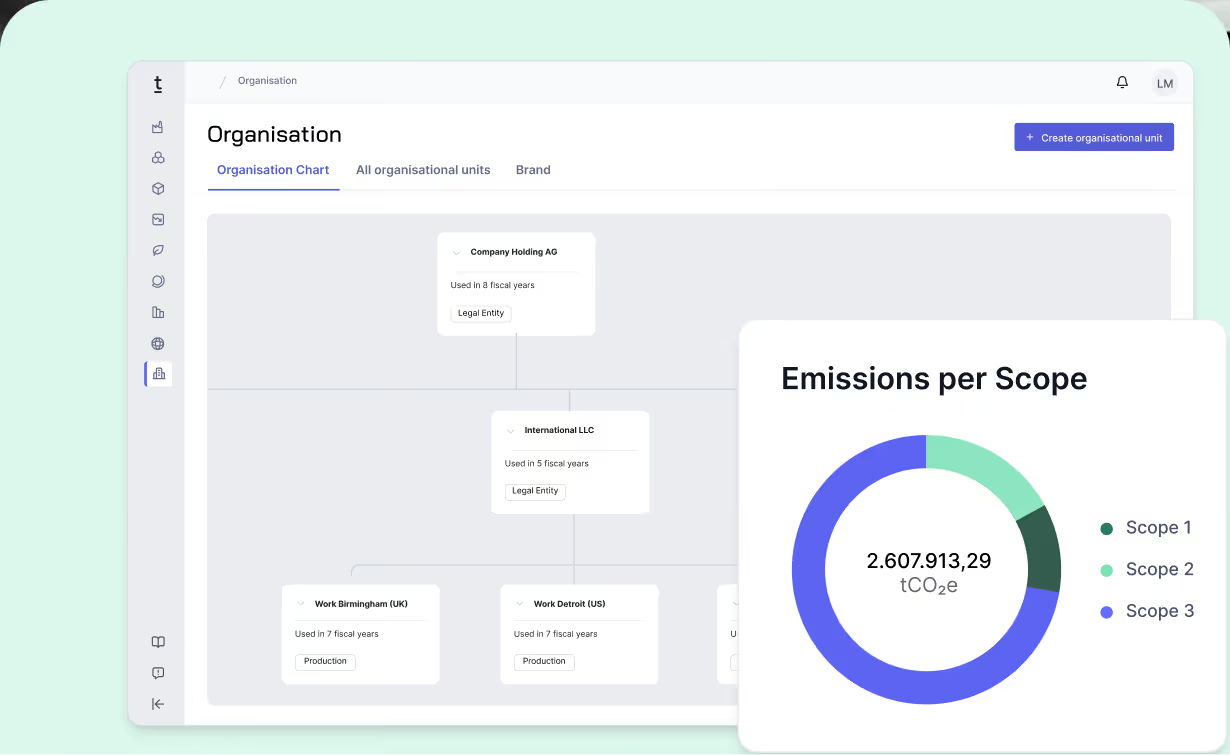
The right software provider supports you specifically in implementing these steps, particularly in the comparison and analysis. This means you don't have to start from zero - instead, you can quickly adapt existing PCF calculations and prepare them for Catena-X data exchange.
In Tanso:
- System boundaries are clearly defined
- Packaging emissions are correctly reported
- Data quality assessments are fully integrated
- Cut-off rules are built into the software
- Emission factors from reliable databases are transparently documented
- PDS and DQR information is embedded in emission factors
As a result, you can already implement the majority of Catena-X requirements directly in the software with just a few clicks. Easy duplication of calculated PCFs and full version tracking ensure that you can make adjustments not only quickly but also traceably. Our experts can additionally help you identify and close current gaps.
This is how you can master the transition from ISO 14067 to the Catena-X Rulebook without major effort.
The checklist: What now, what by end of 2027?
The following table provides an overview of the key methodological requirements for calculating PCFs according to the Catena-X Rulebook, organized by action timeline.
Conclusion
The transition from ISO 14067 to Catena-X is not a restart, but it requires more than a methodological adjustment. Documentation, data structure, and a clear internal process are just as critical as the calculation rules themselves. Those who begin the assessment now and set up their data strategy early will create the leeway that the transition phase offers - without coming under time pressure.














































































.avif)





.avif)
.jpg)


