


PPWR FAQ 2026: Answers to the 35 most important questions for manufacturers, importers, and distributors


Updated on 13 August 2026.
In our PPWR webinar "What companies need to prepare for and how to get ready", many practical questions were submitted. We have compiled the most important answers in this article. The on-demand webinar can be found here.
Questions for manufacturers and producers
If we, as a manufacturer in Germany, sell to a retailer in Austria: who is the producer?
The producer is the retailer in Austria, who places the packaged goods on the market in Austria and is therefore also required to pay EPR fees (licensing fees) to an authorised PRO (collection and recovery system).
We are a mid-sized company and sell the majority of our goods in unprinted standard cartons without a logo, sourced from a domestic supplier. Are we a producer?
No, in this case the producer role does not apply. A producer is anyone who manufactures or commissions the manufacture of packaging and places it on the market under their own name or brand; this role remains with the domestic carton supplier. Since the cartons are unprinted and without a logo, and no conformity-relevant modification takes place (pure filling), the producer role does not transfer to the entity doing the filling. As soon as the cartons are printed or commissioned to be printed with the company's own logo or brand, or the packaging is modified in a way that may affect conformity with the applicable requirements (Art. 15(2) PPWR), the previously filling-only entity itself becomes the producer and assumes full conformity and documentation obligations.
We are receiving specific enquiries from OEMs asking whether we are a producer or a supplier. We ship in transport packaging to customers (B2B), not to end consumers (pallets, wire mesh boxes, cartons, carton inserts, film). Are we a producer? Do we need to label our packaging and request declarations of conformity from our suppliers?
When various packaging components are assembled into a finished transport packaging unit, a new packaging item is generally considered to have been created under PPWR. Commission Guidance C(2026) 2151 explicitly addresses when assembled components are to be treated as a single system.
In a reusable packaging loop (e.g. B2B transport boxes), who is considered the producer - the entity that first places the packaging on the market, or us as participants in the loop who fill and deliver the boxes? Who is responsible for the conformity work (DoC, technical documentation, etc.) in such a model?
In a B2B reusable packaging loop (e.g. a pool of transport boxes), the pool operator or the entity that first places the empty reusable packaging on the market is the producer; not the company that fills the transport box. Conformity obligations therefore lie with the producer.
Questions for importers
If a company imports packaging or packaged products from a third country into the EU and subsequently disposes of them: is it an importer and subject to PPWR?
Definition of importer (Art. 3 No. 15): any natural or legal person established in the EU who places packaging from a third country on the EU market. The declaration of conformity must be prepared by the producer of the packaging, in this case, the manufacturer from the third country. The importer must ensure that the DoC exists and is compliant.
Once the packaging is used and disposed of in the EU, it has been placed on the market, the importer bears the obligations of the producer if no EU producer is present (Art. 18 PPWR).
Does an importer need to draw up its own declaration of conformity?
No. The obligation to prepare the DoC lies with the producer, in this case, the manufacturer from the third country. The importer must ensure that a valid DoC exists and that the technical documentation is in place before placing the packaging on the EU market (Art. 18 PPWR). If no EU producer is present, the importer assumes the producer's obligations in full.
Who is responsible for EPR registration when goods are imported from a non-EU country?
The importer, as the first EU-established person to make the packaged goods available on the market, is subject to EPR obligations, regardless of who manufactured the packaging. In Germany, this means: registration in the LUCID register operated by the ZSVR and participation in a dual system.
Questions for distributors and retailers
What are the obligations of a distributor or retailer under PPWR?
Distributors and retailers who do not manufacture or import packaging themselves have reduced obligations: they must ensure that the packaging they distribute has a valid declaration of conformity from the producer, and must not place packaging on the market without a DoC in place. Producer obligations only arise if they modify the packaging, label it under their own name, or are the first to make it available on the EU market.
Does a retailer become a producer if they sell own-brand products?
Yes. Anyone who places products on the market under their own name or brand is considered a producer under PPWR, regardless of whether they physically manufactured the packaging. This means they assume all producer obligations: conformity assessment, technical documentation, and preparation of the DoC.
Does a distributor need to pay EPR fees when selling packaged goods in another EU Member State?
As the first person to make the packaged goods available on the market in that Member State, the distributor is subject to EPR obligations, provided no other economic operator (manufacturer or importer) has already fulfilled them. A central EU register is not planned until 2029, until then, separate registration is required in each Member State.
Technical Documentation & Declaration of Conformity
Could you elaborate in detail on what data a manufacturer needs to request from their supplier for the technical documentation? We purchase packaged products under our own name.
This article provides an overview of the components of technical documentation, including a comparison with a DoC.
If we supply a packaging system (pallet, carton, label, stretch film) to B2B customers and are therefore the producer required to prepare a declaration of conformity: (1) What should the DoC for this packaging system look like? Is it sufficient to simply collect the supplier information for each individual component? (2) If we print the labels ourselves - how precisely do I need to track the printing ink, for example?
1. The technical documentation for the DoC must include a schematic representation of all integrated and separate packaging components for each packaging type, as well as evidence that the heavy metal limit values for the individual components are met (e.g. a laboratory report).
2. Printing inks are a relevant criterion when assessing recyclable design; compliance with the applicable requirements (delegated act) must be demonstrated from 1 January 2030.
Is a declaration of conformity required from every packaging material manufacturer (cartons, packaging films, wooden crates, adhesive tapes, strapping bands, etc.), and must additional technical documents such as laboratory test reports on heavy metals be requested as part of the duty of care?
What suppliers must provide (Art. 16): "all information and documents that the producer needs to demonstrate conformity." Specifically, per component:
- Material composition
- Heavy metal data (Pb+Cd+Hg+Cr(VI) ≤ 100 mg/kg combined - Art. 5(4), applicable to all packaging)
- PFAS data only for food contact (Art. 5(5))
- Recycled content for plastics (from 2030, Art. 7)
- Recyclability (Art. 6)
This data goes into the Technical Documentation (Annex VII), not the DoC itself; the DoC merely references it.
Regarding laboratory reports and the duty of care: PPWR does not explicitly require ISO 17025 test reports. What is required is "evidence of conformity." A substantiated supplier declaration may suffice, but it must be substantiated, not just a single statement. Our recommendation:
- Low risk (e.g. unprinted natural carton, untreated solid wood): a supplier declaration with material specification is generally sufficient.
- Higher risk (printing inks, pigmented adhesive tapes, coated films, recycled material, coloured strapping bands with pigments): test reports from an accredited laboratory are recommended; pigments and dyes are the primary sources of heavy metals.
For each component where a "higher risk" can be justified, a test report should be obtained.
What should a producer do if a supplier fails to provide sufficient information and data on packaging components in time to confirm PPWR conformity?
Missing supplier data does not release the producer from their obligations.
Recommended approach:
- Written follow-up request with explicit reference to Art. 16(1) PPWR. The supplier has a statutory obligation to provide information.
- Offer an NDA if the supplier cites IP protection as a reason.
- Commission independent testing at an accredited laboratory (ISO 17025 compliant).
- Include contractual clauses in future supplier agreements.
- Document the risk in the technical documentation: which data is missing, what steps were taken, and what alternative evidence was used (e.g. material safety data sheets, REACH conformity confirmations, previous test reports from the supplier pool).
Important: if conformity cannot be demonstrated, the packaging may formally not be placed on the market (Art. 38).
Is there a template showing what a declaration of conformity should look like or contain?
In this article, you will find a template including the components required for a DoC.
A sales product packaging consists of, for example, a foam bag, a cardboard divider, a printed white/brown carton, and a label. Do four separate declarations of conformity need to be issued (one per packaging type), or is one DoC/declaration sufficient for the complete SKU?
One DoC per packaging system/SKU, not four separate ones.
- The individual components (foam bag, divider, carton, label) feed into a single system-wide DoC. Conformity of the overall system is documented, not of each component individually.
- Prerequisite: all components are captured in the technical documentation and the recyclability assessment is carried out for the system as a whole.
If we prepare one conformity declaration per product group: how do we proceed when multiple suppliers are involved? Do we need to consolidate all supplier data? And what do we do if their information does not match or cannot be combined into a single declaration?
A single DoC can only cover multiple packaging items within a product group if all PPWR-relevant characteristics are identical (Commission FAQ, conformity assessment question 11): same material composition, same design/format, same product content, identical conformity results under Art. 5–12.
Data consolidation is possible: all supplier data is compiled in the technical documentation of the packaging unit. For each component, the supplier, the material declaration, and the test reports are documented.
Where there are discrepancies between supplier data for the same packaging (e.g. Supplier A reports 80 mg/kg heavy metals, Supplier B reports 50 mg/kg):
- Option 1: a separate DoC per supplier.
- Option 2: use the worst-case value in a single DoC (i.e. 80 mg/kg) and document this in the technical documentation.
- Option 3: commission independent test results.
Averaging the values or selecting the more favourable one without ensuring that every individual batch falls below the limit value is not permitted.
Tip: when in doubt, it is better to issue one more DoC than one too few.
Labelling (Art. 11 PPWR)
Since 12 August, do I need to have both the address and the identification number on the packaging, or can I still sell off existing stock?
According to the published FAQs of the European Commission, packaging that was already produced and placed on the market before 12 August 2026 is not yet required to comply with the applicable PPWR requirements.
What if there are existing stocks? Can these be sold off?
Existing stock protection: packaging placed on the market for the first time before 12 August 2026 may be sold without this labelling; "placing on the market" is the cut-off date, not the production or sales date (Art. 64 PPWR transitional provision).
Addition from the European Commission's 2nd FAQ edition (August 1–3, 2026): If labeling or documentation is missing for such existing stock because suppliers do not respond or no longer exist, manufacturers must demonstrably attempt to reconstruct the missing information by other means, for example through lab testing, material safety data sheets, or previous test reports. A complete absence of documentation does not automatically exempt manufacturers from the obligation to provide evidence.
Is it sufficient to provide contact details on a label, or must this information be applied directly to the packaging?
A label is sufficient. PPWR requires that the information be affixed to the packaging, not printed directly onto it. A firmly attached label fulfils this requirement. One restriction: the label must be permanently and irremovably affixed. A loose sticker that can easily be peeled off is not sufficient.
Does the unique identifier (identification) for packaging also apply to sales packaging for B2B?
Yes, B2B sales packaging also requires the identification number (the producer's EPR registration number). The exact start date depends on publication of the implementing act.
PPWR Art. 11 does not distinguish between B2B and B2C with regard to labelling obligations. The exception applies only to transport packaging that circulates exclusively between businesses and never reaches the end consumer; reduced labelling requirements apply in that case.
From when must outer packaging be labelled with the producer / entity placing it on the market?
Since 12 August 2026: the legal basis is Art. 15(2) PPWR - the producer must indicate their name, registered trade name or brand, and postal address on the packaging. Importers must additionally include the name and address of the importer.
This requirement applies to all packaging, including secondary and transport packaging. There is no general exemption for outer packaging, the only special rule is Art. 15(11).
Existing stock protection: packaging placed on the market for the first time before 12 August 2026 may be sold without this labelling; "placing on the market" is the cut-off date, not the production or sales date (Art. 64 PPWR transitional provision).
If direct application to the packaging is technically not possible, Art. 15(6) PPWR allows the information to be provided via QR code, data carrier, or accompanying document.
If packaging needs to be labelled - how can this be done for films, for example?
Possible options for films:
- A self-adhesive label on the film
- A QR code or data carrier as an alternative or supplement (Art. 15(6) PPWR) - the QR code must then link to a digitally accessible register containing the producer's details
- An accompanying document, where the film is technically too small or unsuitable (e.g. very thin stretch film around pallets) - the mandatory information is then supplied together with the packaged product
For stretch and strapping films around pallets, a label on the pallet or on the shipping label is the common approach in practice.
Transport Packaging & Packaging Definition
In B2B transport packaging, what counts as the packaging unit - the pallet or an individual carton? And is this consistent across all EU countries?
Under PPWR, there is no single "packaging unit" for B2B transport; instead, all packaging levels are separately in scope:
- Pallet = transport packaging (tertiary)
- Carton/shipping box = secondary or tertiary depending on its function
- Stretch film, edge protectors, carrier material = also separate packaging components
For EPR reporting purposes: each component is recorded and reported by weight, not as a consolidated "unit." The level of granularity is therefore at material level (e.g. corrugated cardboard in kg, PE film in kg).
Do load carriers that are also required for the production process - and not solely for transport protection - also count as packaging?
If the load carrier leaves with the customer (i.e. reaches the end user or enters the waste stream) → packaging. If it remains in the production process and is returned, or is an integral part of the process → not packaging.
Legal basis: Art. 3 No. 1 PPWR defines packaging as an item "for the protection, handling, delivery, or presentation of goods." Annex I is indicative only; according to Commission Guidance C(2026) 2151 final, Section 1, an item listed in Annex I is not automatically packaging, and vice versa.
Concrete examples from the Commission Guidance:
- Adhesive films that remain on semi-finished products during manufacturing → not packaging
- Growing/cultivation pots that remain in the production cycle → not packaging. Only the final pot in which the plant is sold to the end user is packaging.
Practical test:
- If the load carrier is returned after fulfilling its processing function or remains with the customer in their process → not packaging.
- If it is passed on to the end customer with the product or disposed of in the customer's waste stream → packaging.
- If the load carrier serves both a transport and a processing function and is ultimately disposed of by the customer → generally packaging (final destination is decisive).
What about transport packaging that arises within a corporate group? (Products are sold from one entity/location to another within the same group)
The answer depends on whether the supplying and receiving entities are separate legal persons or the same legal person at different locations.
Case A: Delivery between separate legal entities (e.g. German subsidiary delivers to French subsidiary).
Each legal entity is independent. The receiving subsidiary is the manufacturer for EPR purposes in the country of receipt. The transport packaging must therefore:
- Have a declaration of conformity (producer obligation, established once at EU level).
- Be subject to EPR obligations in the member state where it is first made available.
Case B: Delivery between locations of the same legal entity (e.g. Plant A → Plant B, both under the same GmbH).
No "placing on the market" in the legal sense → no manufacturer/EPR obligation arises for this transport.
How are reusable packaging items handled in the B2B sector? (e.g. reusable crates delivering packaged goods to retail)
Reusable packaging must also undergo a conformity assessment procedure. From 12 August 2026, the technical documentation must demonstrate conformity not only with the applicable requirements of Art. 5 (substance restrictions) but also with the applicable requirements of Art. 11 (reusable packaging).
Is wood exempt from PPWR? If not, what applies to wooden pallets from 12 August 2026?
No. PPWR contains no general exemption for wooden packaging. Wooden pallets as transport packaging (tertiary) are fully in scope.
What about aerosols? How are they treated? How is transport packaging handled?
Aerosol cans fall under dangerous goods transport regulations and the Aerosol Dispensers Directive 75/324/EEC. PPWR contains exemptions for "packaging for dangerous goods":
- Art. 6 Recyclability: exemption for dangerous goods packaging (Annex II, Table 1, Cat. 4/5 steel/aluminium — generally applicable, but the dangerous goods exemption applies)
- Art. 7 Recycled content for plastics: exemption for dangerous goods packaging (Art. 7(4) PPWR)
- Art. 29(4) Reuse quotas: exemption for dangerous goods packaging
Food Contact & Material Properties
Do outer packaging items such as cartons also count as food-contact-sensitive packaging if they have no direct food contact? (e.g. food in bags, which are then placed in a carton) Do PFAS limits therefore also need to be met here?
No. "Contact-sensitive" refers to direct food contact. A carton that only encloses a sealed bag is not considered food-contact-sensitive packaging — the bag is the contact-sensitive unit.
If a manufacturer states that their packaging is recyclable, but it cannot be due to its material composition (e.g. composite material) - what applies?
At present, PPWR does not yet set out specific technical requirements for assessing the recyclability of packaging; these will be published via a delegated act under PPWR. The PPWR requirements relating to recyclability of packaging apply from 1 January 2030.
EPR, Registrierung & Lizenzierung (EU-weit)
How high will EPR fees be in the individual countries?
EPR fees depend heavily on the waste management cost structures in the respective member states. Through appropriate eco-modulation of EPR fees, financial incentives are to be created for sustainable packaging design.
PPWR software: Which tools can help?
PPWR software: which tools can help companies comply?
From August 2026, spreadsheets and manual processes are no longer sufficient for PPWR compliance. Companies managing hundreds or thousands of packaging units need a structured data foundation: for per-packaging compliance checks, audit-proof generation of declarations of conformity, and structured supplier communication.
What software solutions support companies in complying with PPWR?
The PPWR software market is still young in 2026. There are four broad approaches: ERP extensions, dedicated packaging software, specialized PPWR compliance tools, and integrated platform solutions. A detailed comparison of the five most relevant solutions can be found in our article Which PPWR software is right for your industrial business?
Which providers in Europe offer PPWR compliance software specifically for manufacturing companies?
For mid-sized and large industrial companies in the DACH region, the most relevant providers are: Tanso (integrated ESG and product compliance platform with PPWR module), PackIntelX (specialized in packaging compliance with accredited recyclability assessment), Packa (AI-driven automation for large FMCG portfolios), Consust (ESG platform with PPWR as one of several modules), and SAP Responsible Design and Production (for large S/4HANA environments). A detailed comparison is available here.
What must a PPWR software solution deliver?
A suitable solution covers at least five core functions: centralized packaging data management at component level, automated compliance checks against PPWR requirements, structured supplier communication without email back-and-forth, audit-proof DoC generation per Annex VIII, and EPR volume capture for reporting in the relevant Member States.
How does Tanso support PPWR implementation?
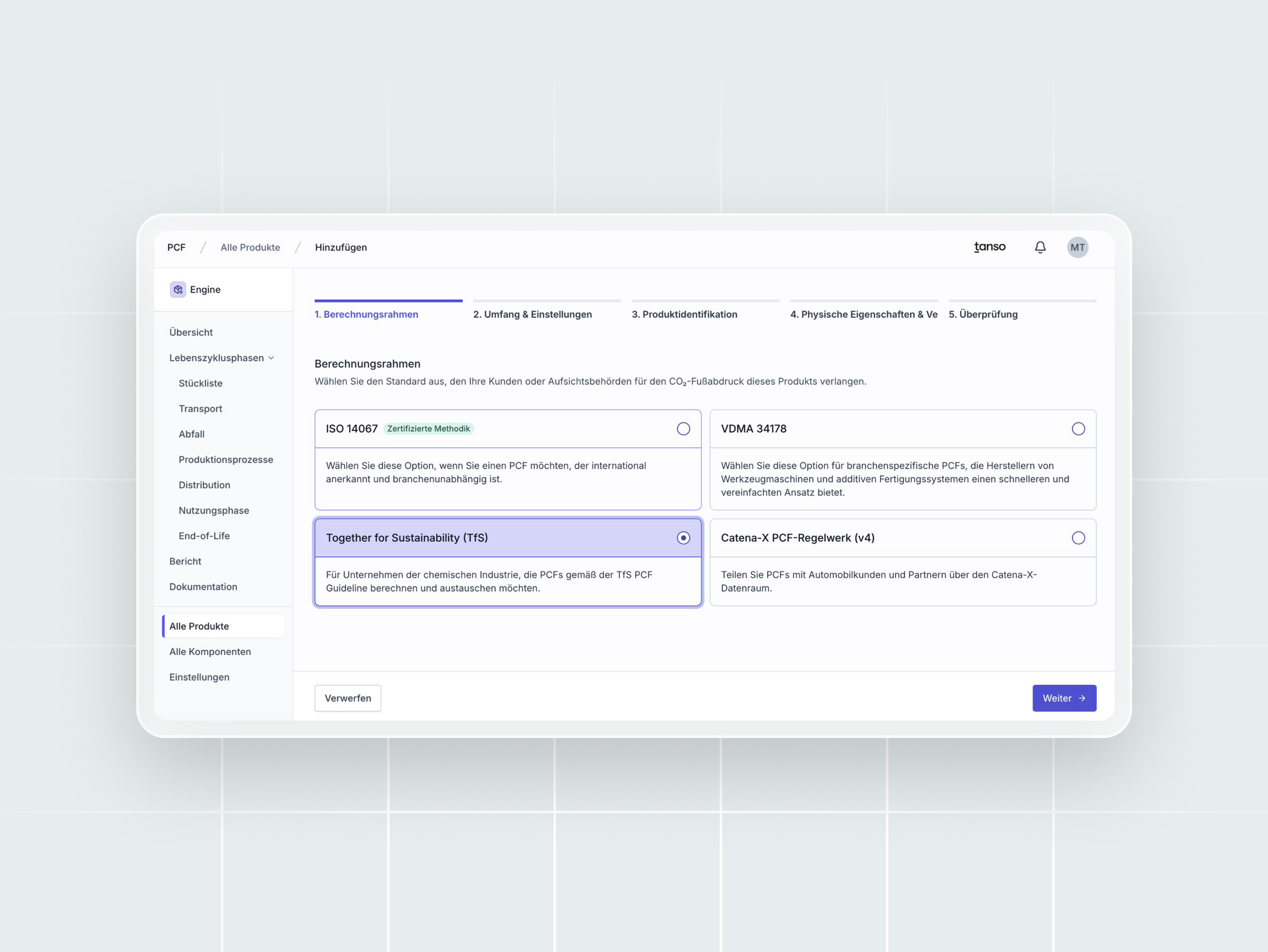
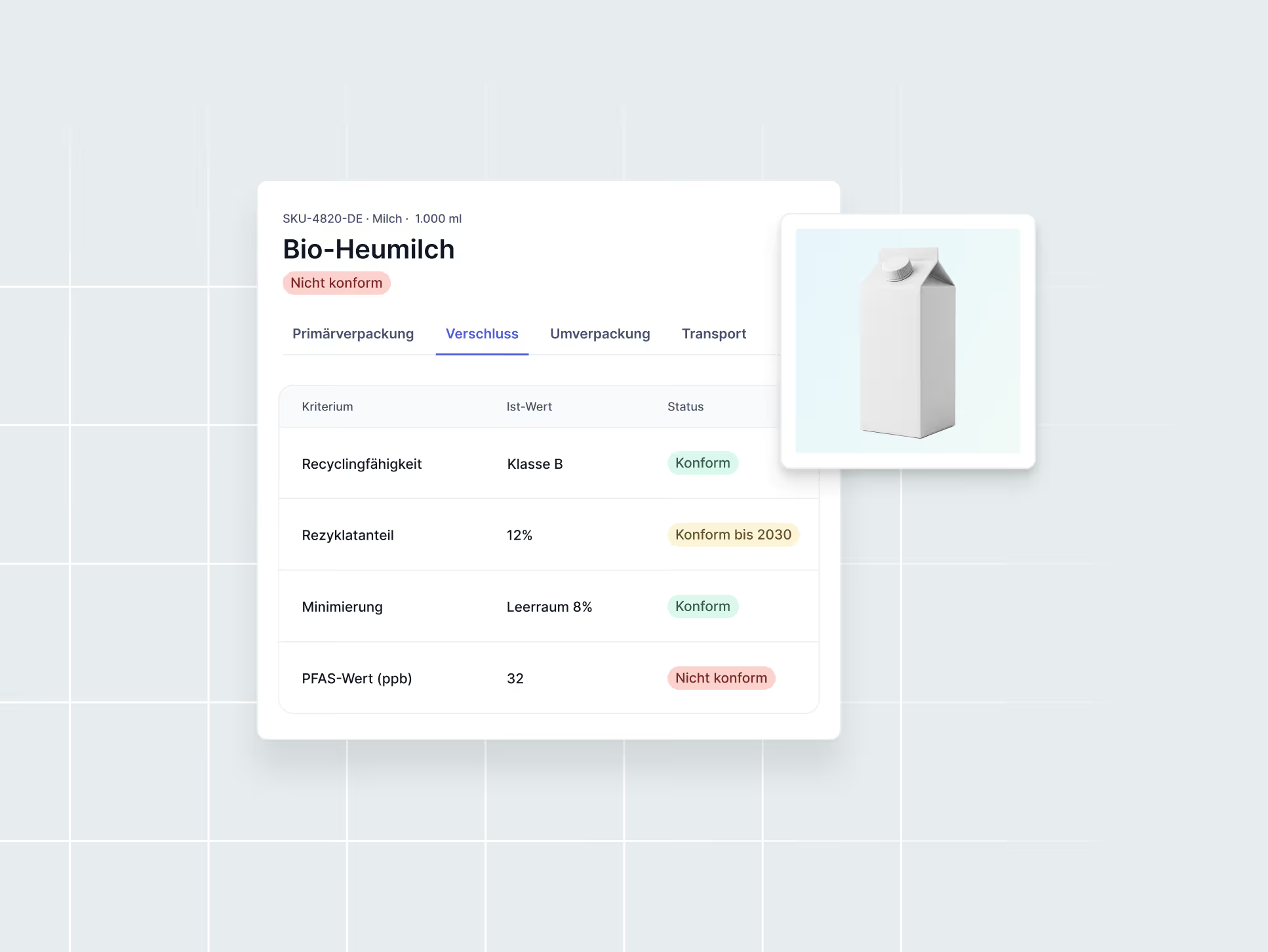
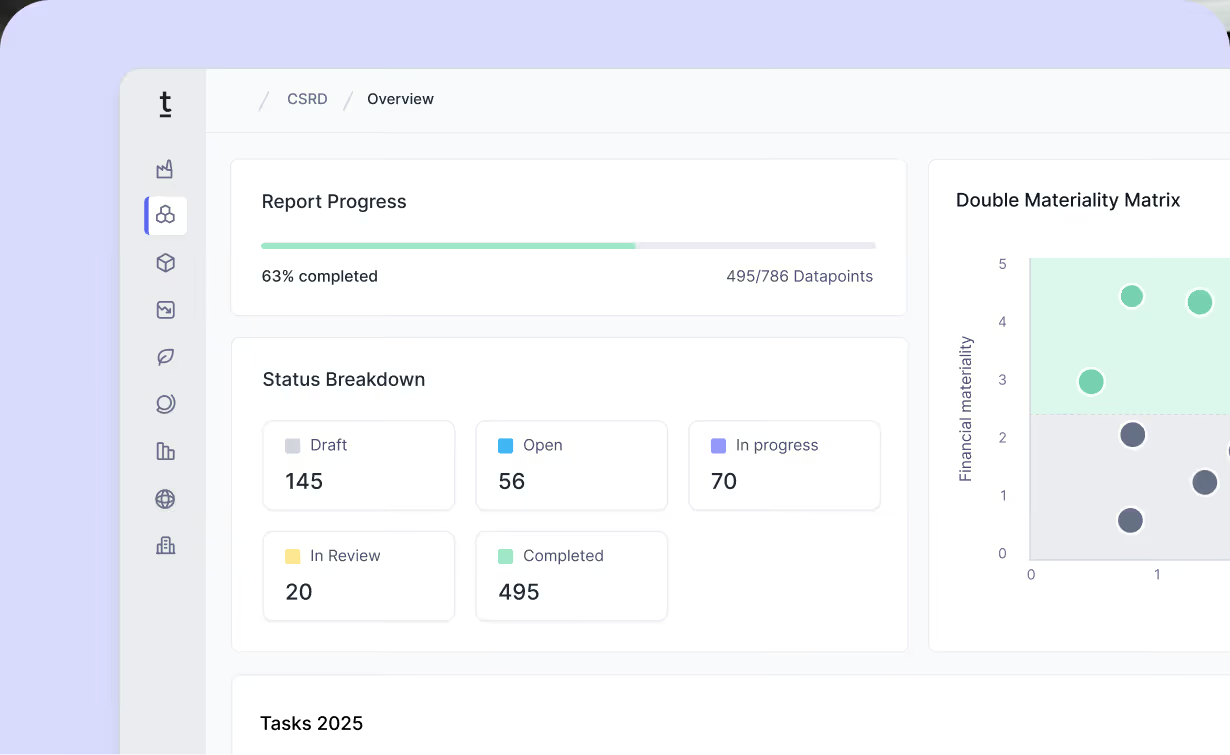
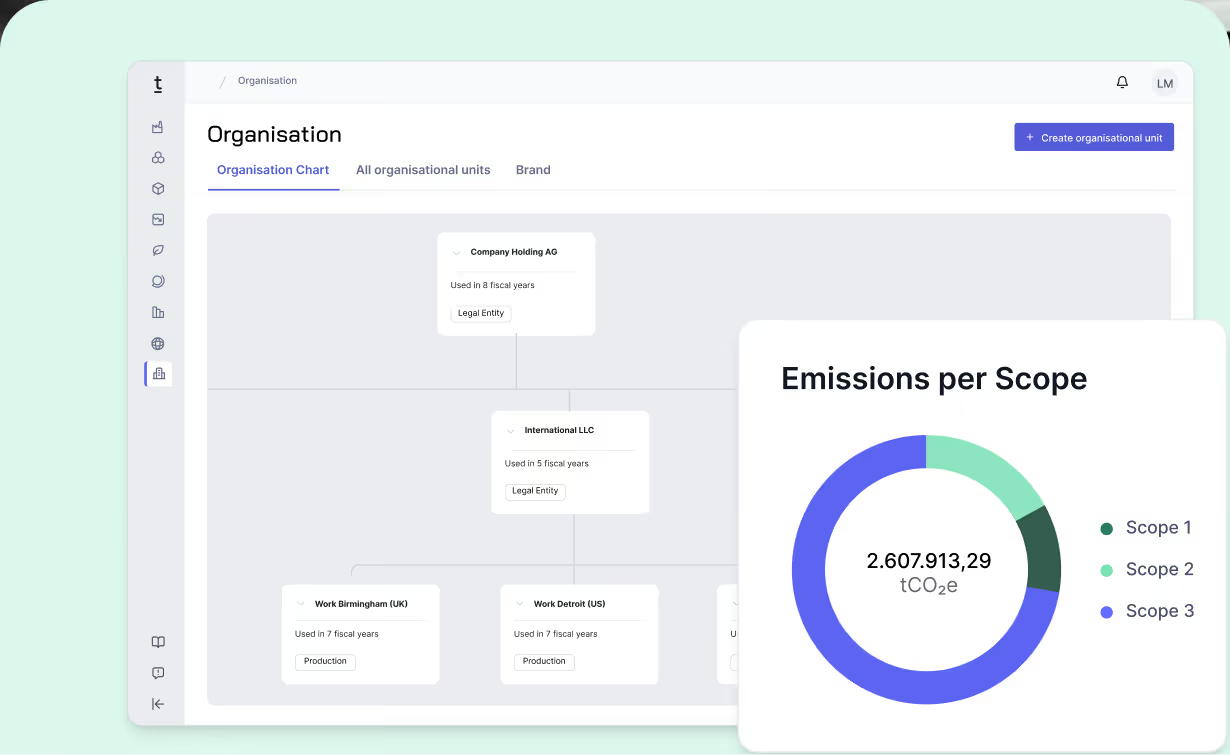
The Tanso PPWR module maps the packaging portfolio hierarchically, from articles to packaging units and their components through to associated suppliers. Every packaging item is automatically checked against PPWR requirements: heavy metal limits, PFAS restrictions, recyclability, and recycled content. Declarations of conformity are generated at the click of a button, multilingual and with full version history. Supplier material data can be requested directly via the integrated supplier portal, with no registration required and automatic status tracking. Since Tanso also covers CCF, PCF, and CSRD reporting, PPWR data is not captured in isolation but feeds into the broader sustainability strategy.









































































.avif)





.avif)
.jpg)


