


PPWR software, ERP, or Excel: Which approach is right for my industrial business?


Updated on August 13, 2026.
Since August 12, 2026, every packaging item placed on the EU market requires a Declaration of Conformity (DoC), with complete technical documentation, verifiable material information, and an auditable audit trail. For companies with several hundred or even thousands of packaging items, this is not just a reporting obligation but a data problem.
Companies looking for a solution to ensure conformity on an ongoing basis will encounter four fundamentally different approaches: manual spreadsheets, their existing ERP system, specialized packaging software, and platform-based solutions for product and sustainability compliance. These options differ not only in their feature sets but in what they are fundamentally capable of, and where they fall short.
Excel: A starting point that doesn't scale
Almost every company starts here. Excel is available, familiar, and ready to use immediately. For an initial inventory of your packaging portfolio, it works fine.
The problem arises when that inventory needs to become regulatory compliance. PPWR requires Declarations of Conformity (DoC) and technical documentation at the component level - per packaging unit, not as a blanket statement. A spreadsheet can store this information, but it cannot evaluate it. It doesn't know whether a hazardous substance threshold is being met, whether the recycled content is sufficient, or whether recyclability meets the criteria of PPWR Article 6. That remains manual work: error-prone, not scalable, and not audit-proof.
There's also the supply chain problem: missing material data has to be requested from suppliers via email. Anyone who has coordinated this across dozens or hundreds of vendors knows what that means: no traceable data history, no systematic follow-up, no audit trail. In the event of a review by market surveillance authorities, that's a hard position to defend.
Much like with ESG reporting, Excel is not a viable foundation for PPWR compliance, not even as an interim solution if your portfolio is anything more than minimal.
ERP and procurement software: A data source, not a compliance system
The logic is straightforward: material master data, supplier relationships, product structures, weights, much of the data required by PPWR already lives in the ERP. Some vendors have begun developing initial modules for packaging data or EPR reporting obligations.
For companies already fully operating within an ERP environment, this offers a familiar entry point. But the approach has a structural limitation that cannot be configured away: .ERP systems are designed for operational processes - transactions, material flows, purchase orders. Compliance logic at the component level that automatically checks against hazardous substance limits, recycled content thresholds, and recyclability criteria, and generates legally sound documentation from that, is generally not something an ERP vendor offers.
There's also a structural timing issue: The PPWR has been in force since August 12, 2026, and will continue to become more concrete step by step over the coming years. ERP systems evolve on long release cycles. What's configured today may not be current tomorrow, without the system itself flagging the gap.
ERP remains an important data source. As a primary PPWR system, however, it is structurally underpowered for most industrial manufacturers.
Dedicated packaging software: Specialization as both a strength and a constraint
Companies looking for a solution built exclusively around packaging will find specialized offerings in the market. Managing packaging portfolios in a structured way, assessing recyclability, centralizing material specifications, defining print layouts, and optimizing packaging: these systems handle that well. For companies that want to not only achieve compliance but genuinely optimize their packaging, this can be a solid approach.
For industrial manufacturers with complex supply chains and mixed portfolios, however, three weaknesses tend to emerge:
- Integration with existing ERP landscapes and product data systems is often more complex than with platforms designed for system connectivity from the ground up.
- The scope remains narrow: companies that also need to address the Digital Product Passport, PFAS documentation, or other product-related regulations after PPWR will find a pure packaging solution quickly limiting.
- The software is often oversized, offering significantly more than compliance requires, which makes the business case harder to justify.
For companies focused on packaging optimization, dedicated packaging software can make sense. For those who see PPWR primarily as a compliance challenge, it's often not the right fit.
Platform-based solutions for product and sustainability compliance: PPWR as a first step
The fourth approach frames the question differently. Not: how do I map PPWR onto my existing systems? But rather: what infrastructure do I need if PPWR is the beginning, not the end, of my product responsibility obligations?
What sets this approach apart from pure packaging solutions, ERP, and Excel is not the depth of PPWR coverage but the architecture behind it: the platform is built to grow beyond PPWR, toward additional product-related requirements like Product Carbon Footprint (PCF), Digital Product Passport (DPP), or PFAS documentation. And it doesn't require a clean data starting point. Companies with packaging data scattered across ERP, Excel, and SharePoint can still get started, data maturity is made visible rather than treated as a barrier. Connectivity to existing platforms and straightforward import and export functions mean existing data gets used rather than rebuilt from scratch.
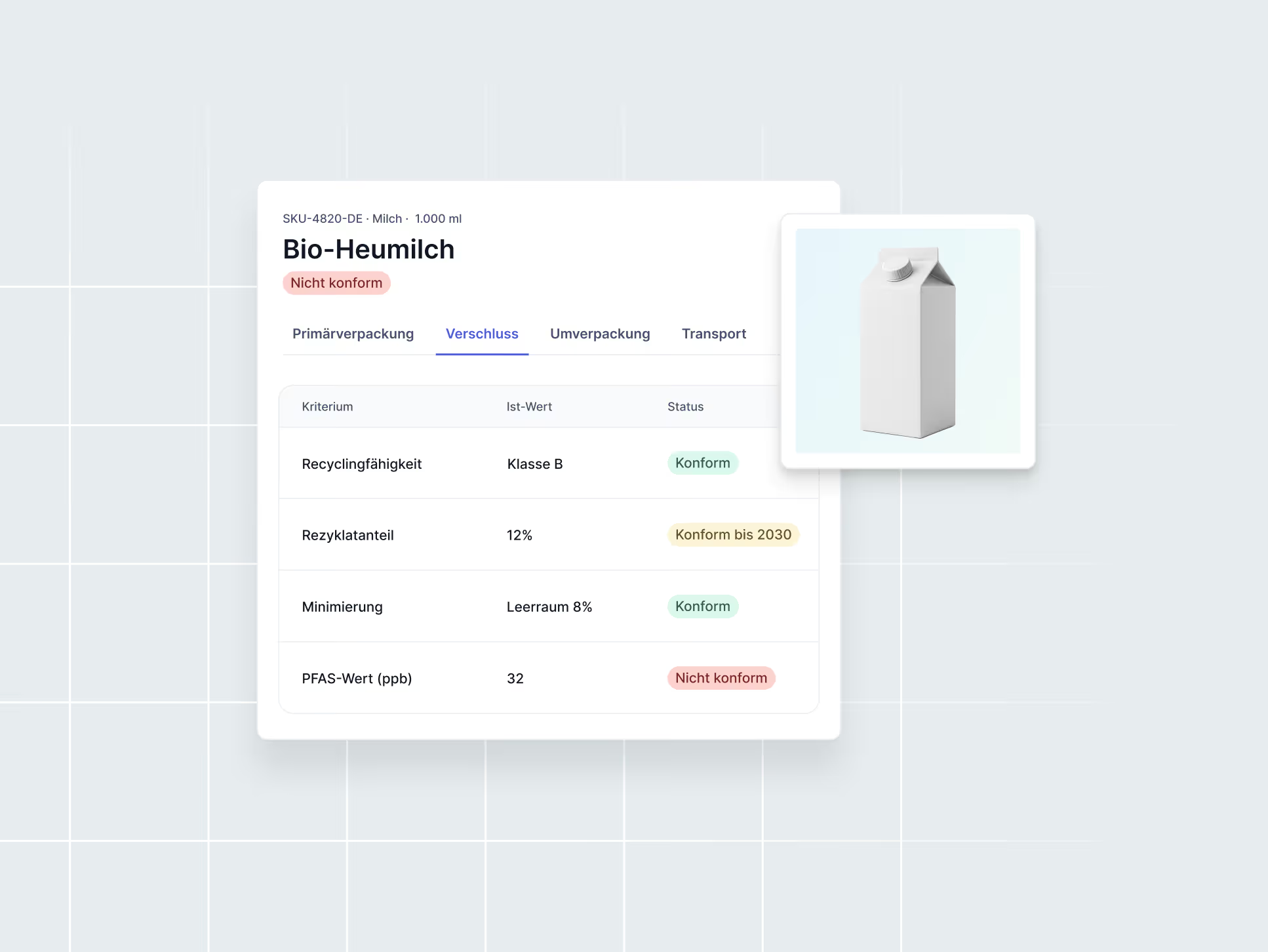
Tanso is one example of such a platform. The PPWR module maps packaging hierarchically, from articles to packaging units and their components, through to the associated suppliers, and automatically checks each packaging item against PPWR requirements. Declarations of Conformity and technical documentation are generated automatically, audit-proof, based on the data on file.
What really drives the decision
Ultimately, the choice of approach is not just a question of feature depth, it's a question of strategy. Companies that treat PPWR as a one-time project can get by with simpler tools. Those who see it as a starting point, the first building block of a compliance management approach that will grow over the coming years, need a platform that can support that.
For companies with a manageable portfolio and a clearly defined scope, Excel or an ERP module may be sufficient to reliably meet the ongoing PPWR requirements. For mid-size and large industrial manufacturers with complex packaging portfolios and fragmented data today, that's the wrong benchmark. They need a solution that won't hit its limits at the first audit cycle.












































































.avif)





.avif)
.jpg)


