


Why chemical companies should calculate their PCFs according to the TfS standard


The pressure on chemical companies to deliver reliable Product Carbon Footprints (PCFs) is growing steadily. Customers along the value chain are requesting product-specific CO₂ values, Scope 3 targets require primary data from suppliers, and cross-industry data ecosystems like Catena-X expect comparable figures. The problem: companies calculating to a non-specific standard produce values that are difficult to compare and imprecise for chemical processes.
This is exactly where the PCF standard of the Together for Sustainability (TfS) initiative for the chemical industry comes in. This article explains what the TfS standard is, why it provides a better foundation for chemical companies than generic standards like ISO 14067, and what concrete steps to take.
What is the TfS PCF standard?
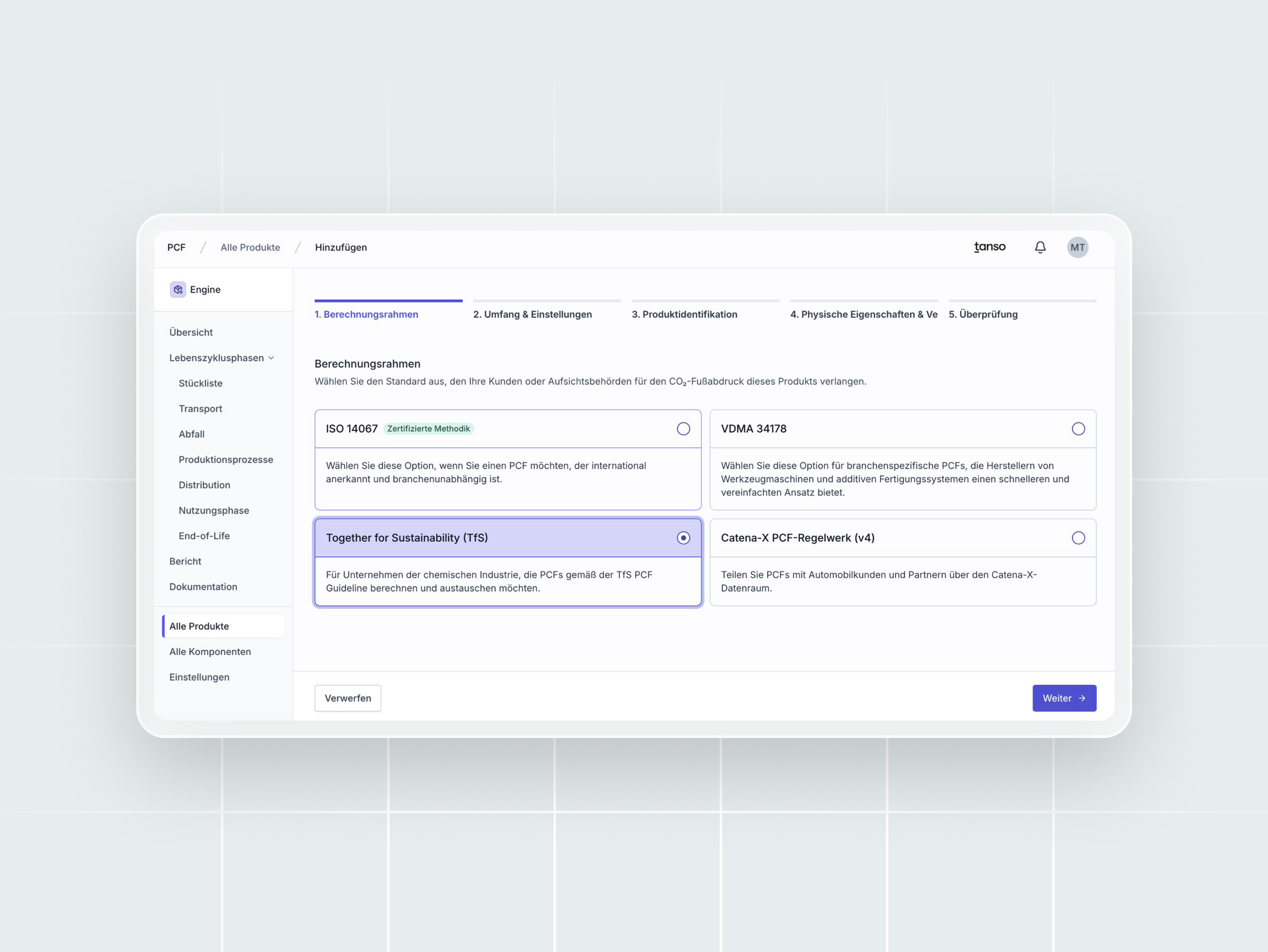
Together for Sustainability is an initiative of leading chemical companies with the goal of developing sustainability standards for global chemical supply chains. The TfS PCF Guideline is the industry-specific standard for calculating Product Carbon Footprints of chemical products that emerged from this initiative. The currently applicable version 3.0 was published in December 2024.
The standard provides concrete, harmonized calculation rules for cradle-to-gate PCFs, from raw material extraction to the factory gate. It is oriented toward Scope 3.1 emissions (purchased goods and services) and is therefore directly compatible with CCF accounting. Importantly, the TfS standard does not replace existing methods, it builds on ISO 14040/44, ISO 14067, and the GHG Protocol Product Standard. It concretizes the general requirements of these foundational standards for the chemical context.
Why PCFs are becoming central for chemical companies now
In the chemical industry, a large share of emissions arises in the upstream value chain. For many companies, the focus of the greenhouse gas balance therefore lies in purchased raw materials and intermediates: in other words, in Scope 3. Product-level transparency is therefore the lever for making emissions along the supply chain visible and reducible in the first place.
This is turning PCFs from a pure reporting obligation into a competitive factor: customers in the chemical industry are demanding product-specific values, and in supplier selection, not only price and quality count but also the carbon footprint. In addition, product-level transparency enables companies to steer sustainability systematically via PCFs, as the Treibacher case study demonstrates. This only works, however, if the figures are calculated according to the same rules and are therefore comparable.
TfS vs. ISO 14067: Where the industry-specific standard makes the difference
Companies already calculating to ISO 14067 have the methodological foundation in place. ISO 14067 is, however, a cross-industry standard that deliberately leaves room for interpretation in many areas. It is precisely this room for interpretation that leads in the chemical industry to divergent results for the same product, depending on the assumptions a company makes. The TfS standard closes these gaps with binding, industry-specific rules. The key differences:
1. Uniform system boundary: cradle-to-gate
TfS mandates cradle-to-gate as the binding system boundary. The use phase and end-of-life are excluded. This creates a clear, uniform foundation for comparing PCFs from different manufacturers and using the data for Scope 3.1, whereas ISO 14067 also permits other system boundaries.
2. Harmonized allocation hierarchy
Chemical processes typically yield multiple co-products. How emissions are distributed across these outputs has a significant impact on the result. TfS prescribes a binding allocation hierarchy and, in version 3.0, has explicitly aligned this with other PCF standards such as Catena-X and PACT. This reduces uncertainty and makes results reproducible.
3. Chemical-specific treatment of biogenic emissions, recycling, and CCU/CCS
Biogenic emissions and removals, recycled feedstocks, and Carbon Capture and Utilization/Storage (CCU/CCS) are commonplace in the chemical industry but only loosely covered in cross-industry standards. TfS provides dedicated decision trees and calculation rules for these cases that chemical companies can apply in their PCF calculations.
4. Measurable data quality and primary data share
TfS harmonizes the assessment of data quality and the disclosure of the primary data share in PCFs. This makes transparent what proportion of a PCF is based on a company's own primary data rather than secondary or average data: a critical quality indicator that ISO does not require as a mandatorily reported metric. The Data Quality Rating (DQR) assesses data quality in terms of technical, temporal, and geographical representativeness.
5. Verification and reporting
The standard sets out requirements for the verification of PCF calculations and for reporting. This increases the credibility of the figures with customers and auditors, particularly where PCFs feed into supplier decisions.
Context: TfS, Catena-X, PACT, and PCF data exchange
A common misconception is that the TfS and Catena-X standards are in competition. The opposite is true. The TfS standard is deliberately designed as a chemical-industry building block with cross-industry interoperability in mind. It is aligned with the PACT methodology of the World Business Council for Sustainable Development (WBCSD) and the Catena-X PCF Rulebook, and calculation rules have been explicitly harmonized across all three standards.
For chemical companies that also supply the automotive industry, this is a decisive advantage: a PCF calculated to TfS can also be shared via the Catena-X data ecosystem. Companies calculating to TfS therefore serve not only their own industry but remain simultaneously compatible with their customers' data ecosystems.
TfS also offers its own data exchange platform. Originally operated as SiGREEN by Siemens, it has been rebranded as Mattermaps following its acquisition by Makersite in 2026. The platform is also aligned with the PACT data exchange guidelines and enables companies to share PCF data with business partners in a controlled way, define who receives which data, and reduce the effort involved in manually entering data into multiple systems.
What does this mean for companies already calculating to ISO?
The good news: the methodological foundation is solid. Companies currently calculating to ISO 14067 do not need to rebuild their calculation logic from scratch. What needs to be added are the chemical-specific concretizations: a consistent cradle-to-gate system boundary, TfS-compliant rules for mass balance and allocation, correct treatment of biogenic shares and recycling, and the explicit disclosure of data quality and primary data share.
Next steps for chemical companies
- Assess your methodological status quo: Are PCFs already being calculated to ISO 14067 or the GHG Protocol? If so, a solid foundation already exists that can be further specified.
- Identify chemical-specific gaps: Are topics such as allocation, biogenic emissions, and recycling already handled in a TfS-compliant way? Is the system boundary clearly documented as cradle-to-gate?
- Address data quality and primary data: Is the primary data share being systematically captured and disclosed? This is often where the greatest lever lies for producing reliable figures.
- Clarify customer requirements: Which customers are already requesting TfS-compliant PCFs, and who expects compatibility with data ecosystems like Catena-X?
- Launch pilots for core products: You don't need to calculate your entire portfolio at once. Start instead with the products most relevant to your key customers and build a robust calculation foundation there.
- Plan data exchange: Clarify early how PCFs will be shared in a standardized way in the future, for example via Mattermaps.
For chemical companies, the TfS standard is therefore not only the methodologically more precise choice but also the strategically smarter one: industry-specific in its accuracy, compatible with ISO and the GHG Protocol, and interoperable via Catena-X with the data ecosystems of a range of customers.











































































.avif)





.avif)
.jpg)


