


PPWR for industrial companies: requirements, deadlines, and the right software


The PPWR (Packaging and Packaging Waste Regulation, Regulation (EU) 2025/40) is the EU's new packaging regulation. It has applied across all EU Member States from August 12, 2026 and affects nearly every industrial company that packages, imports, or distributes products in the EU. For every packaging item, companies must demonstrate compliance with requirements for recyclability, recycled content, hazardous substance limits, and labelling, documented in a declaration of conformity and technical documentation per packaging unit.
For industrial companies with hundreds or thousands of packaging items, this becomes a data challenge. This is exactly where PPWR software comes in: it centralizes packaging data, automates compliance checks, and generates audit-proof documentation.
This guide gives you the complete overview: what the PPWR requires, which roles and obligations apply, which deadlines to watch, and what matters when choosing PPWR software.
Key takeaways
- The PPWR (EU 2025/40) has applied directly across all EU Member Stateswithout transposition into national law.
- Virtually all companies that manufacture, import, or distribute packaging in the EU are affected. There is no exemption for small and medium-sized enterprises.
- Core obligations since August 2026: packaging minimization, recyclability, declaration of conformity (DoC), technical documentation, and EPR registration.
- Obligations depend on the company's role: manufacturer, producer, importer, supplier, or distributor.
- Further deadlines follow in stages through 2040, including recyclability grades from 2030 and recycled content targets.
What is the PPWR?
The PPWR is the first EU-wide, harmonized packaging regulation. It replaces the former Packaging and Packaging Waste Directive of 1994 and turns a fragmented patchwork of national rules into a single, directly applicable regulatory framework. As a regulation, not a directive, it applies directly in all Member States without needing to be transposed into national law. The full regulation text is available on EUR-Lex; supplementary interpretive guidance is in the European Commission's FAQ.
For industrial companies, this means a fundamental shift: packaging compliance moves from a one-time filing to an ongoing, data-driven process. Every packaging item placed on the EU market must demonstrably meet the requirements of Articles 5 through 12.
Who is affected by the PPWR? The five roles
Whether your company needs to draw up a declaration of conformity, only verify one, or register for EPR depends heavily on its role. The PPWR distinguishes five main roles: manufacturer, producer, importer, supplier, and distributor. Particularly confusing: the German and English versions of the regulation use swapped terms, the German "Erzeuger" is the English "manufacturer," the German "Hersteller" is the English "producer."
In brief: the manufacturer places the packaging on the market under its own name and bears the obligation to draw up the declaration of conformity. The producer is the EPR responsibility role, determined per Member State. The importer places packaging from a third country on the EU market for the first time. Suppliers provide materials, and distributors make packaging available without being the manufacturer or importer themselves.
The European Commission, in the second edition of its PPWR FAQ, clarified the role assignment for transport packaging: components such as tape, film, strapping, pallets, pallet collars, and cardboard boxes are separate packaging units, not components of an overall transport packaging unit. Each of these units can have its own manufacturer and its own declaration of conformity. Assembling several such units into a complete transport packaging set does not automatically make the assembling company the manufacturer of the overall packaging.
This departs from the prior interpretation of German authorities such as the ZSVR and the EUNR, under which assembling several components would regularly have resulted in manufacturer status for the overall packaging. Companies that have already carried out role assessments based on the prior interpretation should review them. What remains unchanged: a company that labels transport packaging under its own name or brand, or that has unlabelled packaging custom-made to its own specification, still qualifies as the manufacturer.
PPWR deadlines at a glance
The PPWR is not a single deadline but a step plan spread over 15 years. The key date was August 12, 2026. The core obligations have applied since then. Further requirements follow: harmonized labelling from 2028, digital labelling and an EU-wide register from 2029, a recyclability requirement (at least Grade C) and recycled content targets from 2030, and further tightening through 2040.
For industrial companies, the key point is this: companies that only track the next deadline lose sight of what follows. The same packaging data needed today for the declaration of conformity is the foundation for labelling in 2028 and recyclability assessment in 2030.
Declaration of conformity and technical documentation
Since August 12, 2026, no packaging may be placed on the market without a valid declaration of conformity (DoC) and complete technical documentation. The DoC confirms, per Annex VIII, that the packaging meets PPWR requirements. The technical documentation under Annex VII contains material composition, design details, and evidence relating to hazardous substance limits, recyclability, and minimization.
For industrial companies, this is the most demanding operational part of the PPWR: evidence must be created and maintained per packaging unit, and made available to the market surveillance authority on request.
EPR, LUCID, and modulated fees
Alongside the product-related obligations, extended producer responsibility (EPR) governs who bears the cost of packaging at end of life. In Germany, the Packaging Law Implementation Act (VerpackDG) replaces the former Packaging Act. Any company qualifying as a producer in Germany must register in the LUCID register operated by the ZSVR before placing packaging on the market for the first time.
New under the PPWR are eco-modulated EPR fees: packaging with poorer recycling performance costs more, more recyclable packaging costs less. For companies selling across the EU, multi-country registration adds further complexity, since each Member State has its own register, deadlines, and fee logic.
PPWR and CSRD: the link to ESRS E5
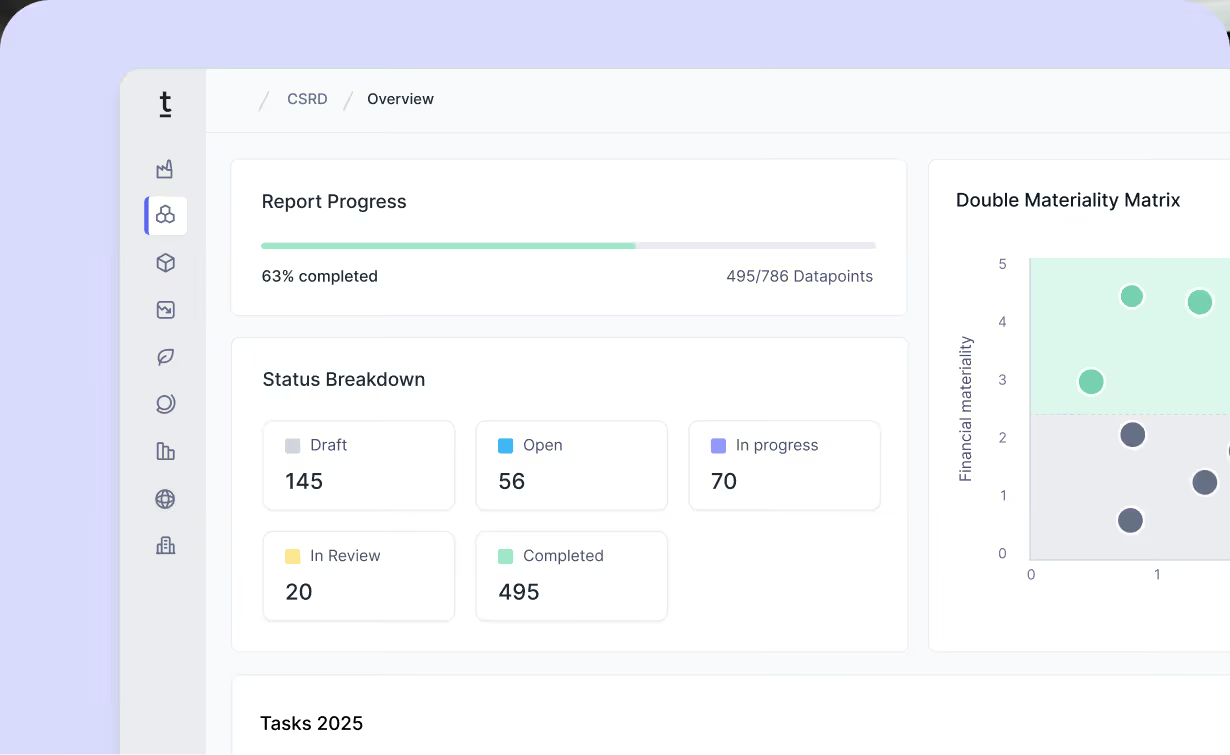
For companies subject to reporting obligations, an important overlap arises: the granular packaging data required by the PPWR per item is also the basis for the aggregated metrics under ESRS E5 (resource use and circular economy) in CSRD reporting. Handling both requirements separately creates duplicate work. Building the data foundation once means using it multiple times.
PPWR software: what matters when choosing
Since August 2026, spreadsheets and manual processes are no longer sufficient for PPWR compliance. Companies managing hundreds or thousands of packaging units need a structured data foundation. A suitable PPWR software solution covers at least five core functions:
- Centralized packaging data management at component level.
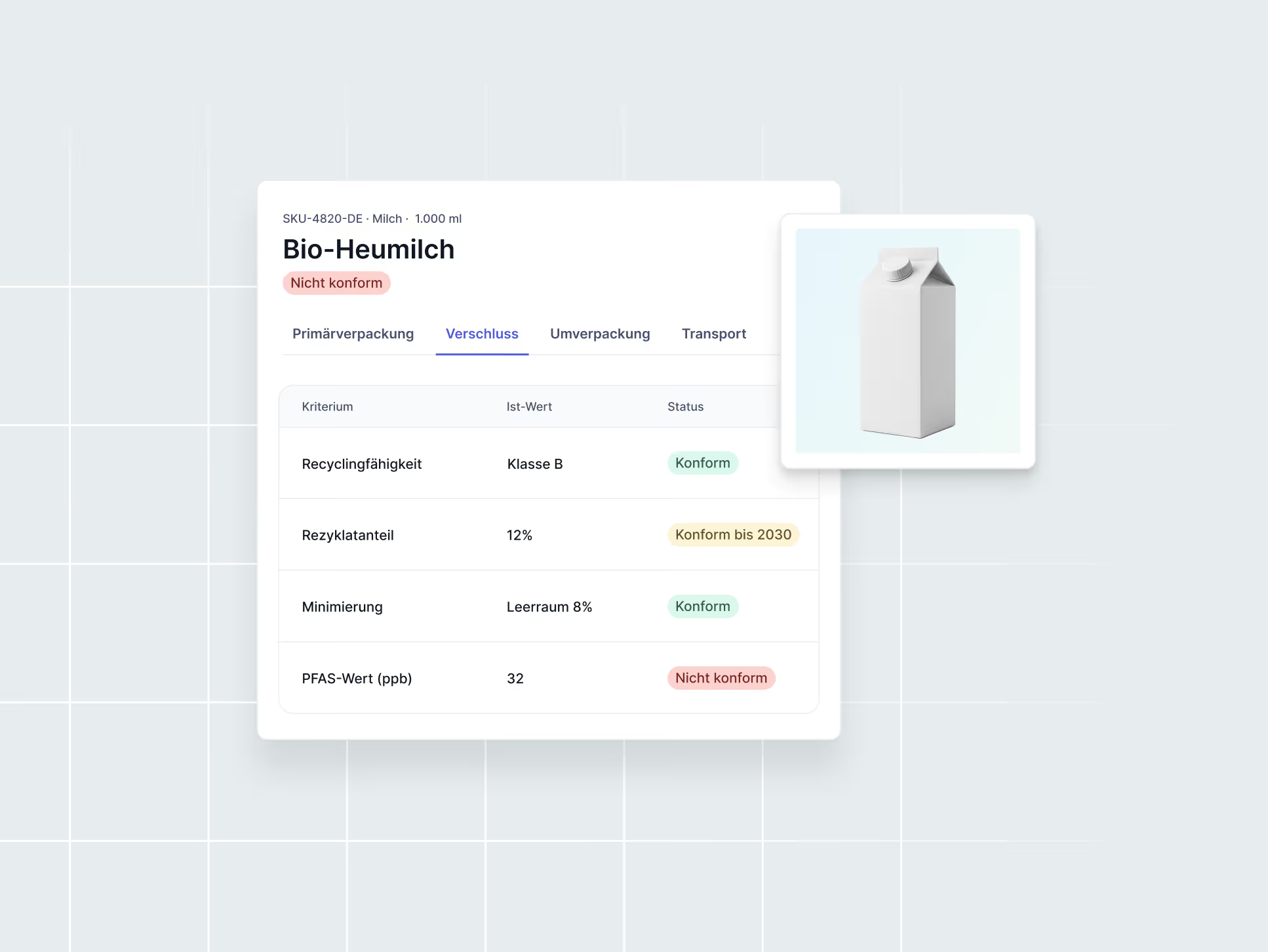
- Automated compliance checks against PPWR requirements: hazardous substance limits, PFAS, recyclability, and recycled content.
- Structured supplier communication that replaces email exchanges.
- Audit-proof generation of declarations of conformity per Annex VIII.
- EPR volume capture for reporting in the relevant Member States.
There are four broad approaches: ERP extensions, dedicated packaging software, specialized PPWR compliance tools, and integrated platform solutions. Which one fits depends on portfolio size, data maturity, and existing system landscape.
Three steps to PPWR compliance
Across numerous customer projects, a proven roadmap has emerged. The real challenge is rarely drawing up the declaration of conformity itself, once the data is in place. The effort lies before that: building a centralized packaging portfolio and securing data availability.
Step 1: Status quo assessment. First, clarify your company's role per packaging item and per Member State, which packaging types are affected, and where the most urgent action is needed. Many companies do not cover their entire portfolio. Focusing on the largest suppliers and most important packaging items, following the Pareto principle, ensures that at least the bulk of the portfolio is compliant.
Step 2: Implementation preparation. Here, packaging data is reviewed and organized. Clustering is often useful: packaging items with identical compliance-relevant characteristics (same material composition, same supplier) can be grouped into packaging types, reducing the number of declarations of conformity needed. Different sizes of the same type may currently be grouped together, since size is not yet a compliance-relevant characteristic. In parallel, supplier communication begins, ideally at the product level and early, since data availability varies significantly across the supply chain.
Step 3: Internal implementation. Data is transferred, the conformity assessment is carried out, and the declaration of conformity and technical documentation are produced. What matters is treating PPWR compliance not as a one-time project but as a recurring process: new packaging, new suppliers, and changing requirements must be captured on an ongoing basis.
One important practical note: a declaration of conformity without substance is a liability, an informed assessment is protection. A signed letter from management is not sufficient as proof of conformity. You need substantiated technical data, such as laboratory findings on heavy metals, which the supplier is required to provide under Article 16 of the PPWR.
Guide: understanding and acting on the PPWR
Companies that want to approach the PPWR in a structured way, not just piecemeal, will find an in-depth summary in our guide: supply chain roles with a decision tree, the full timeline through the 2040s, requirements for the declaration of conformity and technical documentation, plus perspectives from H&Z, valantic, Ypsilon LAW, pacoon, Interzero, and Munich Consulting Group.
PPWR compliance with Tanso
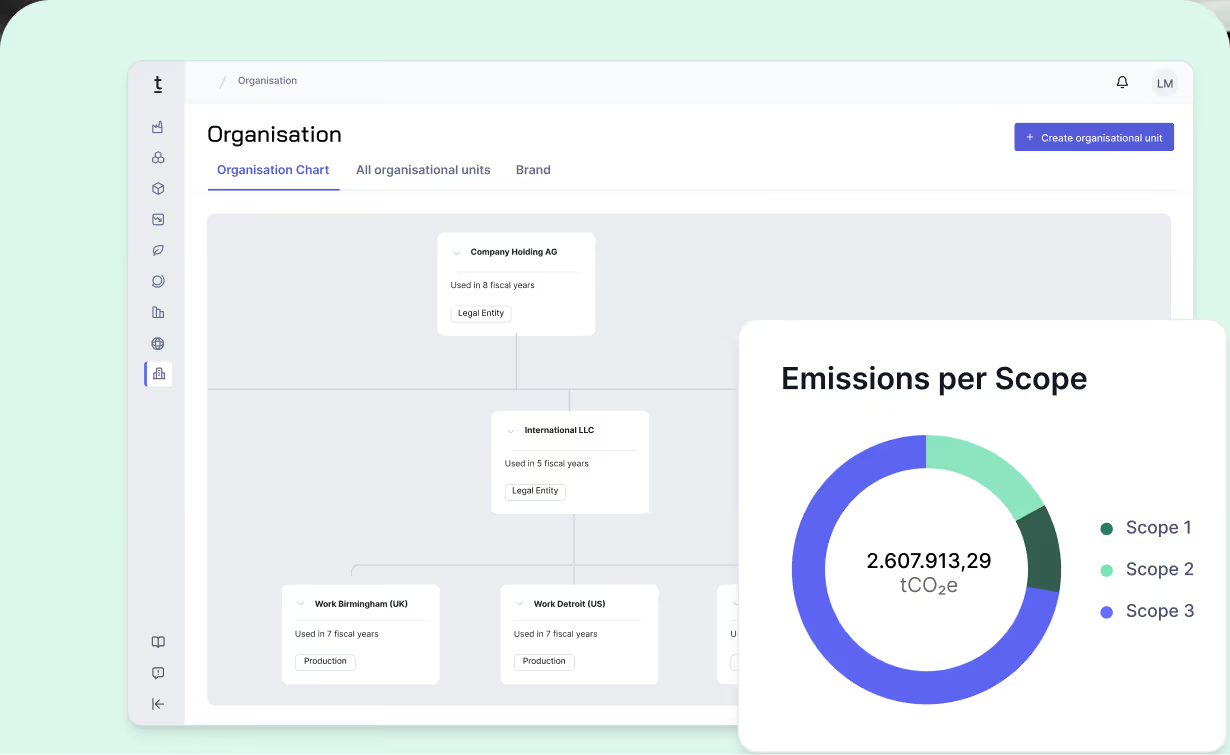
Tanso is the ESG and carbon accounting software trusted by over 300 industrial companies in the DACH region to bring carbon accounting, sustainability reporting, and product-related compliance requirements such as PPWR together in one system with TÜV Rheinland-certified methodology.
The PPWR module maps the packaging portfolio hierarchically, from articles to packaging units and their components through to suppliers, and automatically checks every packaging item against PPWR requirements. Declarations of conformity are generated at the click of a button, multilingual and with full version history. Through the integrated supplier portal, material data can be requested directly from suppliers, with no registration required and automatic status tracking.
What sets Tanso apart from pure packaging tools: PPWR data can be linked directly to Product Carbon Footprints, life cycle assessments, and CSRD reporting, since all modules are built on the same data foundation. Companies that anticipate further product-related compliance requirements to follow after PPWR are building on a platform with Tanso that is designed for exactly that today.

Frequently asked questions about the PPWR
What is the PPWR?
The PPWR (Packaging and Packaging Waste Regulation, Regulation (EU) 2025/40) is the EU's new packaging regulation. It entered into force on February 11, 2025 and has applied since August 12, 2026 across all Member States, directly and without transposition into national law. It replaces the former Packaging and Packaging Waste Directive of 1994 and is part of the European Green Deal, aiming to accelerate the transition to a circular economy.
When does the PPWR apply?
The core obligations of the PPWR have applied since August 12, 2026, marking the end of the transitional period. Further requirements follow in stages: harmonized labelling from 2028, digital labelling and an EU-wide register from 2029, a recyclability requirement (at least Grade C) and recycled content targets from 2030, and further tightening through 2040. Many detailed requirements will only be defined through subsequent delegated acts.
Who is affected by the PPWR?
The PPWR applies to virtually every company that places, imports, or distributes packaging on the EU market, regardless of size or sector. There are some reliefs for micro-enterprises, but in practice these are only of limited relevance. Certain sectors such as medicine and food are treated separately, since additional requirements from existing standards apply there.
What roles exist under the PPWR?
The PPWR distinguishes four roles in the supply chain: supplier, manufacturer, importer, and distributor. In addition, there is the overarching EPR role of the producer. Roles are determined per packaging item and per Member State, not on a blanket company basis. A company can therefore hold several roles at once. Important: the German and English versions of the regulation use swapped terms.
What is the difference between manufacturer and producer under the PPWR?
The manufacturer places packaging on the market under its own name or brand and bears the substantive product compliance responsibility: conformity assessment, technical documentation, declaration of conformity, and labelling. The producer is the EPR responsibility role, determined per Member State, i.e., whoever first makes packaging available in a given Member State. Anyone who is a manufacturer, importer, or distributor is frequently also a producer, but not always.
Who qualifies as an importer under the PPWR?
Any EU-established company that brings packaging or packaged products into the EU for the first time from a non-EU country qualifies as an importer. The importer does not draw up its own declaration of conformity but must verify that a valid declaration of conformity from the manufacturer exists and retain it. In most cases, the importer is also a producer and therefore subject to EPR obligations.
What is the EU declaration of conformity (DoC) under the PPWR?
The EU declaration of conformity (DoC) confirms that a packaging item meets PPWR requirements. The manufacturer must draw one up for each packaging type. Its components are set out in Annex VIII of the PPWR. The DoC can be issued per packaging type rather than per SKU, provided the compliance-relevant characteristics are identical. The accompanying technical documentation must be retained for five years for single-use packaging and ten years for reusable packaging.
What must the technical documentation under the PPWR contain?
The technical documentation under Annex VII substantiates a packaging item's conformity. Since August 12, 2026, two pieces of evidence are primarily required: compliance with the combined limit for heavy metals (under 100 mg/kg for lead, cadmium, mercury, and hexavalent chromium) and, for food contact-sensitive packaging, compliance with PFAS limits. Further requirements such as recyclability and recycled content take effect later and depend on delegated acts still to come.
Does the declaration of conformity need to be submitted to an authority?
No. The declaration of conformity does not need to be actively submitted; it must be kept available and provided to national market surveillance authorities on request. In Germany, current guidance indicates a ten-day window to provide the technical documentation upon request. Responsibility lies with the state-level market surveillance authorities, coordinated with the Federal Environment Agency and the ZSVR.
Is a signed confirmation from the supplier sufficient as proof of conformity?
No. A signed letter from management is not sufficient. You need the complete technical data, such as laboratory findings on heavy metals, to draw up the technical documentation yourself and populate the relevant fields. Under Article 16 of the PPWR, the supplier is legally required to provide you with the necessary information.
What is EPR under the PPWR?
EPR stands for extended producer responsibility. It governs who bears the cost of packaging at end of life: collection, sorting, and recovery. The producer must register in the national registers, report volumes, and pay EPR fees. In Germany, this means registration in the LUCID register operated by the ZSVR and participation in a dual system. New under the PPWR are eco-modulated fees, based on a packaging item's recycling performance.
What is changing with the VerpackDG in Germany?
The Packaging Law Implementation Act (VerpackDG) supplements the directly applicable PPWR and replaces the former Packaging Act (VerpackG). It entered into force on August 12, 2026. New elements include authorization requirements for producers of packaging not subject to system participation, by the end of 2027, expanded labelling obligations, and dedicated fines for PPWR violations of up to 200,000 euros. PPWR fines only take effect from February 12, 2027.
What penalties apply for non-compliance with the PPWR?
Violations of registration or reporting obligations in Germany can result in fines of up to 200,000 euros under the VerpackDG. In the worst case, PPWR violations can also lead to product bans, product recalls, or withdrawals from the market. Loss of market access is therefore the most serious consequence of non-compliance.
Addition from the European Commission's 2nd FAQ edition (August 1–3, 2026): Before imposing sanctions, authorities must first require corrective action and allow a reasonable transition period. Non-compliant packaging is therefore not automatically banned from the market, although fines and distribution bans remain a risk in the event of repeated violations.
Can I combine several packaging items into a single declaration of conformity (clustering)?
Yes, provided all compliance-relevant characteristics are identical: same material composition, same supplier, and same components. Different sizes of the same packaging type can currently be combined, since size is not yet a compliance-relevant characteristic. The empty space minimization requirement only takes effect from 2030. As soon as a relevant characteristic differs and affects the compliance outcome, separate declarations of conformity are required.
What is the difference between manufacturer identification and manufacturer labelling?
Article 15 of the PPWR defines two obligations. Manufacturer identification means that every packaging unit must be uniquely traceable via a type, batch, or serial number. This applies to the overall packaging unit, not individual materials. Manufacturer labelling under paragraph 6 additionally requires the registered trade name, postal address, and, where applicable, an electronic means of communication to appear on the packaging.
Does my industrial business need PPWR software?
For companies with few, simple packaging items, a manual approach may be sufficient. For industrial companies with hundreds or thousands of packaging items, multiple legal entities, several countries, and distributed data sources, specialized PPWR software is generally necessary. It creates a central data foundation, automates compliance checks, structures supplier communication, and enables a recurring process rather than a one-time compliance exercise.
Are tape, film, pallets, and cardboard boxes separate packaging units for transport packaging?
Yes. On August 1, 2026, the European Commission, in the second edition of its PPWR FAQ, clarified that components such as tape, film, strapping, pallets, pallet collars, and cardboard boxes are separate packaging units, not components of an overall transport packaging unit. Each unit can have its own manufacturer and its own declaration of conformity. Assembling several such units into a complete transport packaging set does not automatically make the assembling company the manufacturer of the overall packaging. This clarification departs from the prior interpretation of German authorities such as the ZSVR and the EUNR; role assessments already carried out should be reviewed.
How does Tanso support PPWR implementation?
Tanso is the ESG and carbon accounting software for industrial companies in the DACH region. The PPWR module maps the packaging portfolio hierarchically, from articles to packaging units and their components through to suppliers, and automatically checks every packaging item against PPWR requirements. Declarations of conformity are generated at the click of a button, multilingual and with version history. Through the integrated supplier portal, material data can be requested in a structured way. Since Tanso also covers CCF, PCF, and CSRD reporting, PPWR data can be directly linked to these modules.








































































.avif)





.avif)
.jpg)


