To overview

Decentralised data collection and ESG data management across 118 sites in 21 countries

Goldbeck Case Study: Decentralized Data Collection and ESG Data Management across over 100 locations in 21 countries

About Goldbeck

Goldbeck develops pioneering real estate in Europe. The company understands buildings as products and offers its customers all services from a single source: from design through construction to services during operation. With the aspiration of “building excellence,” the family-owned company delivers real estate that is economical, fast and sustainable with precisely tailored functionality. GOLDBECK is a partner for mid-sized businesses and large corporations, investors, project developers and public-sector clients. Its service portfolio includes logistics and industrial halls, multi-storey car parks, office andschool buildings, sports halls, fire stations and residential buildings. Revitalization projects and building-related services complete the range.

Background

Since the 2021/22 financial year, GOLDBECK has voluntarily reported on the company's sustainability key figures and measures in an annual sustainability report. Since 2022, GOLDBECK's environmental management system has been certified according to the internationally recognized DIN EN ISO 14001 standard. Both requirements necessitate a robust, transparent, and verifiable data basis.

In the initial years, data collection was entirely manual, using Word and Excel spreadsheets: For each of the over 100 locations, a separate Excel file was sent via email to on-site employees, then manually transferred to a central file and forwarded to an external office for evaluation. The results were not available until months later.

With the establishment of the central Group Sustainability department in 2022, the topic gained strategic importance – supported by the Management Board and through the appointment of a Chief Sustainability Officer.

In 2023, GOLDBECK intensified its search for a professional solution for collecting sustainability data – primarily driven by the goal of contributing to decarbonization and the ambition to make its own processes efficient and lean for management, and auditable for the upcoming CRSD reporting requirements.

"With over 100 sites across 21 countries, consistent data collection is by no means a given. Tanso reflects our corporate structure, enabling us to manage this complexity – with site-specific, traceable and scalable data. This simply would not have been feasible with Excel.“
Fabian Westhaus
Fabian Westhaus
Strategic Sustainability Manger at GOLDBECK

Challenges

With over 100 locations in 21 countries, GOLDBECK's data collection process in sustainability management significantly exceeded the typical scope and complexity found in medium-sized businesses – and presented the following challenges:

  • Decentralized Collection across numerous locations: Data was requested via location-specific Excel spreadsheets, which were then manually consolidated. Data loss, incomplete responses, and transmission errors were frequent consequences.
  • Long Collection Cycle: Several months passed from the initial data request to the final result.
  • Limited Data Quality: Site managers often recorded consumption data without knowing the underlying energy source. Missing documentation made it difficult to correctly assign emission factors and impaired the validity of the results.
  • Unclear Responsibilities: The CSRD significantly expands the data requirements framework – beyond environmental data to include employee, compliance, and procurement data. Internally clarifying responsibilities required substantial coordination.
  • Heterogeneous Conditions Across Europe: Diverse national infrastructures, energy sources, and building structures complicated the establishment of a uniform data collection logic across all European sites.

Why Tanso

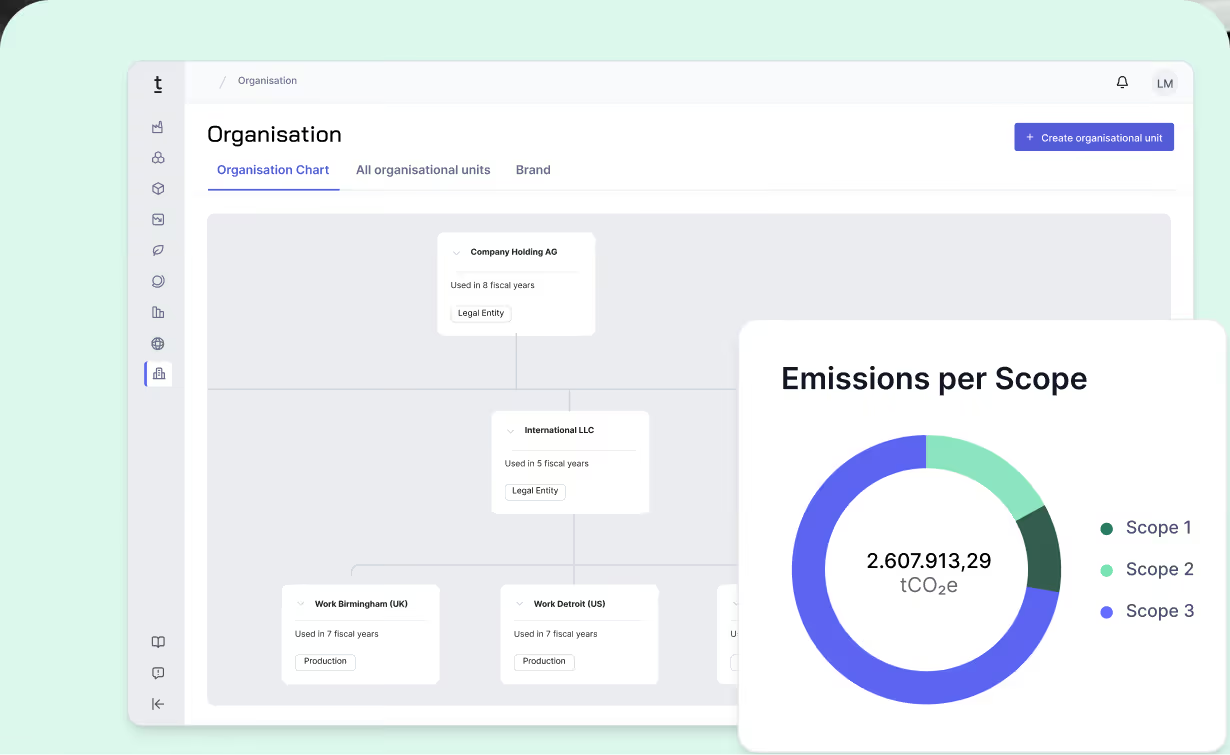
GOLDBECK sought a solution that combines CO₂ accounting and ESG reporting in one platform – efficient, audit-proof, and capable of mapping complex corporate structures with numerous sites and international entities.

CCF Module: Site-Specific Hotspot Analysis

Tanso enables site- and business-unit-specific evaluations based on a specific reporting date – differentiated by site type, emission source, and country. This immediately highlights hotspots in the emissions balance. In the second year of data collection, the automated transfer of the previous year's inventory further accelerates the process.

ESG Module: A Single Data Source for All Requirements

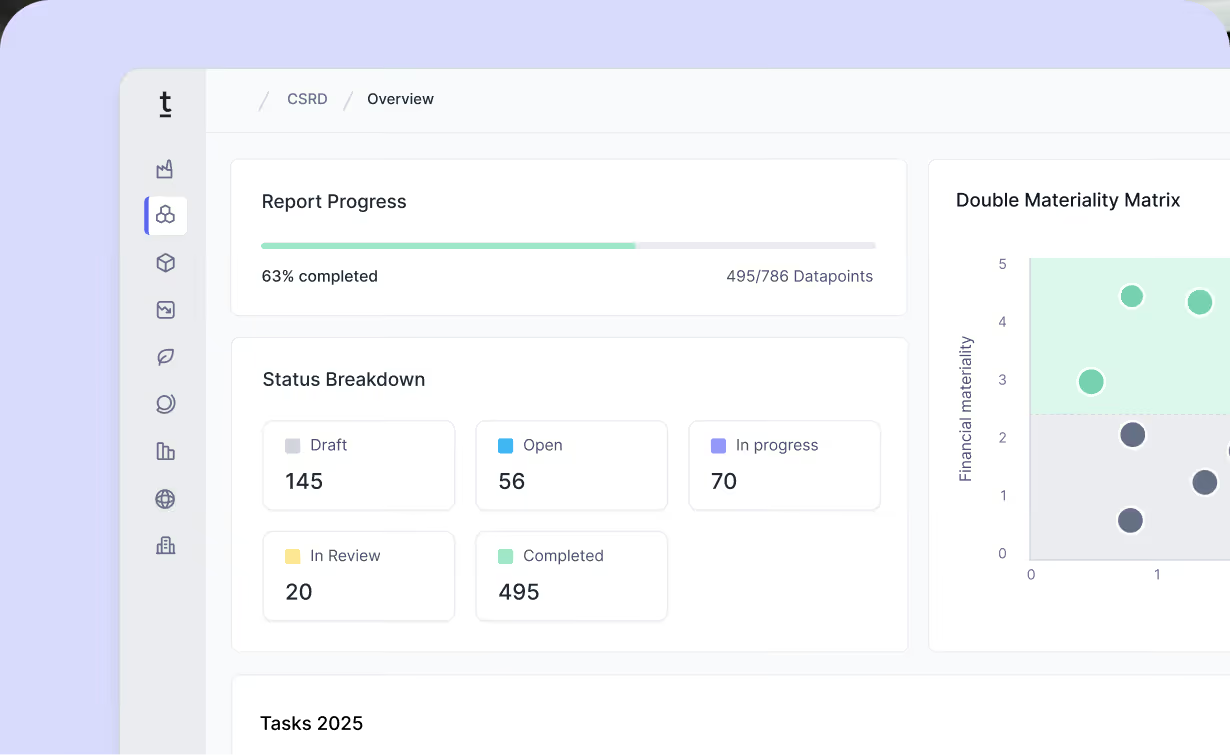
ESG key figures are consolidated in a central data source, creating a uniform data foundation for future European reporting obligations under CSRD, EcoVadis ratings, annual sustainability reports, and customer questionnaires. Data collection is structured periodically, eliminating individual queries and significantly reducing coordination efforts.

Clear Data Ownership and Approval Process

Responsibilities are directly mapped within the platform: data points are internally assigned, recorded, and approved – transparent, audit-proof, and without sending Excel files. This allows sustainability teams to work independently on individual topics while collaborating efficiently.

Implementation and Scaling

Kick-offs, Q&A sessions with the Tanso expert team, and AI-powered assistance directly within the software enable structured implementation across all sites and continuous process improvement.

“For us, Tanso is far more than just a tool for meeting CSRD requirements. It forms the central foundation for holistic sustainability data management. As all the information is consolidated in one place, there is no need for time-consuming individual coordination with separate departments. This leads to significant efficiency gains.”
Céline Kähler
Céline Kählers
Strategic Sustainability Managerin bei GOLDBECK

Results

The transition from Excel to Tanso has significantly streamlined GOLDBECK's data collection and professionalized the management of sustainability data. Tanso is not merely used as a compliance tool but as a central platform for collecting, evaluating, and developing sustainability-relevant data.

Sites gain direct insight into their own emission values within Tanso, thus taking a more active role in emission reduction. Instead of solely focusing on corporate key figures, department heads and site managers now see where their own levers for emission reduction lie. Based on this, GOLDBECK prioritizes reduction measures more precisely and can track their impact over the years directly within the tool.

Key Results at a Glance:

Result Detail
Data collection period ca. 60% shorter → Reduced from 5 months (April → August) to around 8 weeks (April → June).
Location-specific analysis Hotspot analysis by location and business unit – scalable across 100 locations in 21 countries.
Central database CO2 and ESG data is consolidated on a single platform – rather than scattered across site-specific Excel spreadsheets.
Multi-reporting without any extra effort Data is collected just once and is used simultaneously for CCF, CSRD, EcoVadis, ISO 14001, customer questionnaires and the sustainability report – this significantly reduces the workload for central specialist departments and for those responsible at decentralised sites.
EcoVadis Gold Rating GOLDBECK Deutschland GmbH has upgraded its EcoVadis medal to Gold thanks to a significant improvement in the quality of its ESG data.
More efficient processes through clear lines of responsibility Clear data responsibilities and a structured approval process in Tanso.
“With Tanso, we have reduced the data collection process for our carbon footprint assessment by around 60 per cent – from five months to around eight weeks. Clear lines of responsibility, structured approval processes and centralised data collection ensure that the entire process is now significantly more efficient, transparent and audit-proof.”
Fabian Westhaus
Fabian Westhaus
Strategic Sustainability Manger at GOLDBECK

Outlook

The focus is on closing existing data gaps, expanding Scope 3 transparency, and further automating data collection. To this end, options are being explored to connect internal systems for energy and utility cost data, as well as personnel data, to Tanso, in order to further streamline processes. In parallel, important decarbonization projects are being implemented in Poland and the Czech Republic. With Tanso, GOLDBECK aims to ensure auditable data collection, further improve data transparency through meaningful analyses, and continuously develop its sustainability and reporting processes.


To the overview

Decentralised data collection and ESG data management across 118 sites in 21 countries

About Goldbeck

Goldbeck develops pioneering real estate in Europe. The company understands buildings as products and offers its customers all services from a single source: from design through construction to services during operation. With the aspiration of “building excellence,” the family-owned company delivers real estate that is economical, fast and sustainable with precisely tailored functionality. GOLDBECK is a partner for mid-sized businesses and large corporations, investors, project developers and public-sector clients. Its service portfolio includes logistics and industrial halls, multi-storey car parks, office andschool buildings, sports halls, fire stations and residential buildings. Revitalization projects and building-related services complete the range.

Background

Since the 2021/22 financial year, GOLDBECK has voluntarily reported on the company's sustainability key figures and measures in an annual sustainability report. Since 2022, GOLDBECK's environmental management system has been certified according to the internationally recognized DIN EN ISO 14001 standard. Both requirements necessitate a robust, transparent, and verifiable data basis.

In the initial years, data collection was entirely manual, using Word and Excel spreadsheets: For each of the over 100 locations, a separate Excel file was sent via email to on-site employees, then manually transferred to a central file and forwarded to an external office for evaluation. The results were not available until months later.

With the establishment of the central Group Sustainability department in 2022, the topic gained strategic importance – supported by the Management Board and through the appointment of a Chief Sustainability Officer.

In 2023, GOLDBECK intensified its search for a professional solution for collecting sustainability data – primarily driven by the goal of contributing to decarbonization and the ambition to make its own processes efficient and lean for management, and auditable for the upcoming CRSD reporting requirements.

"With over 100 sites across 21 countries, consistent data collection is by no means a given. Tanso reflects our corporate structure, enabling us to manage this complexity – with site-specific, traceable and scalable data. This simply would not have been feasible with Excel.“
Fabian Westhaus
Fabian Westhaus
Strategic Sustainability Manger at GOLDBECK

Challenges

With over 100 locations in 21 countries, GOLDBECK's data collection process in sustainability management significantly exceeded the typical scope and complexity found in medium-sized businesses – and presented the following challenges:

  • Decentralized Collection across numerous locations: Data was requested via location-specific Excel spreadsheets, which were then manually consolidated. Data loss, incomplete responses, and transmission errors were frequent consequences.
  • Long Collection Cycle: Several months passed from the initial data request to the final result.
  • Limited Data Quality: Site managers often recorded consumption data without knowing the underlying energy source. Missing documentation made it difficult to correctly assign emission factors and impaired the validity of the results.
  • Unclear Responsibilities: The CSRD significantly expands the data requirements framework – beyond environmental data to include employee, compliance, and procurement data. Internally clarifying responsibilities required substantial coordination.
  • Heterogeneous Conditions Across Europe: Diverse national infrastructures, energy sources, and building structures complicated the establishment of a uniform data collection logic across all European sites.

Why Tanso

GOLDBECK sought a solution that combines CO₂ accounting and ESG reporting in one platform – efficient, audit-proof, and capable of mapping complex corporate structures with numerous sites and international entities.

CCF Module: Site-Specific Hotspot Analysis

Tanso enables site- and business-unit-specific evaluations based on a specific reporting date – differentiated by site type, emission source, and country. This immediately highlights hotspots in the emissions balance. In the second year of data collection, the automated transfer of the previous year's inventory further accelerates the process.

ESG Module: A Single Data Source for All Requirements

ESG key figures are consolidated in a central data source, creating a uniform data foundation for future European reporting obligations under CSRD, EcoVadis ratings, annual sustainability reports, and customer questionnaires. Data collection is structured periodically, eliminating individual queries and significantly reducing coordination efforts.

Clear Data Ownership and Approval Process

Responsibilities are directly mapped within the platform: data points are internally assigned, recorded, and approved – transparent, audit-proof, and without sending Excel files. This allows sustainability teams to work independently on individual topics while collaborating efficiently.

Implementation and Scaling

Kick-offs, Q&A sessions with the Tanso expert team, and AI-powered assistance directly within the software enable structured implementation across all sites and continuous process improvement.

“For us, Tanso is far more than just a tool for meeting CSRD requirements. It forms the central foundation for holistic sustainability data management. As all the information is consolidated in one place, there is no need for time-consuming individual coordination with separate departments. This leads to significant efficiency gains.”
Céline Kähler
Céline Kählers
Strategic Sustainability Managerin bei GOLDBECK

Results

The transition from Excel to Tanso has significantly streamlined GOLDBECK's data collection and professionalized the management of sustainability data. Tanso is not merely used as a compliance tool but as a central platform for collecting, evaluating, and developing sustainability-relevant data.

Sites gain direct insight into their own emission values within Tanso, thus taking a more active role in emission reduction. Instead of solely focusing on corporate key figures, department heads and site managers now see where their own levers for emission reduction lie. Based on this, GOLDBECK prioritizes reduction measures more precisely and can track their impact over the years directly within the tool.

Key Results at a Glance:

Result Detail
Data collection period ca. 60% shorter → Reduced from 5 months (April → August) to around 8 weeks (April → June).
Location-specific analysis Hotspot analysis by location and business unit – scalable across 100 locations in 21 countries.
Central database CO2 and ESG data is consolidated on a single platform – rather than scattered across site-specific Excel spreadsheets.
Multi-reporting without any extra effort Data is collected just once and is used simultaneously for CCF, CSRD, EcoVadis, ISO 14001, customer questionnaires and the sustainability report – this significantly reduces the workload for central specialist departments and for those responsible at decentralised sites.
EcoVadis Gold Rating GOLDBECK Deutschland GmbH has upgraded its EcoVadis medal to Gold thanks to a significant improvement in the quality of its ESG data.
More efficient processes through clear lines of responsibility Clear data responsibilities and a structured approval process in Tanso.
“With Tanso, we have reduced the data collection process for our carbon footprint assessment by around 60 per cent – from five months to around eight weeks. Clear lines of responsibility, structured approval processes and centralised data collection ensure that the entire process is now significantly more efficient, transparent and audit-proof.”
Fabian Westhaus
Fabian Westhaus
Strategic Sustainability Manger at GOLDBECK

Outlook

The focus is on closing existing data gaps, expanding Scope 3 transparency, and further automating data collection. To this end, options are being explored to connect internal systems for energy and utility cost data, as well as personnel data, to Tanso, in order to further streamline processes. In parallel, important decarbonization projects are being implemented in Poland and the Czech Republic. With Tanso, GOLDBECK aims to ensure auditable data collection, further improve data transparency through meaningful analyses, and continuously develop its sustainability and reporting processes.

Discover Tanso -
Your all-in-one solution for sustainability

Other articles that may be of interest to you

Stay up-to-date with news from Tanso.