
EU Commission Publishes Revised ESRS Draft and Voluntary Standard - Feedback Possible Until June 3



The European Commission published on May 6, 2026 its revised version of the European Sustainability Reporting Standards (ESRS) as a draft based on the EFRAG proposal from December 2025. In parallel, the EU Commission also presented a draft for the new Voluntary Standard (VS), which is intended to replace the VSME in the future. The new drafts are designed to provide companies with additional flexibility in implementation without lowering regulatory standards. Of particular note is that the EU is increasingly responding to feedback from the business community and taking practical implementation challenges into account.
A large proportion of the proposed changes from the EFRAG draft ESRS have been retained in the EU Commission's proposal. There are only a few minor adjustments.
Key changes in the proposal at a glance
1. Double Materiality Assessment (DMA): Top-Down approach preferred
The EU explicitly recommends the top-down approach for double materiality analysis as it is more efficient and works with available data. Companies can, if necessary, make supplementary company-specific disclosures to ensure fair presentation.
2. GHG accounting boundary: methodological flexibility
In contrast to the EFRAG draft, which favored the "financial control approach," companies should now have the option to choose between the three recognized methods: financial control, equity share, or operative control. This methodological flexibility accommodates the complexity of modern corporate structures and takes into account particularities in shareholding relationships and supply chains.
3. Policies, Actions & Targets (PAT): more efficient bundling
The revision emphasizes the possibility of describing a single PAT covering multiple material topics only once and then referencing it. This reduces administrative burden and promotes integrated sustainability strategies.
4. Estimates: greater tolerance for financial effects
The revised draft acknowledges that estimates are legitimate for financial impacts, particularly when better data is not available. Importantly: subsequent adjustments due to improved data availability do not constitute error corrections of prior reporting periods, but rather represent the normal process of data improvement.
5. Microplastics: simplified reporting for secondary microplastics
The reporting requirement for secondary microplastics is eliminated, while primary microplastics remain relevant. This simplification acknowledges the practical limitations of data collection in globally complex supply chains.
6. SVHC (Substances of Very High Concern): one-year transition period for users
Companies that process or use products containing substances of very high concern (SVHC) – without manufacturing them themselves – receive a one-year transition period for corresponding data collection. This particularly relieves processors and system integrators in technically complex value chains.
7. Worker metrics: The biggest changes
The Own Workforce chapter experiences the most substantial content changes in data points. Particularly noteworthy are transition relief measures for selected S1 data points that ease the data collection burden on companies.
Revised Voluntary Standard (VS) for companies with ≤1,000 employees
The new VS is designed for companies with up to 1,000 employees that are not subject to the CSRD and provides them with a standardized reporting framework for sustainability topics.
The previous VSME will be phased out and replaced by the new VS starting from fiscal year 2027. Until the VS is introduced, the VSME will remain valid as a transitional solution for companies with ≤1,000 employees.
With the new VS, the EU aims to implement the "Value-Chain Cap." This is a reduced set of requirements that stipulates CSRD-liable companies may only request a limited scope of ESG data from smaller, non-affected companies (≤1,000 employees and ≤€450 million in revenue) for their reporting purposes. This significantly reduces the reporting burden for companies outside the CSRD scope. The standard is expected to come into force from fiscal year 2027 onwards.
Key findings on the new VS draft
- Same structure as the VSME: The VS retains the two-module structure (Basic and Comprehensive Modules), and most data points remain unchanged.
- Clear labeling of requirements: Each section is now explicitly labeled as "necessary," "necessary if applicable," "voluntary," or "consideration when reporting sector information." Using these labels, companies can clearly understand their reporting obligations and transparently justify Value-Chain Cap requirements. According to the current EU Commission proposal, only requirements marked as "necessary" could be mandatorily requested from the supply chain for CSRD reporting.
- New exemptions for micro-enterprises: Companies with ≤10 employees will receive additional relief, for example in reporting on GHG emissions and water consumption.
- Simplifications in biodiversity reporting: Parts of biodiversity reporting (area B5) have been removed, as these are also no longer included in the new ESRS draft.
- Compatibility with EMAS: The VS will be compatible with EMAS reports, thereby reducing duplicate reporting for companies with EMAS certification.
Feedback until June 3: industry must act
Companies and stakeholders can submit their feedback on both drafts by 3 June 2026 via the EU Commission's portal – once for the new ESRS draft and once for the VS draft.
Timeline: final version expected before year-end
- 3 June 2026: Deadline for feedback submissions ("Have Your Say")
- Summer 2026: EU revises both drafts based on feedback
- By 18 September 2026 at the latest: Final publication of the ESRS and, as expected, the VS
- FY 2026: Optional application of the new ESRS (or alternatively the old ESRS) and VSME for companies with ≤1,000 employees
- FY 2027: Mandatory application of the ESRS and replacement of the VSME with the VS
How Tanso supports
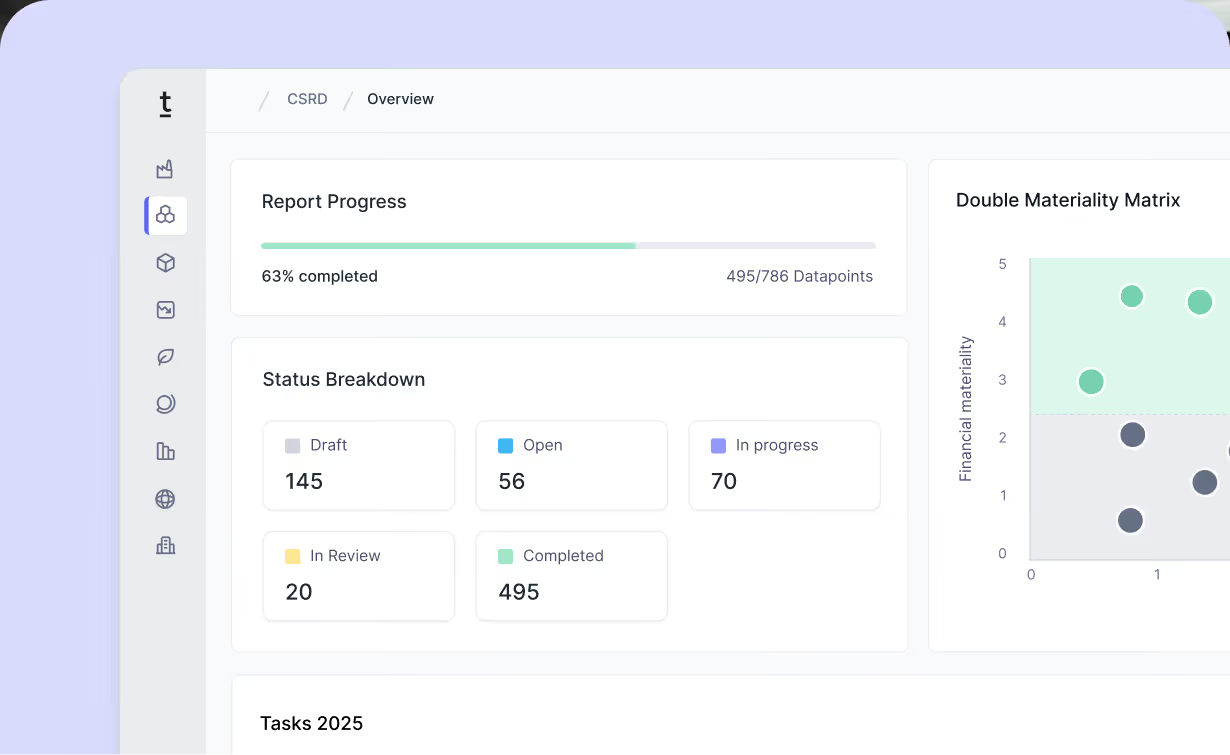
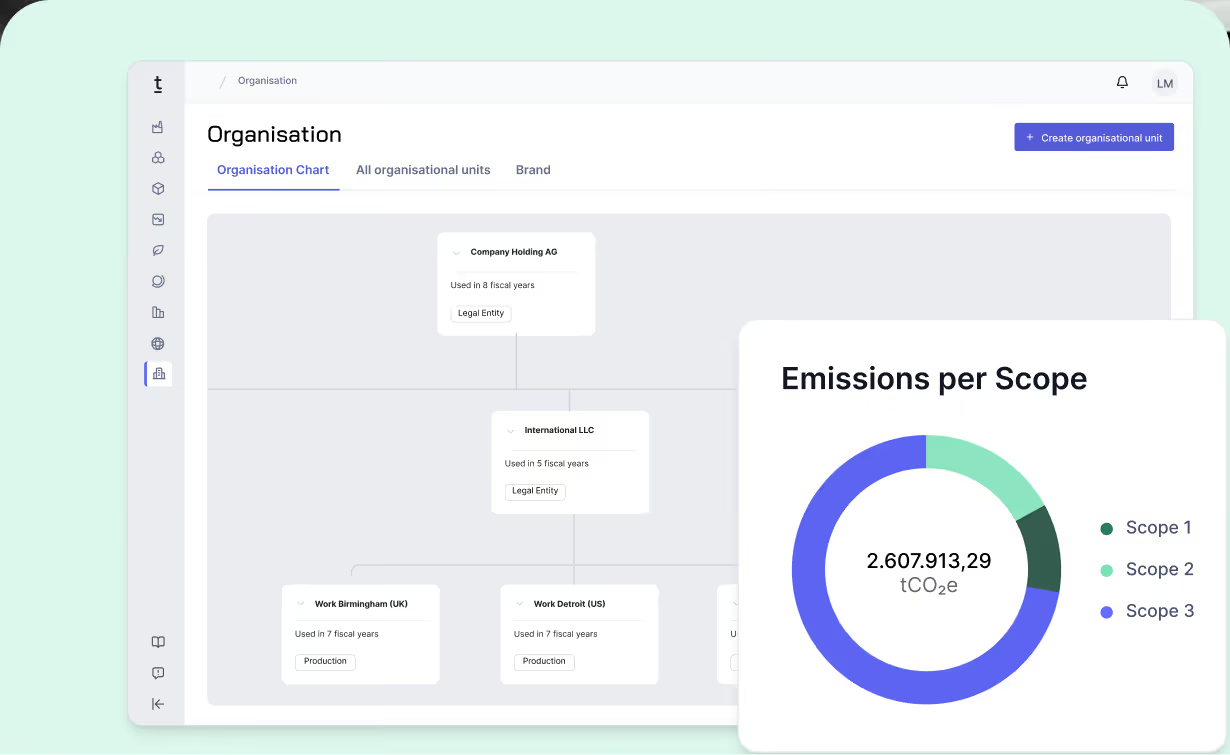
Tanso supports sustainability reporting according to ESRS with an audit-compliant, AI-powered platform – including Double Materiality Assessment.
Until the final new ESRS is published, you can already prepare a sample report based on EFRAG's draft ESRS from December 2025. This version is integrated as a filter function in our software and contains detailed descriptions of changes compared to the old ESRS. This allows you to already build the necessary data collection processes with a reduced and adapted reporting scope without waiting for the final version. Once the final version including the data point list is published, we will integrate it into Tanso – both the revised ESRS and the new Voluntary Standard.














































































.avif)





.avif)
.jpg)


