To overview

From 41 to 69 points: How ATIS improved its EcoVadis rating with Tanso
Tanso Case Study with ATIS

About ATIS

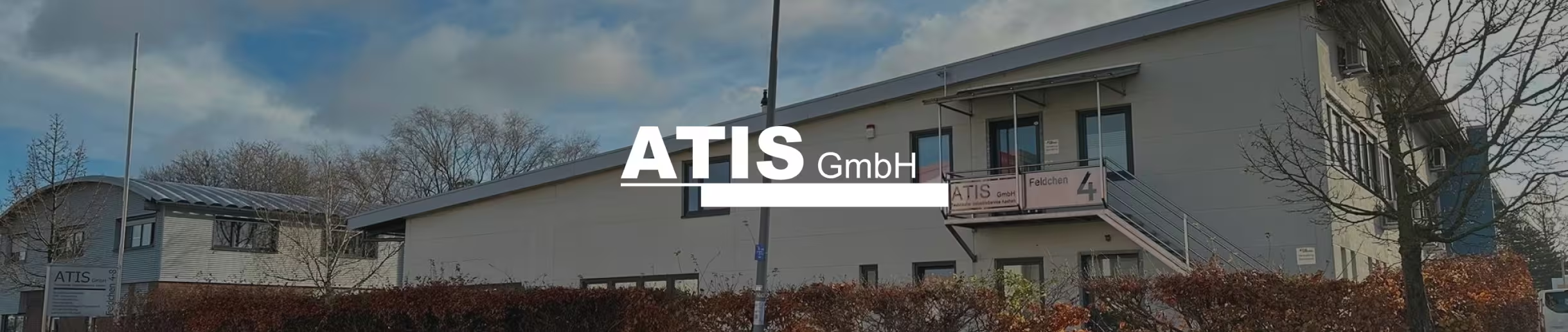
ATIS GmbH specializes in the design and manufacturing of custom mechanical components and special-purpose machinery for industries including manufacturing, food production, automotive supply, and laser technology. With a high level of in-house production, ATIS delivers technically sophisticated solutions from a single source — covering consulting and design through to manufacturing, assembly, and technical services.

Initial situation: EcoVadis as a business-critical requirement

In 2024, ATIS was required by one of its largest customers to participate in the EcoVadis rating for the first time — including a clearly defined minimum score. In the first assessment, the company achieved 41 points, falling just short of the required 44. As a result, EcoVadis evolved from a formal supplier request into a business-critical requirement. Improving the rating became a strategic priority to secure the customer relationship long term.

At that point, sustainability was not yet structurally embedded within the company. There were no formal ESG processes, no sustainability report, and no carbon accounting in place. With the explicit customer requirement, sustainability moved into strategic focus for the first time.

VSME as a structured foundation for EcoVadis

Rather than treating the EcoVadis questionnaire as a standalone task, ATIS and its advisors — attorney Alexander Theek (Ypsilon) and auditor Alexander Hinz (Xcellence | Wirtschaftsprüfung | Steuern | Beratung | ESG) chose a systematic approach: Developing a sustainability report based on the VSME standard, including carbon accounting, alongside a foundational set of sustainability policies.

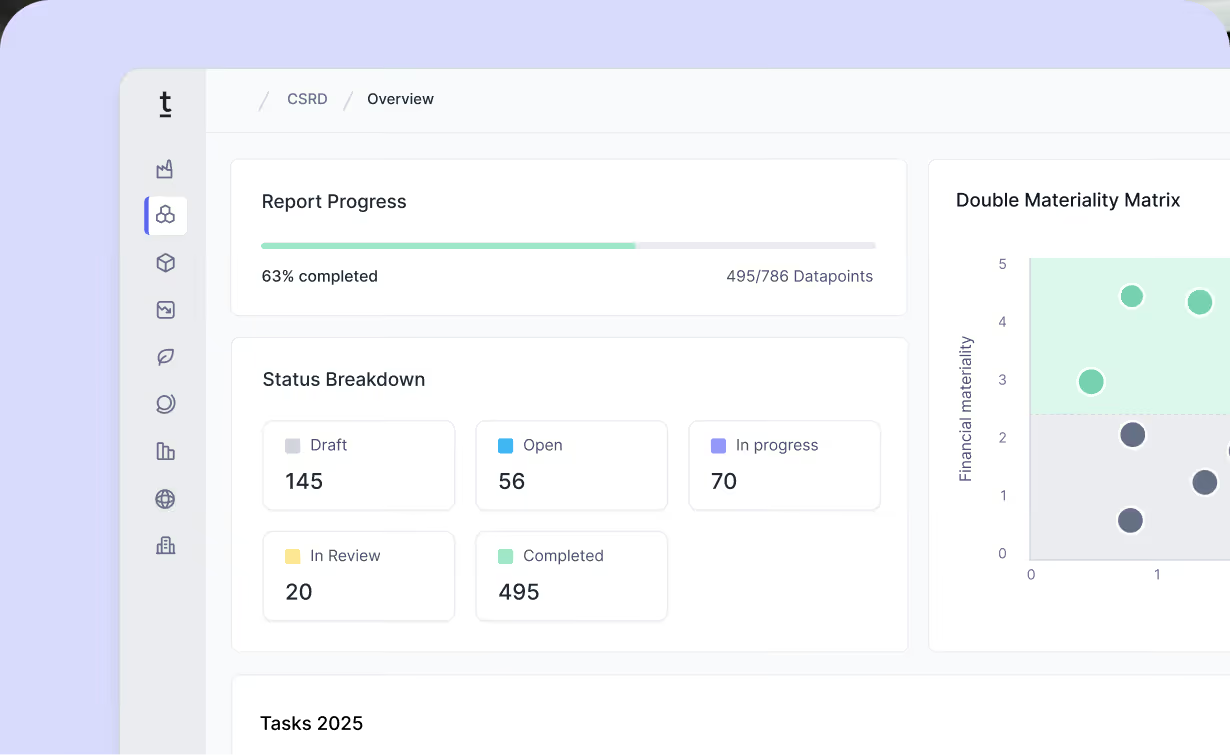
A standardized reporting framework like VSME creates a reliable and comparable data foundation that can be systematically used as evidence for EcoVadis and other requirements. To strategically leverage the VSME report for EcoVadis, a gap analysis between VSME and EcoVadis requirements was conducted. This ensured that EcoVadis-specific requirements were addressed, while maintaining the broader VSME framework beyond rating needs. The goal was clear: build a sustainable and scalable reporting structure, rather than optimizing for a single rating.

“By combining CCF data collection, VSME reporting, and EcoVadis mapping, ATIS was able to build a cross-standard ESG architecture. Mapping all requirements within Tanso simplifies data collection, significantly increases efficiency across ESG and EcoVadis processes, and provides the structure needed for consistent implementation.”
Alexander Theek
Alexander Theek
Attorney, Sustainability-Auditor (IDW), Director Legal Compliance & ESG Assurance at Ypsilon Group

Challenges

  1. Building internal expertise – Sustainability requirements, reporting standards, and rating methodologies first had to be introduced and understood.
  2. Limited time resources – Implementation ran alongside the day-to-day responsibilities of Managing director Melanie Berlin, without dedicated ESG resources.
  3. Limited data availability – Relevant sustainabilty data had not previously been systematically collected.

This was particularly evident in Scope 3: There were no structured procurement systems or supplier databases in place. Emissions data had to be partially reconstructed using accounting data and manual analysis.

Why Tanso

For ATIS, it was critical not to approach EcoVadis as a one-off rating exercise, but to build a robust structural foundation. Tanso enabled exactly this approach: By combining VSME reporting, EcoVadis gap analysis, and integrated carbon accounting, all requirements could be managed within a single system — rather than across fragmented processes. Especially given limited internal resources, this integrated setup was key to enabling an efficient implementation without duplication of work.

“Without dedicated ESG resources, we would not have been able to manage the effort internally without software. With Tanso, we were able to structure the requirements and execute the entire process much more efficiently.”
Melanie Berlin
Melanie Berlin
Managing Director at ATIS

Results with Tanso

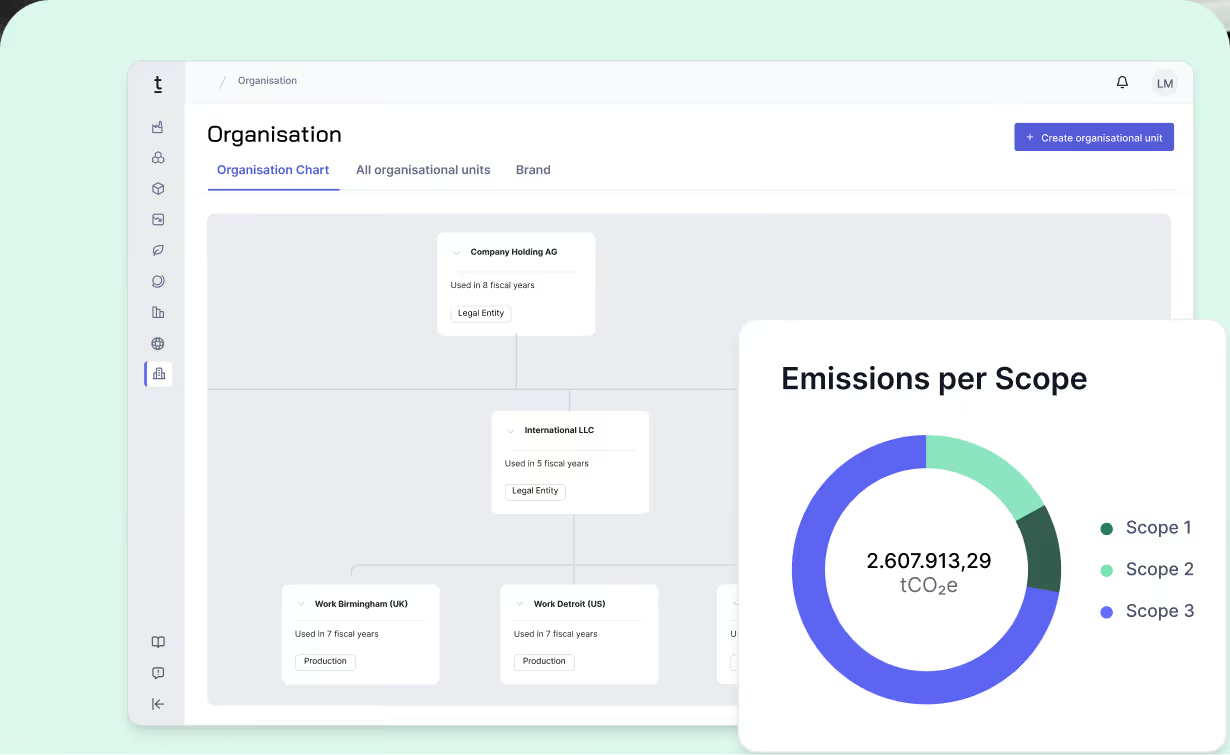
With Tanso, ATIS was able to quickly build its first Corporate Carbon Footprint (CCF) in a structured way — with significantly less effort compared to a manual approach. Scope 1 and 2, as well as the most relevant Scope 3 categories, were captured and now form a solid basis for reporting and future decarbonization efforts. In addition, the integrated VSME–EcoVadis mapping enabled requirements from the rating to be efficiently derived from the existing reporting structure — without setting up parallel systems.

“For us, it was essential not to approach sustainability only for a rating, but to build a long-term structure. With Tanso, we increased our EcoVadis score from 41 to 69 points and secured key supplier relationships.”
Melanie Berlin
Melanie Berlin
Managing Director at ATIS

Results at a glance

  • Increase of EcoVadis score from 41 to 69
  • Secured key supplier relationships through EcoVadis Bronze rating
  • Significantly reduced manual effort through automated reporting
  • Fast and structured implementation of the first carbon footprint (CCF)
  • Established a cross-standard ESG data foundation
  • Direct submission of reports from Tanso to EcoVadis

Tanso served as the central operating framework, enabling transparency, clear processes, and efficient collaboration across all ESG topics.

“Together with Tanso, we support our clients in structuring sustainability data and improving data quality. Integrated documentation and clear system logic result in reliable, audit-ready information, enabling efficient and compliant reporting.”
Alexander Theek
Alexander Theek
Attorney, Sustainability-Auditor (IDW), Director Legal Compliance & ESG Assurance at Ypsilon Group

Key drivers of the EcoVadis improvement & identified potential

The biggest impact on the EcoVadis rating came from the development and documentation of policies, including a code of conduct, an updated human rights policy, an anti-corruption policy, a procurement policy, and an environmental policy. The implementation of concrete measures and improved reporting also significantly contributed to the score increase.

Following the rating, additional improvement potential was identified. This includes expanding reporting across environmental topics, particularly through the inclusion of KPIs, further implementing sustainability measures, and completing as well as reporting on the double materiality assessment.

Further optimization potential exists particularly in climate data. A full greenhouse gas inventory across all Scope 3 categories is not yet in place, and currently only around 42% of spend in Category 3.1 is covered — representing significant potential for further improvement in future EcoVadis ratings.

Outlook

Due to time constraints, the double materiality assessment (DMA) has not yet been fully completed. However, AI-supported suggestions in Tanso significantly accelerated the identification of impacts, risks, and opportunities (IROs) and provided valuable input throughout the process. The next step is to finalize the assessment in order to enable more targeted and robust reporting next year  while also further improving the EcoVadis rating.

In the area of climate data, the goal is to complete the greenhouse gas inventory and further improve data quality by 2028. Expanding the Scope 3 data foundation will be essential to enable the definition of future reduction targets, while concrete reduction targets for Scope 1 and 2 are planned by 2030.


To the overview

From 41 to 69 points: How ATIS improved its EcoVadis rating with Tanso

About ATIS

ATIS GmbH specializes in the design and manufacturing of custom mechanical components and special-purpose machinery for industries including manufacturing, food production, automotive supply, and laser technology. With a high level of in-house production, ATIS delivers technically sophisticated solutions from a single source — covering consulting and design through to manufacturing, assembly, and technical services.

Initial situation: EcoVadis as a business-critical requirement

In 2024, ATIS was required by one of its largest customers to participate in the EcoVadis rating for the first time — including a clearly defined minimum score. In the first assessment, the company achieved 41 points, falling just short of the required 44. As a result, EcoVadis evolved from a formal supplier request into a business-critical requirement. Improving the rating became a strategic priority to secure the customer relationship long term.

At that point, sustainability was not yet structurally embedded within the company. There were no formal ESG processes, no sustainability report, and no carbon accounting in place. With the explicit customer requirement, sustainability moved into strategic focus for the first time.

VSME as a structured foundation for EcoVadis

Rather than treating the EcoVadis questionnaire as a standalone task, ATIS and its advisors — attorney Alexander Theek (Ypsilon) and auditor Alexander Hinz (Xcellence | Wirtschaftsprüfung | Steuern | Beratung | ESG) chose a systematic approach: Developing a sustainability report based on the VSME standard, including carbon accounting, alongside a foundational set of sustainability policies.

A standardized reporting framework like VSME creates a reliable and comparable data foundation that can be systematically used as evidence for EcoVadis and other requirements. To strategically leverage the VSME report for EcoVadis, a gap analysis between VSME and EcoVadis requirements was conducted. This ensured that EcoVadis-specific requirements were addressed, while maintaining the broader VSME framework beyond rating needs. The goal was clear: build a sustainable and scalable reporting structure, rather than optimizing for a single rating.

“By combining CCF data collection, VSME reporting, and EcoVadis mapping, ATIS was able to build a cross-standard ESG architecture. Mapping all requirements within Tanso simplifies data collection, significantly increases efficiency across ESG and EcoVadis processes, and provides the structure needed for consistent implementation.”
Alexander Theek
Alexander Theek
Attorney, Sustainability-Auditor (IDW), Director Legal Compliance & ESG Assurance at Ypsilon Group

Challenges

  1. Building internal expertise – Sustainability requirements, reporting standards, and rating methodologies first had to be introduced and understood.
  2. Limited time resources – Implementation ran alongside the day-to-day responsibilities of Managing director Melanie Berlin, without dedicated ESG resources.
  3. Limited data availability – Relevant sustainabilty data had not previously been systematically collected.

This was particularly evident in Scope 3: There were no structured procurement systems or supplier databases in place. Emissions data had to be partially reconstructed using accounting data and manual analysis.

Why Tanso

For ATIS, it was critical not to approach EcoVadis as a one-off rating exercise, but to build a robust structural foundation. Tanso enabled exactly this approach: By combining VSME reporting, EcoVadis gap analysis, and integrated carbon accounting, all requirements could be managed within a single system — rather than across fragmented processes. Especially given limited internal resources, this integrated setup was key to enabling an efficient implementation without duplication of work.

“Without dedicated ESG resources, we would not have been able to manage the effort internally without software. With Tanso, we were able to structure the requirements and execute the entire process much more efficiently.”
Melanie Berlin
Melanie Berlin
Managing Director at ATIS

Results with Tanso

With Tanso, ATIS was able to quickly build its first Corporate Carbon Footprint (CCF) in a structured way — with significantly less effort compared to a manual approach. Scope 1 and 2, as well as the most relevant Scope 3 categories, were captured and now form a solid basis for reporting and future decarbonization efforts. In addition, the integrated VSME–EcoVadis mapping enabled requirements from the rating to be efficiently derived from the existing reporting structure — without setting up parallel systems.

“For us, it was essential not to approach sustainability only for a rating, but to build a long-term structure. With Tanso, we increased our EcoVadis score from 41 to 69 points and secured key supplier relationships.”
Melanie Berlin
Melanie Berlin
Managing Director at ATIS

Results at a glance

  • Increase of EcoVadis score from 41 to 69
  • Secured key supplier relationships through EcoVadis Bronze rating
  • Significantly reduced manual effort through automated reporting
  • Fast and structured implementation of the first carbon footprint (CCF)
  • Established a cross-standard ESG data foundation
  • Direct submission of reports from Tanso to EcoVadis

Tanso served as the central operating framework, enabling transparency, clear processes, and efficient collaboration across all ESG topics.

“Together with Tanso, we support our clients in structuring sustainability data and improving data quality. Integrated documentation and clear system logic result in reliable, audit-ready information, enabling efficient and compliant reporting.”
Alexander Theek
Alexander Theek
Attorney, Sustainability-Auditor (IDW), Director Legal Compliance & ESG Assurance at Ypsilon Group

Key drivers of the EcoVadis improvement & identified potential

The biggest impact on the EcoVadis rating came from the development and documentation of policies, including a code of conduct, an updated human rights policy, an anti-corruption policy, a procurement policy, and an environmental policy. The implementation of concrete measures and improved reporting also significantly contributed to the score increase.

Following the rating, additional improvement potential was identified. This includes expanding reporting across environmental topics, particularly through the inclusion of KPIs, further implementing sustainability measures, and completing as well as reporting on the double materiality assessment.

Further optimization potential exists particularly in climate data. A full greenhouse gas inventory across all Scope 3 categories is not yet in place, and currently only around 42% of spend in Category 3.1 is covered — representing significant potential for further improvement in future EcoVadis ratings.

Outlook

Due to time constraints, the double materiality assessment (DMA) has not yet been fully completed. However, AI-supported suggestions in Tanso significantly accelerated the identification of impacts, risks, and opportunities (IROs) and provided valuable input throughout the process. The next step is to finalize the assessment in order to enable more targeted and robust reporting next year  while also further improving the EcoVadis rating.

In the area of climate data, the goal is to complete the greenhouse gas inventory and further improve data quality by 2028. Expanding the Scope 3 data foundation will be essential to enable the definition of future reduction targets, while concrete reduction targets for Scope 1 and 2 are planned by 2030.

Discover Tanso -
Your all-in-one solution for sustainability

Other articles that may be of interest to you

Stay up-to-date with news from Tanso.