


Corporate Sustainability Reporting Directive (CSRD) - The most important facts at a glance


Definition & Background
With the introduction of the NFRD (Non-Financial Reporting Directive) in 2014, the European Union took an important step toward greater transparency on environmental, social, and governance (ESG) aspects in companies. The goal was to provide investors and other stakeholders with better insight into non-financial risks and the impacts of corporate activities.
To support the goals of the European Green Deal of 2019 - particularly the reduction of net greenhouse gas emissions in the EU by at least 55% by 2030 compared to 1990, and achieving net zero by 2050 - the regulatory framework for sustainability reporting was significantly expanded. A key component of this development is the Corporate Sustainability Reporting Directive (CSRD).
The CSRD aims to close existing gaps in the NFRD and enable a much more standardized, comparable, and verifiable approach to sustainability reporting.
What is the CSRD?
The CSRD defines which sustainability information companies must report and how this information should be structured and disclosed.
Reporting is based on the European Sustainability Reporting Standards, which were adopted in July 2023. These standards establish uniform requirements for the disclosure of environmental, social, and governance information. Compared to the previous NFRD, the CSRD changes both:
- the scope of reporting requirements
- as well as the depth and standardization of reporting
The introduction of the CSRD represents a significant step toward greater corporate responsibility and transparency in carbon accounting, as it requires key European economic actors and major emitters to provide detailed and traceable information on emissions at the company level. In addition, the CSRD requires transparency across nine other environmental, social, and governance areas.
Why was the CSRD introduced?
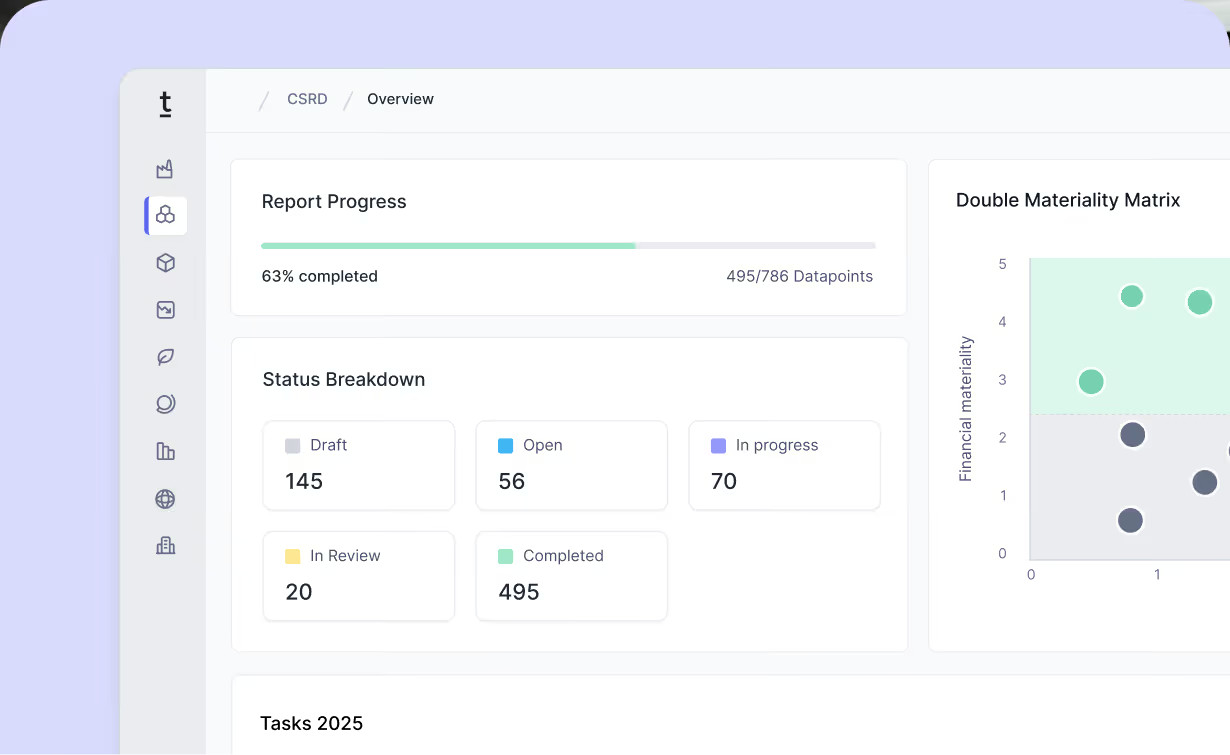
The provision of non-financial information in a transparent format for investors and civil society organizations is of great importance for affected companies. In this context, the EU Taxonomy, which is linked to the CSRD, creates a direct connection to financial reporting by evaluating revenue, CapEx, and OpEx based on sustainability criteria. The information from the CSRD and the EU Taxonomy enables stakeholders to better understand a company’s sustainability performance and align their investment decisions accordingly. Improved consideration of sustainability risks and impacts, as well as a reduction in the reporting burden for companies, can be achieved through a double materiality assessment in line with the CSRD. This assessment considers both the financial and non-financial materiality of sustainability aspects, allowing companies to identify their most relevant sustainability topics and exclude non-material ones. Through a double materiality assessment, companies can ensure that their non-financial reporting provides relevant and meaningful information that meets the needs of their stakeholders.
Which companies are affected by the CSRD?
Through the EU Sustainability Omnibus I package, the scope of the CSRD has been significantly adjusted and simplified.
Directly affected
Under the current legal framework, companies are required to report if they meet the following criteria:
- More than 1,000 employees AND
- More than €450 million in revenue
This adjustment significantly reduces the originally planned scope of the CSRD.
Timeline for the introduction of reporting requirements
The introduction of reporting obligations is being phased in. In addition, certain deadlines have been postponed by two years through the Stop-the-Clock Directive.
- January 2024 (reports from 2025 for FY 2024): Companies that were already subject to the original first wave of the CSRD (former NFRD companies). From 2027 onwards, only companies with >1,000 employees and >€450 million in revenue will remain in scope.
- January 2027 (reports from 2028 for FY 2027): Large, private EU companies with
- 1,000 employees AND
- €450 million in revenue
- January 2029 (reports from 2030 for FY 2029): Non-EU companies with
- €450 million revenue in the EU AND
- an EU subsidiary or branch with >€200 million in revenue
Through Omnibus I, the direct CSRD reporting obligation no longer applies to many companies, in particular:
- listed SMEs
- large companies with fewer than 1,000 employees and less than €450 million in revenue
Indirectly affected
The CSRD triggers a “snowball effect” that must be considered when determining the scope of affected companies. For example, Original Equipment Manufacturers (OEMs) may be directly required to disclose information about emissions in their supply chain. This can mean that companies that were not previously subject to reporting obligations must now provide sustainability indicators such as the Product Carbon Footprint (PCF) or information on their energy mix to their business customers. This interconnected reporting structure causes reporting obligations to cascade along the supply chain, ultimately contributing to a more comprehensive understanding of CO₂ emissions and overall sustainability performance.
How do companies have to report?
Companies subject to the CSRD must publish their sustainability information as part of the management report within their annual report.
Reporting is carried out:
- in accordance with the European Sustainability Reporting Standards (ESRS)
- in a standardized digital format
- with mandatory external assurance (audit) – currently with limited assurance
A key principle is double materiality. Companies only report on topics that have been identified as material through this assessment. If climate change is assessed as a material topic (which is common), Scope 3 emissions also play an important role in reporting. These include indirect emissions along the entire value chain, for example from:
- purchased materials
- business travel
- logistics
- the use or disposal of products.
Consequences in case of violation
- Sanctions and penalties: The determination of sanctions is the responsibility of EU member states. Germany is currently still in the process of developing the CSRD implementation law, which is expected during the course of 2026. Under current law in Germany, companies can be penalized for incorrect or incomplete reports in accordance with § 331 para. 1 no. 1 or 2 HGB with fines or up to three years of imprisonment. Additionally, administrative fines may be imposed under § 334 para. 1 no. 3 or 4 HGB.
- Reputational damage: Non-compliance with the CSRD can lead to a loss of trust and significant reputational damage, with long-term business consequences.
- Competitive disadvantages: Companies that do not meet sustainability standards risk losing customers and investors. This can result in revenue losses and a weakened competitive position. In addition, non-compliance with the CSRD may lead to exclusion from public tenders in accordance with § 289 et seq. HGB.
How to prepare for the CSRD requirements
Preparing effectively for CSRD requirements
Many mid-sized industrial companies face significant challenges when implementing CSRD requirements. Even if a company is not directly subject to reporting obligations, requirements may arise from supply chains, ESG ratings, banks, or investors. It is therefore advisable to start early with the collection and structuring of sustainability data. Given the complexity of the requirements, using appropriate software can provide valuable support.
How Tanso supports
We support your company in establishing structured and future-proof sustainability management—from the strategic interpretation of regulatory requirements to operational implementation. At the core is an integrated ESG data management approach that creates transparency across processes, KPIs, and responsibilities, and can be leveraged as a strategic advantage for ESG ratings as well as financial incentives from banks and insurers.
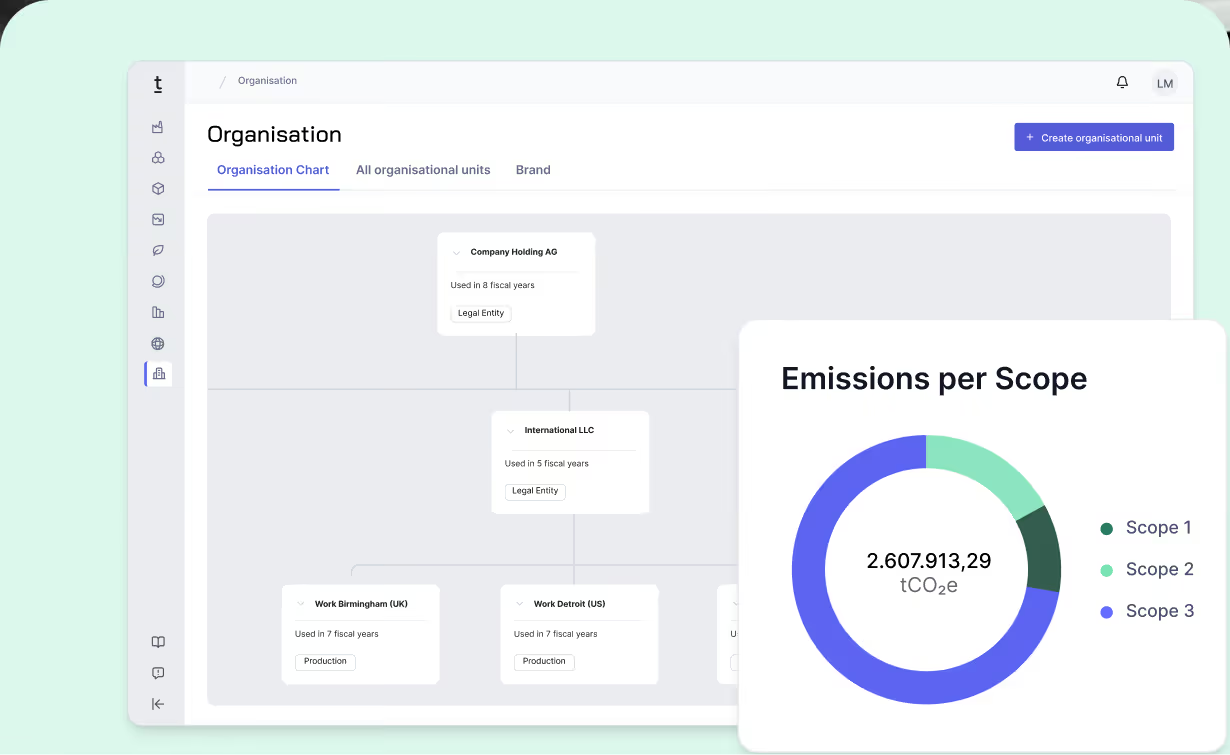
With Tanso’s software, CCF, PCF, and social KPIs can be captured consistently and aligned with stakeholder requirements. In the context of the Sustainability Omnibus, Tanso also enables flexible multi-reporting across various ESG standards - including ESRS, EcoVadis, SAQ 5, GRI, CDP, and VSME.































































.avif)





.avif)
.jpg)






-p-800.webp.avif)
-min-p-800.webp.avif)