
CSRD & CSDDD: Trialog agreement offers prospects of clarity on future reporting requirements



The European Union reached a provisional trialog agreement on December 8 on the revision of the Corporate Sustainability Reporting Directive (CSRD) and the Corporate Sustainability Due Diligence Directive (CSDDD). This significantly increases the likelihood that both legislative processes will be finalized soon, giving companies more planning certainty in the future.
The agreement between the Parliament’s JURI Committee and the Council of the European Union includes the following:
CSRD: Higher thresholds and a stronger focus on quantitative data
In the future, only companies that meet both of the following criteria will be required to report:
- more than 1,000 employees and
- more than €450 million in net turnover
The same turnover threshold is expected to apply to non-EU companies if this turnover is generated within the EU. This reduces the number of companies required to report by 90%.
Further adjustments:
- Sector-specific standards will become voluntary rather than mandatory.
- Reporting is expected to become more quantitative and clearly structured.
- Companies with fewer than 1,000 employees will be allowed to refuse requests for voluntary disclosures that go beyond the voluntary VSME standard (value-chain cap).
These changes reduce the administrative burden for many small and medium-sized enterprises while increasing comparability among large market players.
CSDDD: Significantly higher applicability threshold
In the future, the directive will apply only to companies with:
- more than 5,000 employees and
- more than €1.5 billion in net turnover
The same thresholds will apply to non-EU companies operating in the EU market. This reduces the number of companies covered by the directive by around 70%.
Further adjustments:
- The start date will be postponed by another year to January 1, 2029.
- The due diligence approach will be risk-based across the entire chain of activities (not only tier-1 suppliers).
- Companies will no longer be required to publish climate transition plans.
- There will be no unnecessary information requests to companies not within scope (value-chain cap).
- Penalties will be capped at 3% of global net turnover instead of 5%.
- Liability will remain governed by national law and will not be harmonized at EU level.
As a result, the CSDDD will focus primarily on large multinational companies, while the majority of mid-sized businesses will be relieved of these obligations.
Next steps in the legislative process
According to the current timeline, the following steps are planned:
- December 10: Vote in the Council of the EU (Coreper II)
- December 11: Vote in the Parliament’s JURI Committee
- December 16: Vote in the European Parliament in Strasbourg (12:30–13:30)
- Publication in the EU Official Journal: New rules enter into force 20 days later
- Transposition into national law: Planned within 12 months, ideally by the end of 2026
Thus, binding application of the revised directives can be expected by early 2027, and potentially as early as late 2026.
Importantly, the agreement contains a review clause on the possible extension of the scope for both CSRD and CSDDD. This indicates that some policymakers have reservations about the significant narrowing of applicability.
What this means for companies
- Large companies will have to prepare much more intensively for quantitative, verifiable sustainability data.
- Mid-sized companies will be relieved by the higher thresholds but will still need to meet supply-chain-related requirements from large customers.
- Reliable data processes for CCF, PCF and CSRD will become a key competitive advantage, regardless of direct applicability.
Since the German CSRD law aims to align with decisions at EU level, adoption into German law is no longer expected before the end of the year.
The German draft law already accounts for Stop-the-Clock provisions and the 1,000-employee threshold but does not yet include the revised turnover threshold. The German Bundesrat has already discussed the draft positively, and the Bundestag has referred it to the Committee on Legal Affairs and Consumer Protection. Currently, no vote on this matter appears on the parliamentary schedule before the end of the year. As a result, the NFRD will very likely remain applicable in Germany for another year.
The recommendation for German companies in Wave 1 (capital-market oriented, more than 1,000 employees) is therefore to prepare an NFRD report aligned with the ESRS for the 2025 financial year, placing strong emphasis on quantitative disclosures.
All other companies may report according to the VSME standard in 2025 in order to benefit from a more pragmatic sustainability reporting approach.
How Tanso supports you
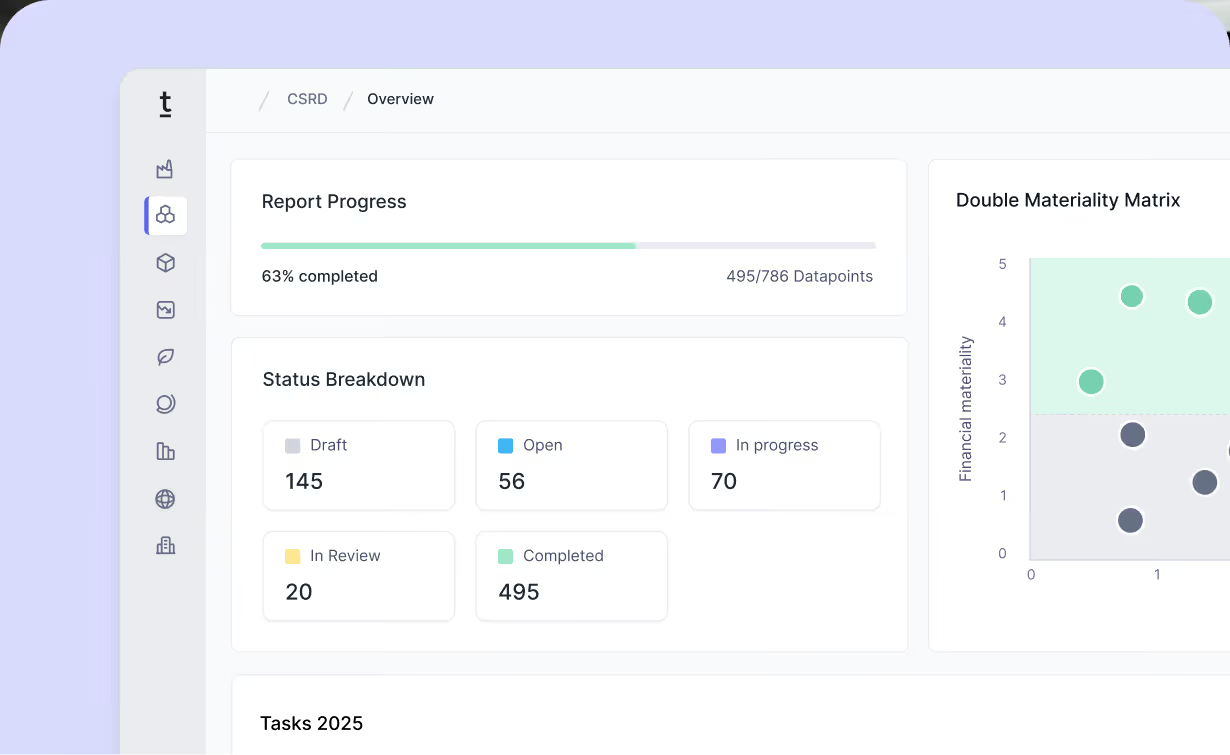
At Tanso, we help you strategically build your sustainability management system, including comprehensive ESG data management across your entire organization. This includes all relevant areas such as CCF, PCF and diversity KPIs, aligned with the expectations of your stakeholders.
In the context of the Omnibus process, this may also include multi-standard reporting across various ESG frameworks such as CDP, EcoVadis, SAQ 5, GRI and VSME, rather than focusing solely on CSRD compliance













































































.avif)





.avif)
.jpg)


